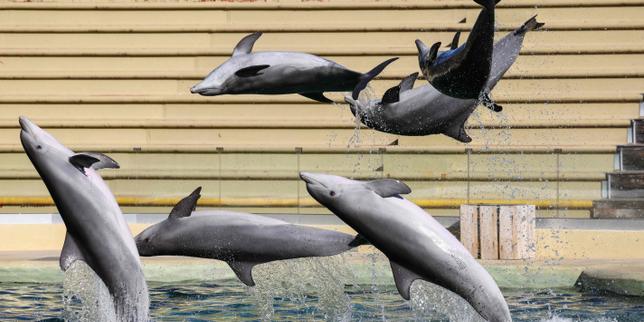
The water in the temporary transport crate was cold, smelling faintly of heavy salt, rubber, and fear. For Rocky, a twenty-nine-year-old bottlenose dolphin born into the artificial permanence of a concrete enclosure, the world had suddenly shrunk to the dimensions of a stretcher and the deafening roar of cargo engines. Months earlier, the French legislation of 2021 had drawn a definitive line in the sand regarding the fate of captive cetaceans, promising that the era of chlorine pools and theatrical performances was drawing to a close. Yet laws written on paper often stutter when confronted with the logistics of flesh and blood.
When the decision was made to relocate eight dolphins from the shuttered basins of Marineland d'Antibes across the border to Selwo Marina in Spain, conservationists raised immediate alarms. They argued that uprooting sensitive marine mammals from their familiar surroundings, dismantling lifelong social structures, and shipping them to foreign basins violated the very spirit of animal protection. Those warnings were dismissed as bureaucratic obstructionism.
Then came a quiet Sunday morning in October.
Rocky died.
The confirmation from Marineland arrived via brief statements and corporate disclaimers, noting that an autopsy at the Spanish facility was underway to determine exact physiological triggers. But for organizations like Sea Shepherd France and One Voice, whose activists had fought tooth and nail against the convoy trucks leaving the Riviera, the post-mortem findings were almost secondary to the overarching tragedy. This was the transfer of too many, too far, handled with a reckless disregard for the delicate psychological architecture of intelligent marine life.
Consider what happens when an apex swimmer, adapted by evolution to navigate vast acoustic horizons, is abruptly placed into a foreign tank hundreds of miles away. Stress is not merely an emotion for a cetacea; it is a physical catalyst. It floods the bloodstream, suppresses immune response, and unravels the tight threads of social cohesion that dictate daily survival in captivity. When Rocky breathed his last breath in Spanish waters, he did not just succumb to an isolated medical event. He became the living, tragic embodiment of a loophole.
The French law was designed to stop exploitation on national soil, but it inadvertently created a migration crisis of a different sort. Instead of transitioning animals toward progressive, semi-natural European coastal sanctuaries where they could live out their years under attentive, non-commercial care, animals were shuffled across international borders to facilities eager to fill empty summer schedules.
Outrage quickly spilled across digital platforms and downtown streets. Activists pointed out that the average life expectancy of a bottlenose dolphin in controlled environments can reach into late decades, but longevity numbers mean nothing when the baseline quality of existence is subjected to disruptive, cross-border real estate transactions. The death of one aging male has transformed a quiet administrative headache into an ethical firestorm, casting a long, uncomfortable shadow over the remaining animals still slated for export.
We are left looking at empty transport crates and unanswered questions. The official autopsies will tally organ failures and tissue samples, but they will never quite measure the weight of displacement.
The concrete basins in Antibes sit silent now, save for the wind rippling across the surface of water that no longer holds a shadow. Somewhere south, across the Pyrenees, the remaining cétacés swim in circles under a foreign sky, while the architects of their transit try to explain how a safety measure turned into a sentence.