Morning on a construction site does not begin with the roar of machinery. It begins with silence.
The air is cold, smelling of damp earth, curing concrete, and the sharp, metallic tang of unworked steel. Before the concrete pumps roar to life and the hoists begin their metallic screeching, there is a window of quiet. That was the time he preferred. The time when a safety manager could walk the skeleton of a building and see it not as a mountain of schedules and budgets, but as a geometry of risk.
Let us call him David. It is a placeholder name for a reality that repeats across cities worldwide with terrifying regularity. David wore a yellow hard hat, a high-visibility vest that had seen too many storms, and carried a clipboard that felt heavier with every passing year. He was not an adversary to the workers. He was the person standing between a paycheck and a catastrophe.
To understand what happened on that morning in Hong Kong, you have to understand the height. Ten floors. From the ground, ten stories look like a manageable reach. From the tenth floor, looking down, the world transforms. People become moving specks. Delivery trucks shrink to toy scale. Gravity ceases to be a theoretical law of physics and becomes an active, breathing presence, leaning against your shoulder, waiting for a moment of distraction.
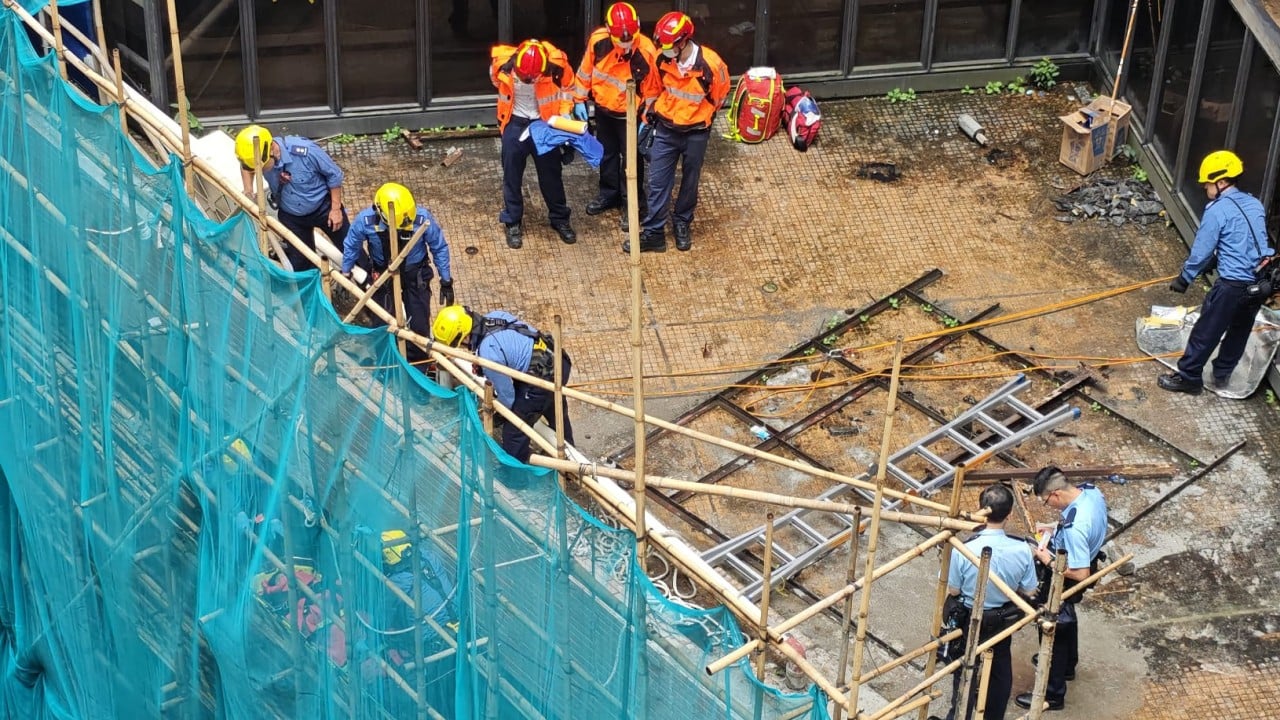
According to initial reports from the scene, David was conducting a routine inspection on a high-rise development site. Somewhere between the upper tiers, the margin for error vanished. A sudden shift. A missing tie-off point. A momentary misstep on a scaffolding plank that looked secure until weight met weakness.
Fall ten floors. The math of it is brutal. Acceleration takes over in a fraction of a second. Terminal velocity is a luxury gravity does not need over a thirty-meter drop.
When the news hit the wire, it came in the sterile language of industrial reporting. A brief headline. A casualty count. An investigation pending. The Labor Department dispatched inspectors. The developer issued a standard statement expressing profound regret and promising full cooperation. The machinery of bureaucracy ground into gear, parsing codes, reviewing safety harnesses, checking compliance logs.
Yet, behind the police tape and the flashing amber lights of emergency responders, a deeper question hangs in the humid air. Why do we keep building our modern monuments on a foundation of preventable blood?
Safety management in construction is often treated as a checkbox exercise. We talk about Occupational Safety and Health Administration guidelines, fall arrest systems, toe boards, and lanyard lengths as if safety could be engineered solely through regulation. But rules are ink on paper. They cannot catch a man falling through open air.
Consider what happens when a deadline looms. Penalties for delay run into the millions. Pressure trickles down from the boardroom, through the main contractors, down to the subcontractors, until it pools at the boots of the men and women standing on the edge. In that cascade of pressure, shortcuts stop looking like recklessness and start looking like survival.
David knew the codes by heart. He could recite the load-bearing capacities of scaffolding brackets in his sleep. He had spent decades arguing with foremen about edge protection and safety nets. He knew that a harness left unclipped for five seconds to maneuver around a tight corner was all it took. And yet, the system demands speed. The city demands verticality. We want our glass towers scraping the clouds, our transit hubs expanding, our skylines shifting overnight, and we rarely look down to check the price tag written in human vulnerability.
When a construction worker dies, the shockwave is localized. A grieving family in a cramped apartment. A crew of workers sitting in stunned silence during the morning safety briefing the next day, staring at their coffee cups. Then, the site reopens. The crane swings again. Concrete is poured over the memory.
We must ask ourselves what an inspection is actually worth if it ends at the bottom of an elevator shaft.
The investigation in Hong Kong will likely point to specific failures. Human error. Equipment malfunction. Protocol lapses. These are the standard categories we use to file away tragedies so we can sleep at night, comforted by the illusion that catastrophes are anomalies rather than structural symptoms. If a worker makes a mistake, it is blamed on carelessness. If a safety manager falls, it is treated as an isolated tragedy.
But look closer at the landscape of modern mega-projects. Margins are squeezed. Shift times are brutal. Fatigue is an invisible hazard that no hard hat can deflect. When workers are pushed past exhaustion, their reflexes dull. When safety managers are outnumbered ten to one by active work zones, oversight becomes a guessing game.
Imagine walking that tenth floor yourself. Strip away the statistics. Feel the wind off the harbor pulling at your clothes. Look at the open edge where the exterior curtain wall has not yet been installed. There is no railing. Just a yellow warning tape fluttering pathetically in the breeze. Step forward. Feel the drop pull at your stomach.
That is the environment where decisions are made in fractions of seconds.
The tragedy in Hong Kong is not just about one man losing his footing. It is about a collective failure of imagination. We have built an industry where safety is viewed as a cost center rather than the core mission. We train people to manage risk while simultaneously incentivizing them to ignore it in the name of progress.
Change will not come from another revised safety manual. It will come only when the human cost of a delay is valued higher than the financial cost of a shutdown. Until the person wearing the high-visibility vest has the unquestioned, absolute power to halt an entire project the moment a single hazard appears—without fearing for their job, without calculating the budget impact—the drops will continue.
The sirens have long since faded from the Hong Kong street. The reporters have packed up their cameras. The investigation report will eventually be filed in a cabinet, gathering dust alongside dozens of others just like it.
Up on the tenth floor, the wind still blows off the water, whistling through the empty concrete frames of a city that never stops climbing.