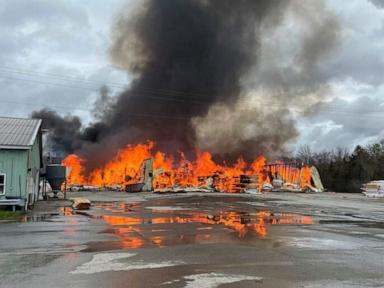
The tragic death of a lumber mill co-owner following a devastating facility fire and explosion underscores a systemic safety crisis hiding in plain sight across the timber industry. While local news outlets routinely cover these events as isolated, unpredictable tragedies, industrial safety data reveals a different reality. Combustible dust explosions are predictable, preventable, and increasingly fatal as aging infrastructure meets production pressure.
When a mill goes up in flames, the immediate focus lands on the immediate spark. But the true culprit is almost always a failure of dust management systems, regulatory gaps, and an industry-wide reluctance to invest in modern mitigation technology. For an alternative view, read: this related article.
The Invisible Tinderbox Underneath the Floorboards
Lumber mills look solid, heavy, and industrial. Yet their greatest vulnerability is microscopic.
Wood processing generates massive volumes of fine dust. When this dust accumulates on rafters, light fixtures, and hidden ledges, it transforms the entire facility into a bomb. It takes less than a sixteenth of an inch of dust accumulation—about the thickness of a paperclip—across a fraction of a room to trigger a catastrophic secondary explosion. Related reporting on this trend has been provided by TIME.
The mechanics of these disasters follow a distinct, lethal pattern.
[Primary Spark/Flash] -> [Dislodges Settled Dust] -> [Creates Airborne Dust Cloud] -> [Secondary Massive Explosion]
A minor mechanical failure, such as a overheated bearing on a conveyor belt or a spark from a saw blade, creates a small localized fire or flash. This initial event creates a pressure wave. That wave shakes the building, dislodging the settled dust from the high structures. The dust hangs in the air, mixing perfectly with oxygen. The initial fire then ignites this airborne cloud, causing a massive, facility-wide explosion that tears through steel and concrete.
The Regulatory Blind Spot and the Voluntary Compliance Myth
The Occupational Safety and Health Administration (OSHA) has long recognized the hazard of combustible dust, yet a comprehensive, standalone federal standard for all industries remains tied up in bureaucratic red tape. Instead, regulators rely on a patchwork of general duty clauses and fire protection standards, alongside guidelines from the National Fire Protection Association (NFPA).
This regulatory fragmentation leaves small to mid-sized mill operators in a dangerous gray zone. Compliance becomes a financial calculation rather than an operational absolute.
- Capital Expenditure vs. Risk: Retrofitting an older mill with certified spark detection systems, explosion venting, and specialized industrial vacuum networks can cost hundreds of thousands of dollars. For a family-owned operation running on thin margins, these upgrades are frequently deferred in favor of routine maintenance.
- The Insurance Paradox: Commercial insurers often mandate basic fire suppression, like sprinklers, but rarely demand the specialized deflagration isolation valves necessary to stop an explosion from traveling through ductwork.
- Enforcement Gaps: OSHA inspection cycles are notoriously slow. A facility might go a decade without an inspector stepping foot on the kill floor, allowing unsafe dust accumulations to become standard operating procedure.
Relying on voluntary compliance in a high-commodity, low-margin industry is a strategy proven to fail. The cost of prevention is high, but the cost of inaction is measured in human lives.
Mechanical Friction and Environmental Factors
To truly understand why these explosions persist, one must look at the physical environment of a modern mill. High-speed automation has increased throughput, but it has also multiplied the friction points within a facility.
The Problem with High-Speed Bearings
Modern saws and planers run hotter and faster than their predecessors. If a single bearing loses lubrication, it can reach temperatures exceeding 1,000 degrees Fahrenheit within minutes. This heat source sits directly adjacent to the dust collection hoods, creating a direct path for ignition.
The Moisture Conundrum
Mill operators face a constant battle with ambient humidity. Dry winter air strips moisture from wood waste, making the dust far easier to ignite. Conversely, high humidity can cause dust to cake inside ductwork, restricting airflow, reducing collection efficiency, and creating dense pockets of fuel just waiting for a spark.
Shifting from Reaction to Inherent Safety
Smarter operations are moving away from reactive housekeeping toward inherent safety design. Clean-up crews with brooms and compressed air lines often worsen the problem by blowing dust into the air, creating the very explosive clouds they are trying to prevent.
True safety requires continuous extraction at the point of generation. This means enclosing machinery completely and utilizing negative pressure systems that capture dust before it ever escapes into the wider room. Furthermore, facilities must install deflagration venting on the outside walls of dust collectors. These vents act as sacrificial panels, directing the force of an explosion outward into an empty yard rather than inward through the factory floor.
The loss of a mill owner or worker is never just a compliance failure. It is a failure of structural design, mechanical maintenance, and industry priorities that treat combustible dust as an unavoidable nuisance rather than a lethal threat. Until the industry treats dust management with the same urgency as production quotas, the next explosion is merely a matter of time.