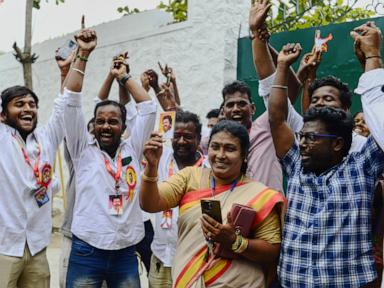
The political landscape of West Bengal has fractured beyond recognition. For fifteen years, Mamata Banerjee’s Trinamool Congress (TMC) held the state with a grip that seemed impenetrable, rooted in a potent mix of populist welfare and aggressive street-level mobilization. That era ended today. As the final rounds of counting for the 2026 Assembly elections conclude, the Bharatiya Janata Party (BJP) has surged past the 190-seat mark, leaving the TMC struggling to even remain in triple digits. This is not just a change in government; it is a fundamental rejection of the political culture that has defined Bengal for over a decade.
The scale of the collapse is staggering. The "Presidency" region, long considered the inner sanctum of TMC power, has seen double-digit swings toward the saffron camp. In Bhabanipur, the Chief Minister herself is locked in a desperate, ward-by-ward struggle against her former protégé, Suvendu Adhikari. The imagery is heavy with irony. The very man who helped build her rural network a decade ago has now dismantled it from the inside out.
The Infrastructure of Discontent
To understand this shift, one must look past the loud campaign rallies and into the mechanics of rural life. For years, the TMC relied on "Duare Sarkar" (Government at your Doorstep) to deliver everything from bicycles to direct cash transfers for women. It was a formidable machine. However, the machine began to grind against the reality of local corruption. In the tea gardens of North Bengal and the tribal belts of Jangalmahal, the narrative changed. Voters stopped seeing these doles as gifts from a benevolent leader and started seeing them as their right—rights that were often filtered through local "syndicates" or "cut-money" middle-men.
The BJP capitalized on this by focusing on the "Special Intensive Revision" of voter rolls. While the TMC cried foul over the deletion of names, the opposition focused on a specific demographic: the aspirational rural youth. These are voters who were children when the Left Front fell in 2011. They are not moved by the nostalgia of the anti-land acquisition movements in Singur or Nandigram. They want industrial jobs, not just the "Lakshmir Bhandar" monthly allowance. By promising an industrial corridor that connects the ports of Haldia to the mineral-rich belts of Jharkhand, the BJP offered a vision of "Viksit Bengal" that finally outweighed the safety net of the TMC’s social schemes.
The Sandeshkhali Echo
While economic factors laid the groundwork, the moral authority of the TMC took its hardest hit in the backwaters of the Sundarbans. The events in Sandeshkhali—where allegations of systemic land grabbing and the exploitation of women by local party strongmen surfaced—became a shorthand for everything wrong with the ruling party's local administration. It broke the TMC’s monopoly on the women's vote, a demographic that Mamata Banerjee had curated with surgical precision for years.
The BJP didn’t just use this as a talking point; they turned it into a recruitment tool. They fielded local women who had been at the forefront of those protests. By doing so, they neutralized the "outsider" tag that the TMC had successfully used in 2021. This time, the faces of the opposition weren't just leaders from Delhi; they were the neighbors of the aggrieved.
A New Arithmetic in the South
The most significant data point in this election is the collapse of the TMC in urban and semi-urban pockets of South Bengal. Historically, the BJP was a force in the Hindi-speaking belts and North Bengal. But today, they have breached the "potato belt" of Hooghly and Barddhaman.
Rural distress played a quiet but lethal role here. A prolonged potato crisis, where farmers were squeezed between falling market prices and rising cold-storage costs, turned the agricultural heartland into a protest zone. The TMC’s inability to stabilize these prices, combined with a perceived neglect of the middle-class urban voter, created a pincer movement.
The Breakdown of the Third Front
The Left Front and Congress, which had hoped to emerge as a "secular" alternative to both the TMC and BJP, have once again been relegated to the margins. Their failure to offer a distinct economic program meant that voters viewed the election as a binary choice. Even the emergence of new players, like the party formed by Humayun Kabir, only served to fracture the TMC’s traditional minority vote banks in districts like Murshidabad and Malda.
The Problem of Leadership
The BJP now faces its own set of challenges. While the victory is decisive, the party has yet to announce a Chief Ministerial face. The current front-runner is undoubtedly Suvendu Adhikari, whose performance in this election has solidified his status as the state's most effective campaigner. However, the party's top brass in Delhi has a history of choosing "X-factors"—unexpected faces who aren't always the most prominent in the headlines.
Maintaining this coalition of tribal voters, urban professionals, and disenchanted rural workers will be difficult. The BJP has won on a platform of "Poriborton" (Change) 2.0, but the expectations are now sky-high. Bengal’s debt-to-GDP ratio is one of the highest in the country, and the industrial revival promised on the trail will require more than just political will; it will require a total overhaul of the state's bureaucracy.
The Institutional Shift
This election was also a test of the state's institutions. With voter turnout crossing 90% in several districts, the sheer volume of participation suggests a population that felt the stakes were existential. The heavy presence of central forces and the Election Commission’s scrutiny of the rolls meant that the "scientific rigging" often attributed to Bengal politics was much harder to execute.
The TMC’s dominance was built on the idea that they were the sole protectors of "Bengali Identity." That shield has cracked. By successfully framing the debate around "Asol Poriborton" (Real Change) and focusing on governance over identity, the BJP has managed to transplant its national narrative into the complex soil of Bengal.
The fire at the Trinamool office in Kolkata today is symbolic of more than just a lost election. It marks the end of a specific brand of personalized, charismatic leadership that centered entirely on the persona of "Didi." Bengal is moving into a period of deep uncertainty as the transition begins. The TMC is staring at a long period in the wilderness, and the BJP is about to find out that winning Bengal was the easy part. Governing it is a different beast entirely.
New Bengal: Understanding the BJP's 2026 victory
This video provides an in-depth breakdown of the specific factors, including voter turnout and the Sandeshkhali impact, that led to the BJP's historic surge in West Bengal.