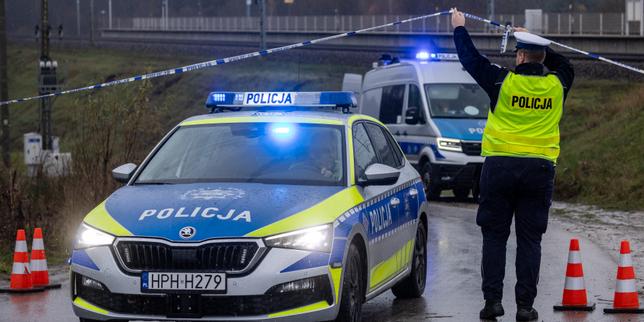
A suspicious fire tore through a Polish drone components facility overnight. Intelligence agencies are scrambling. Security cameras caught a masked person scaling a fence just before the blaze erupted.
This wasn't an ordinary industrial accident. The facility belongs to WB Electronics in Skarżysko-Kamienna, Poland's largest private defense contractor. It manufactures critical composite structures and control systems for unmanned aerial systems. Crucially, these are the exact parts used in the FlyEye reconnaissance drones and Warmate loitering munitions deployed heavily by both the Polish and Ukrainian armed forces. Learn more on a similar topic: this related article.
When a defense plant supplying the front lines catches fire right after a security breach, nobody in Warsaw or Kyiv calls it a coincidence.
The Anatomy of a Suspected Sabotage Operation
The timeline reads like a textbook security failure turned active investigation. At roughly 12:23 a.m., an intrusion alarm triggered an alert at a private monitoring firm. Moments later, a small blaze broke out inside the plant. Because the factory was closed for the night, no workers were injured. Further reporting by BBC News highlights comparable views on the subject.
Local police arrived alongside tracking dogs and thermal-imaging drones to comb the perimeter. They didn't come up empty. Investigators found an abandoned backpack and a long-sleeved sweatshirt discarded near the fence line. Surveillance footage subsequently revealed an unidentified individual wearing a balaclava crossing into restricted zones.
Poland's Internal Security Agency, known as the ABW, along with military counterintelligence, took over the case immediately. Jacek Dobrzyński, spokesperson for the security services, confirmed they are treating the situation with extreme gravity. They want to establish with absolute certainty whether foreign operatives or local proxies orchestrated an act of sabotage.
Why European Defense Plants Are Under Siege
This incident doesn't happen in a vacuum. Over the past month, a wave of unexplained disruptions has hit military and critical infrastructure sites across Europe. Facilities in Estonia, Bulgaria, and Italy have all reported similar security scares or mysterious fires.
Intelligence officials across the continent have warned that foreign actors are shifting tactics. Instead of relying solely on conventional cyberattacks or open military aggression, hostile intelligence services are increasingly using local proxy networks and petty criminals for physical sabotage. Paying local operatives small sums to set fires or plant tracking devices creates plausible deniability while disrupting the supply lines feeding the Ukrainian war effort.
For Poland, the stakes couldn't be higher. Prime Minister Donald Tusk recently warned of a severe risk of Russian escalation and hybrid warfare. Poland acts as the primary logistics hub for Western military aid entering Ukraine. Securing that corridor has become an uphill battle against invisible threats operating right inside NATO's borders.
The Production Bottleneck Crisis
Beyond the immediate security threat, this fire highlights the fragile state of European defense manufacturing. Private firms like the WB Group have ramped up production drastically to meet relentless battlefield demands. Ukraine requires thousands of drones monthly to maintain parity against electronic warfare and massive aerial bombardments.
Losing even a minor component assembly line creates a cascading effect. Control systems and composite airframes take time to manufacture, calibrate, and ship. While firefighters managed to contain this blaze before it gutted the entire complex, the downtime required for structural safety inspections and forensic sweeps hurts immediate output.
Governments are pouring money into defense sectors, but physical security infrastructure hasn't kept pace with the sudden surge in geopolitical tension. Fences, cameras, and night patrols aren't enough when state-sponsored actors are willing to invest heavily in probing every weak spot along the supply chain.
Expect tougher security mandates across European manufacturing plants before the week is out. Factories turning out military gear can no longer afford to operate like standard commercial warehouses. The front line is no longer just hundreds of miles away in the east; it's right at the factory gates.


:max_bytes(150000):strip_icc()/moscow-kremlin-and-st-basil-cathedral-at-dusk-158200423-5a64f4594e46ba00377331fb.jpg)