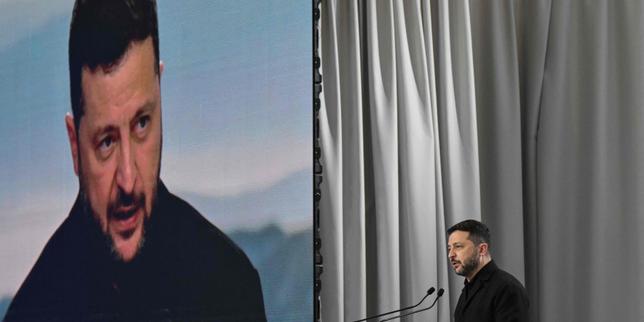
Most diplomatic coverage treats a meeting between Volodymyr Zelensky and Donald Trump like a reality television showdown with territorial borders on the line. Standard news reports—such as live-blog coverage of their New York sit-down—focus heavily on the immediate friction points: who needs whom more, whether U.S. aid will dry up overnight, and what concessions might be forced onto the table.
That framing misses the structural reality of how high-stakes diplomacy actually works. Looking at a meeting in New York simply as a binary clash between "unconditional support" and "forced capitulation" is a classic analytical mistake. Both leaders operate under severe domestic and geopolitical constraints that make the loudest media narratives practically impossible to execute.
To understand what actually happens when Kyiv and Washington sit across from each other during a U.S. election cycle or transition period, you have to strip away the campaign rhetoric and look at the mechanics of leverage, congressional appropriations, and European security architecture.
The Lazy Consensus on U.S. Aid and Leverage
The dominant narrative in mainstream commentary assumes a simple transaction: the United States holds all the cards because it supplies the weapons, and Ukraine must simply accept whatever terms are dictated from Washington. Conversely, critics from the other side argue that any deviation from current policy means instant abandonment of a democratic ally.
Both views misunderstand the nature of asymmetric alliances.
In international relations theory—specifically what political scientists like Glenn Snyder termed the "alliance security dilemma"—a smaller state is rarely a passive recipient of orders from a larger patron. A patron state faces the risk of entrapment (being dragged into a wider conflict it does not want), while the smaller ally faces the risk of abandonment. However, the smaller state possesses its own form of reverse leverage: the catastrophic cost to the patron's global credibility if the ally collapses.
In practice, foreign policy analysts and former diplomats who have worked on Eastern European security desks consistently point out that sudden, unilateral cutoffs rarely happen cleanly. Even when executive rhetoric shifts sharply, aid pipelines are governed by multi-year Defense Department contracts, Ukraine Security Assistance Initiative (USAI) funds already obligated, and bipartisan majorities in the U.S. Senate that view deterrence against Moscow as tied directly to deterrence in the Indo-Pacific.
What the Live-Blog Framing Misses
When outlets run minute-by-minute updates focusing on body language, delayed start times, or sharp soundbites outside Trump Tower or the United Nations, they optimize for immediate clicks rather than strategic clarity. Here is what gets buried beneath the noise:
- The "Victory Plan" as a Negotiating Anchor: When Zelensky brings a detailed strategic framework to New York, the goal is not to get a signature on the spot. In diplomatic negotiations, presenting a structured plan establishes the anchoring bias. It forces the counterpart to react to Kyiv's definitions of security guarantees, long-range strike permissions, and economic recovery rather than starting from a blank slate.
- Domestic Signaling vs. Private Bargaining: Public statements made by Trump regarding ending the war in "24 hours" or criticizing the scale of U.S. spending serve a specific domestic political function—signaling fiscal restraint and strength to voters. Behind closed doors, however, former national security officials from his own first administration (such as Keith Kellogg and Fred Fleitz, who authored policy papers on the conflict) have outlined approaches that rely on conditional leverage—using the threat of increased arms shipments to pressure Moscow, alongside the threat of withholding aid to pressure Kyiv into talks.
- The European Variable: Analysts often write as if Washington and Kyiv exist in a vacuum. By this stage of the conflict, European nations—led by Germany, the UK, Poland, and the Nordic states—have matched or exceeded U.S. financial commitments in several categories. A U.S. pivot does not automatically end the war; it shifts the burden and alters the timeline, something both Zelensky and Trump calculate into their opening positions.
Redefining the Core Question
Readers following breaking news about a Zelensky-Trump meeting usually ask: "Will Trump force Ukraine to give up territory?" or "Will Zelensky convince Trump to keep funding the war?"
Both questions are flawed because they assume a single meeting can override the physical realities on the ground in Donbas and the political realities in Moscow.
A better question is: What does a sustainable freeze or deterrence model actually require, and who pays for it?
Even if Washington and Kyiv agreed tomorrow on a framework for negotiations, a ceasefire requires a third party—Vladimir Putin—to accept terms that halt Russian advances without achieving Moscow's maximalist political goals in Kyiv. Furthermore, any frozen conflict line across a 1,000-kilometer front requires massive, ongoing military deterrence to prevent a renewed offensive two years later.
As military strategists at institutions like the Center for Strategic and International Studies (CSIS) and the Royal United Services Institute (RUSI) have documented, a poorly enforced ceasefire is not peace; it is an operational pause that favors whichever side can reconstitute its artillery and manpower faster. Therefore, the real discussion in New York is rarely about "war versus peace." It is about the cost structure of deterrence—whether the U.S. continues funding active attrition or shifts toward arming a fortified border while Europe takes over the financial bill.
The Mechanics of High-Stakes Diplomatic Meetings
When two leaders with vastly different communication styles meet under intense media scrutiny, the actual work happens across three distinct layers:
1. The Transactional Layer (Economic and Resource Diplomacy)
Zelensky has increasingly framed Ukraine not as a charity case, but as an economic and strategic asset. Discussions around critical minerals—such as lithium, titanium, and rare earth elements located in Ukrainian territory—and post-war reconstruction contracts are deliberately tailored to appeal to a business-oriented American administration. By presenting joint resource development and European-funded purchases of American defense equipment, Kyiv attempts to convert a "foreign aid expense" into an "American industrial return."
2. The Deterrence Layer (NATO and Security Guarantees)
The core dispute remains NATO membership versus bilateral security agreements. While immediate NATO accession faces steep political hurdles in Washington and Berlin, Kyiv pushes for irreversible steps—such as formal invitations or air-defense integration—that raise the cost of future Russian aggression. Trump's team has historically favored bilateral arrangements and increased European burden-sharing over expanding formal Article 5 commitments. The friction in New York stems from trying to reconcile Kyiv's demand for ironclad guarantees with Washington's desire to limit open-ended entanglement.
3. The Narrative Layer (Saving Face)
Neither leader can afford to leave a high-profile meeting looking weak to their domestic base.
- Zelensky cannot be seen trading away sovereign land while Ukrainian soldiers are actively fighting and dying on the eastern front; doing so would trigger severe political instability inside Ukraine.
- Trump cannot be seen signing onto an open-ended status quo that contradicts his core critique of current U.S. foreign policy.
Consequently, both teams engineer public readouts that sound contradictory to casual observers. One side emphasizes "shared commitment to a just peace," while the other emphasizes "getting a fair deal for American taxpayers." Both statements can be true simultaneously because they describe different facets of the same exploratory conversation.
The Limits of the Contrarian View
To be intellectually honest, viewing this meeting purely through the lens of rational leverage and institutional guardrails has its own blind spots.
First, personality and personal grievance matter in foreign policy. Diplomatic history is full of moments where structural logic took a back seat to personal rapport—or personal friction. The lingering fallout from the 2019 phone call and subsequent impeachment proceedings created a documented history of distrust between Trump and Zelensky. Overcoming personal skepticism requires deliberate diplomatic groundwork, and a single misstep in a press conference can harden positions for months.
Second, domestic political timelines rarely align with battlefield timelines. The U.S. political calendar operates on two- and four-year cycles, whereas wars of attrition operate on industrial and demographic cycles. If political gridlock in Washington delays critical air-defense interceptors or artillery shells for even three or four months, the resulting territorial losses on the front line become permanent facts that no subsequent diplomatic framework can easily reverse.
Reading Between the Lines of Diplomatic Coverage
When evaluating coverage of the Zelensky-Trump meeting—or any major wartime summit—ignore the breathless live-blog headlines and watch three concrete indicators instead:
- Watch the wording on "security guarantees" vs. "security assistance." Assistance means sending weapons now; guarantees mean committing to intervene later. Which phrase dominates the post-meeting statements tells you who won the framing battle.
- Track the role of defense industrial proposals. Look for mentions of lending programs, European-financed U.S. weapons purchases, or critical mineral partnerships. That is where compromise is actually built.
- Monitor the reaction from European capitals, not just Moscow. When Berlin, Warsaw, and London immediately announce emergency summits or new funding packages following a U.S.-Ukraine meeting, it signals that private discussions pointed toward a sharp reduction in American burden-sharing.
Stop reading diplomatic meetings as a scoreboard where one leader walks out a winner and the other walks out defeated. In wartime statecraft, a meeting in New York is simply an opening bid in a negotiation where the real currency is time, ammunition, and who gets stuck paying the bill when the shooting stops.