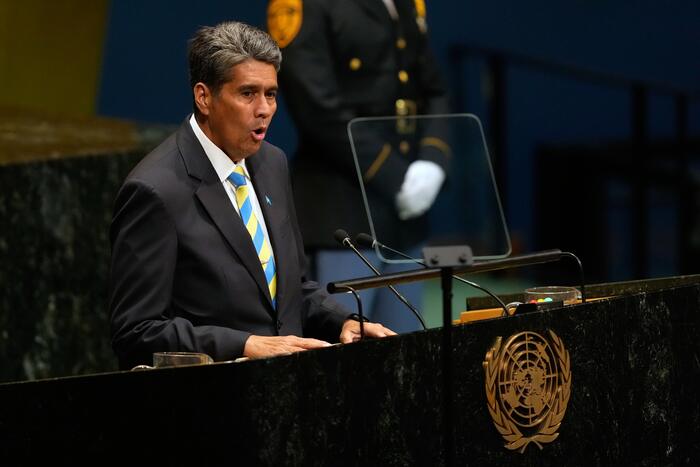
The mainstream press loves a shiny object. Yesterday, Donald Trump shared a clip of the Pakistani Prime Minister at the United Nations thanking him for halting Operation Sindoor, and the entire foreign policy establishment promptly lost its collective mind.
Cable news panels immediately broke into their predictable, tribal camps. One side screamed about ego, vanity, and a dangerous disregard for diplomatic protocol. The other side cheered it as proof of unmatched peacemaking muscle. Both sides are dead wrong. They are staring at the finger while missing the moon.
If you actually understand how modern statecraft, asymmetric deterrence, and domestic political signaling work in South Asia, you know that sharing that UN clip wasn't a vanity project. It was a calculated, multi-layered pressure play designed to corner New Delhi, rescue Islamabad from total internal collapse, and rewrite the rules of American mediation in the subcontinent.
The Lazy Consensus About Diplomatic Vanity
Let’s dismantle the primary narrative first. The prevailing wisdom among Beltway pundits is that Trump’s social media feed is purely an extension of his personal ego. The competitor coverage treats this repost like a billionaire putting a trophy on his mantelpiece.
That is amateur-hour analysis.
In international relations, public attribution is currency. When a sitting Pakistani Prime Minister stands at the United Nations General Assembly—the most scrutinized podium on Earth—and explicitly credits an American leader for stopping an active Indian military operation, he is not just saying thank you. He is signing a geopolitical receipt.
By amplifying that exact clip, Trump wasn't bragging to his domestic base in Ohio or Pennsylvania. Almost nobody in Akron knows what Operation Sindoor is, let alone the tactical nuances of cross-border strikes along the Line of Control. That repost was aimed directly at South Block in New Delhi and General Headquarters in Rawalpindi.
I have spent two decades watching Washington misread South Asian signaling, and the mistake is always the same. Western analysts assume public statements are meant for Western ears. They aren't. When Washington publicly validates Islamabad’s version of a ceasefire, it shatters India’s most sacred foreign policy doctrine: strict bilateralism.
The Third-Party Mediation Trap
To understand why this matters, you have to understand the Simla Agreement of 1972. For over fifty years, the bedrock of Indian foreign policy has been a non-negotiable refusal of third-party mediation in disputes with Pakistan. Whether it was Kargil in 1999, the Parliament attack standoff in 2001, or Balakot in 2019, New Delhi’s official posture has remained identical. India handles its own neighborhood. Foreign powers do not get to play referee.
Now, look at what happened during Operation Sindoor.
India launched precision strikes to dismantle terror infrastructure and re-establish escalation dominance. Pakistan was caught flat-footed, facing severe economic headwinds and domestic instability, unable to sustain a prolonged conventional exchange. Islamabad needed an off-ramp that didn't look like a surrender to its own military establishment or its public.
Enter Washington.
By allowing—and then actively promoting—the narrative that American intervention halted Operation Sindoor, two massive shifts occurred simultaneously:
- Pakistan’s Face-Saving Mechanism: The Pakistani Prime Minister could go to the UN and frame the halt not as a retreat from Indian firepower, but as statesmanlike deference to a global superpower. It insulated Rawalpindi from domestic humiliation.
- India’s Diplomatic Corner: If New Delhi aggressively denies Trump’s role, it publicly humiliates a sitting U.S. administration it needs for trade, tech transfers, and countering China in the Indo-Pacific. If New Delhi stays silent, it tacitly accepts the precedent that Washington can step in and freeze Indian military operations whenever things get too hot.
That is not vanity. That is geopolitical leverage of the highest order.
Did Trump Actually Stop Operation Sindoor?
Let’s address the elephant in the room. People keep asking whether Washington genuinely forced a ceasefire or if the Pakistani PM was simply flattering an American leader to secure IMF bailout backing and bilateral goodwill.
The answer lies in how modern escalation control actually works. Nobody in the White House picks up a red phone and orders Indian generals to stand down. That is Hollywood fiction.
Instead, Washington controls the logistics, the intelligence sharing, the diplomatic cover at the UN Security Council, and the economic arteries that keep both nations functioning. During high-intensity flare-ups, American backchannels operate on a simple, brutal calculus. Washington tells Islamabad what happens to its economy and military aid if it retaliates disproportionately. Simultaneously, Washington tells New Delhi what happens to its strategic partnerships and foreign direct investment if the conflict spirals into a full-scale war.
Imagine a scenario where two boxers are locked in the center of the ring, both bleeding, both exhausted, and the promoter steps in and threatens to cancel the purse for both fighters unless they step back to their corners. Did the promoter throw a punch? No. Did the promoter stop the fight? Absolutely.
Operation Sindoor had already achieved its primary tactical objectives before the halt. India had demonstrated capability and resolve. Continuing the operation carried diminishing returns and rising nuclear-threshold risks. Trump didn't stop a war India was about to win in 48 hours; he provided the diplomatic cover for both sides to step back from an abyss neither wanted to fall into, and then he claimed the credit to remind both capitals who holds the leash.
Why New Delhi’s Silence Speaks Volumes
If you want proof that this was a calculated strategic squeeze rather than a harmless social media repost, look at the reaction from the Indian Ministry of External Affairs.
Normally, when a foreign leader claims credit for mediating between India and Pakistan, New Delhi issues a swift, icy rebuttal within hours. We saw this repeatedly during Trump’s first term when he casually offered to mediate on Kashmir. The pushback from India was immediate and unmistakable.
This time? Calculated restraint.
Why? Because the global chessboard has changed. New Delhi is navigating a brutal trade environment, shifting supply chains, and persistent border friction with Beijing. Pick a public fight with Washington over who gets credit for ending Operation Sindoor, and you risk retaliatory tariffs, delayed defense deliveries, and a sudden chill in the Quad alliance.
Trump knows this. His advisors know this. By sharing the Pakistani PM’s speech, Washington is subtly reminding New Delhi that strategic autonomy has limits when your economy and defense modernization rely heavily on Western alignment. It is a transactional reality check. You want American jet engines, semiconductor partnerships, and intelligence sharing? Then you swallow the bitter pill of watching an American leader take a victory lap over your military restraint.
The Dangerous Precedent Nobody Is Talking About
Here is where the contrarian take has to acknowledge the dark side. Just because Trump’s move was strategically intentional doesn't mean it is safe. In fact, it introduces a massive moral hazard into South Asian security.
Think about the incentive structure this creates for Pakistan’s military establishment, the real power center behind the civilian Prime Minister who spoke at the UN.
For decades, Rawalpindi’s playbook has been predictable:
- Allow or sponsor asymmetric provocations across the border.
- Wait for India to respond with conventional military force.
- Immediately rattle the nuclear saber and scream for international intervention.
- Use foreign mediators to freeze the conflict before India can inflict decisive, long-term structural damage.
When the Pakistani PM thanks Trump at the UN for halting Operation Sindoor, and Trump amplifies that message to millions of people, it validates Rawalpindi’s exact strategy. It tells the generals in Pakistan that if they provoke a crisis and things go south, Washington will step in to save them from the full weight of Indian retaliation, provided they flatter the White House afterward.
This weakens deterrence. Deterrence only works when the aggressor believes the defender will be allowed to finish what the aggressor started. If Islamabad believes there is an automatic American circuit breaker built into every South Asian crisis, the cost of future provocations drops dramatically.
What Washington Actually Wants From Islamabad
To understand why Trump would willingly hand Pakistan a propaganda win on the world stage, you have to stop looking at India and Pakistan in a vacuum. Look slightly north and west.
Afghanistan is a disaster zone teeming with resurgent terror networks. Iran is a persistent flashpoint. Central Asia is a battleground for Russian and Chinese influence. And China’s Belt and Road Initiative runs straight through Pakistan via the China-Pakistan Economic Corridor.
Washington cannot afford a completely collapsed, rogue, nuclear-armed Pakistan falling entirely into Beijing’s lap. For the last few years, U.S. policy leaned heavily toward isolating Islamabad while courting New Delhi. The result? Pakistan became a virtual client state of China, dependent on Beijing for loans, weapons, and diplomatic protection.
Sharing that UN speech is an olive branch to Islamabad—a cheap, zero-cost gesture that costs the U.S. taxpayer zero dollars while signaling to Pakistan’s leadership that the door to Washington isn't welded shut. It drives a subtle wedge between Islamabad and Beijing without Washington having to sign a single check or deploy a single troop.
How Analysts and Investors Should Read This Moving Forward
If you are watching South Asian geopolitics—whether as a policy analyst, an investor with exposure to Indian equities, or a defense contractor—you need to throw out the old rulebook. The polite, predictable diplomacy of the post-Cold War era is dead.
Here is how you actually read signals like the Operation Sindoor repost without getting fooled by media noise:
- Ignore the tone; track the transaction. Don't get distracted by whether a statement sounds boastful or undiplomatic. Ask what leverage was gained. In this case, Washington gained quiet compliance from New Delhi and renewed relevance in Islamabad.
- Watch trade and defense approvals, not press briefings. If New Delhi is genuinely furious about Washington taking credit for halting Operation Sindoor, you won't see it in a fiery speech. You will see it in delayed bilateral trade negotiations or sudden procurement pivots toward European defense suppliers.
- Expect shorter, sharper military flare-ups. Because Washington is actively signaling a willingness to intervene early and claim credit for de-escalation, future Indian military operations will likely be designed to achieve maximum kinetic impact within a 24-to-48-hour window—before the diplomatic circuit breakers can even be triggered.
The Brutal Reality of Modern Statecraft
The pundits mocking Trump for sharing the Pakistani Prime Minister’s speech are stuck in a 1990s mindset where statecraft happened behind closed doors in mahogany-paneled rooms, and credit was politely shared via joint communiqués.
That world no longer exists. Today, public narrative is statecraft. A single repost on social media can undo fifty years of rigid diplomatic doctrine, alter the domestic political calculus of two nuclear-armed rivals, and signal a shift in regional alliances to Beijing—all before the morning news cycle finishes its first cup of coffee.
New Delhi didn't lose the military battle during Operation Sindoor, and Islamabad didn't win a diplomatic victory at the UN. Both capitals just got reminded that in a transactional world, whoever controls the megaphone controls the terms of peace.