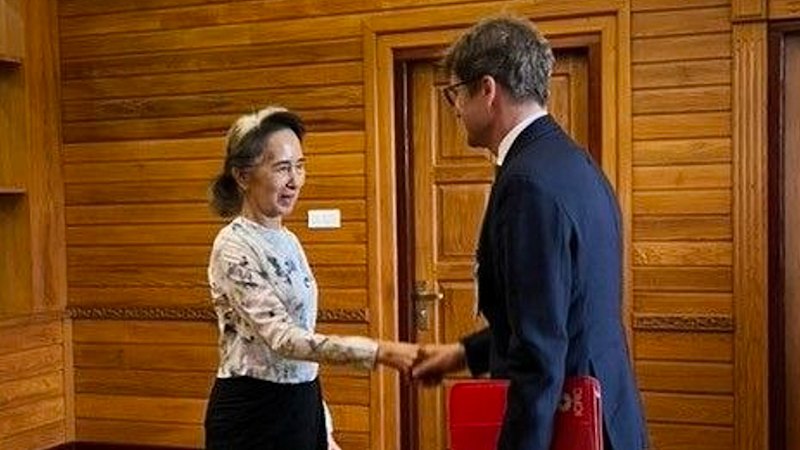
Every time a blurry snapshot emerges from a military detention center in Naypyidaw, the global commentariat loses its collective mind. A fresh proof of life photo drops, and the newsrooms in London, Washington, and Bangkok spin up the exact same tired narrative. They obsess over the pixels. They parse the angle of her posture, the color of her traditional dress, the faint gray in her hair. They treat a prison Polaroid like a sacred relic of political resurrection.
It is a masterclass in missing the forest for the trees.
For years, watching foreign policy analysts react to these calculated leaks has felt like watching people argue over the seating chart on the Titanic while the ship is already vertical. The lazy consensus goes something like this: Aung San Suu Kyi remains the magnetic center of Myanmar’s political gravity, and any sign of her continued physical endurance signals an imminent threat to the State Administration Council. The generals release a photo to project control; human rights advocates circulate it to demand her release; the international community treats it as a barometer for democratization.
This entire framing is obsolete. It belongs in a geopolitical history textbook from 2012.
If you think Myanmar's civil war hinges on whether an octogenarian former state counselor can walk to a makeshift courtroom, you do not understand modern conflict economics, ethnic armed organizations, or the decentralized digital resistance. The generals do not fear Suu Kyi the political operator anymore. They manage her as a historical artifact, and the resistance movements that actually hold territorial control have long since moved past the era of waiting for a single charismatic messiah to reclaim the throne.
The Myth Of The Monolithic Resistance
Let us dismantle the foundational fiction of modern Myanmar reporting. The narrative pushed by legacy media presents a binary struggle: the brutal military junta versus the heroic National League for Democracy, waiting for their trapped matriarch to give the signal.
Reality is far more fractured, violent, and pragmatic.
I have spoken with defense strategists and clandestine supply-chain operators running logistics across the Thai border, and their perspective is brutally utilitarian. They do not care about prison photos. They care about drone manufacturing kits, encrypted Starlink terminals, and ammunition supply lines.
The People Defense Forces and seasoned ethnic armed organizations like the Karen National Union and the Kachin Independence Army have spent the last several years carving out autonomous zones. They are building administrative infrastructure, tax systems, and local governance models from scratch. They are not fighting to restore the pre-2021 status quo. They remember the NLD era vividly. They remember how Suu Kyi defended the military during the Rohingya crisis at the International Court of Justice in The Hague. They remember being sidelined, ignored, and betrayed by the very civilian leadership the West idolizes.
When an outlet hyperventilates over a proof of life image, they are feeding an addiction to clean, personality-driven narratives. Modern civil wars are dirty, decentralized, and ideologically messy. Myanmar is no exception. By reducing a complex, multi-factional revolution to a soap opera about one prisoner, international media outlets commit journalistic malpractice. They flatten a massive liberation movement into a single aging face.
The Junta Calculated PR Strategy
Consider the mechanics of how these photos leak. Nothing leaves a maximum-security facility in Myanmar by accident. Every frame is curated.
The military regime, known officially as the State Administration Council, is fighting a multi-front disaster. They are losing territory in the north and the east. Conscription laws have triggered a massive brain drain and youth exodus. Inflation is rampant, basic utilities are failing, and their economic lifeline from foreign currency reserves is drying up.
When things get particularly bleak on the battlefield, what happens? A photo appears.
It is a psychological pressure valve. The generals leak a controlled image to remind the domestic population that resistance is futile—she is still ours, locked away and powerless. Simultaneously, they toss a bone to international diplomats who are desperate for any excuse to engage in business-as-usual diplomacy. It signals to ASEAN members and weary foreign ministries that the situation is managed, that she is alive, and that negotiations remain theoretically possible.
Falling for this trap requires a profound misunderstanding of authoritarian survival tactics. Dictators do not release political prisoners or grant unmonitored access out of humanitarian grace. They leverage human collateral when they need leverage. The photo is not a window into her well-being; it is a mirror reflecting the junta's desperation for legitimacy.
By treating the image as a major news event, foreign journalists and diplomats become unwitting press agents for the very generals they condemn. Every op-ed dissecting her health status is a distraction from the real story: the systematic atrocities committed against civilian populations in airstrikes, the collapse of the formal economy, and the quiet consolidation of local governance by armed youth networks who never even met Aung San Suu Kyi.
Why The West Clings To A Ghost
The obsession with her survival exposes a deeper malaise in Western foreign policy thinking: the savior complex.
For decades, the diplomatic playbook regarding Southeast Asia was simple. Find a charismatic, Western-educated icon who speaks fluent English, build an international PR campaign around them, and wait for democratic norms to magically install themselves. It worked in specific contexts during the late-twentieth-century wave of democratization.
It fails completely in the face of twenty-first-century hybrid warfare and entrenched military kleptocracies.
The Tatmadaw—Myanmar’s military—is not a conventional army that respects institutional norms. It is a sprawling business conglomerate with guns, controlling telecommunications, ruby mines, jade trade, and real estate. They did not launch the 2021 coup on a whim; they did it because the civilian government threatened to touch their economic empire.
Waiting for a court ruling to reverse that coup, or hoping that a frail prisoner will emerge from detention to lead a grand reconciliation, is political infantilism. It ignores the structural reality of the corporate state. Even if the gates were flung open tomorrow, the country cannot simply revert to a power-sharing agreement that proved utterly dysfunctional even before the tanks rolled into Naypyidaw.
The real power dynamics in Myanmar have shifted to the ground level. They live in encrypted chat groups, underground clinics, localized food security networks, and tactical command posts in the jungle.
The Cost Of Manufactured Nostalgia
Every hour spent analyzing a pixelated prison snapshot is an hour stolen from investigating what actually matters.
We should be tracking how sanctioned fuel reaches military jets. We should be auditing the offshore bank accounts funneling cash to the procurement officers buying Russian and Chinese arms. We should be listening to the voices of Gen-Z activists in Yangon and Mandalay who are risking their lives printing underground newspapers and organizing sabotage, many of whom look past the old guard with polite indifference.
When you ask people on the ground in Myanmar what they think of the international obsession with Suu Kyi's health, you do not get awe. You get exhaustion. They are too busy dodging artillery shells and figuring out how to educate their children in liberated territories to care about symbolic martyrdom.
The transition away from military rule is happening, but it is being forged in blood, decentralized code, and tactical grit—not in the courtroom where a kangaroo tribunal sentences a former icon to decades behind bars.
Stop looking at the photo. Look at the supply lines. Look at the liberated townships. The future of the country is already being built without permission from the prison guards, and it is moving far too fast for the old ghosts to catch up.