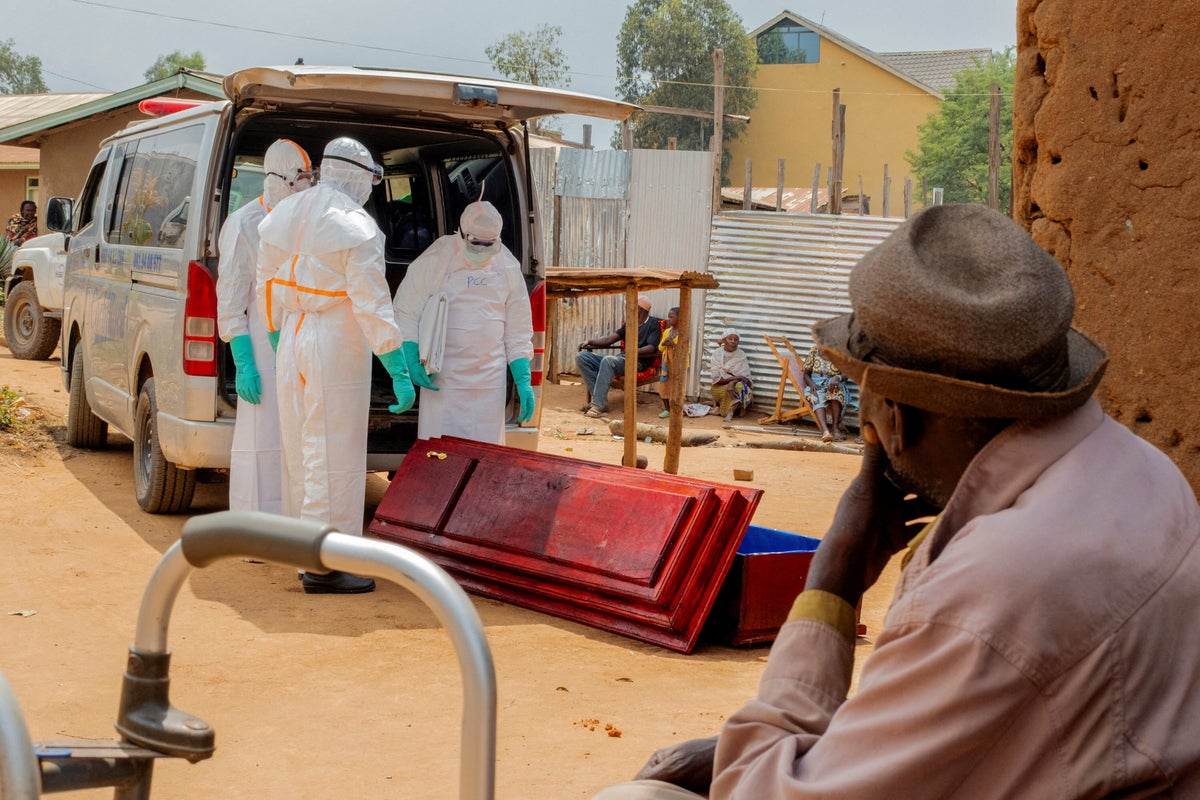
An epidemiological evaluation of an infectious disease outbreak requires isolating raw transmission metrics from operational noise. The escalating outbreak of the Bundibugyo virus disease (BVD) strain across the Democratic Republic of Congo (DRC) and Uganda presents an asymmetrical data set: 906 suspected cases and 223 suspected deaths are under investigation, juxtaposed against a narrow baseline of 125 confirmed cases and 17 confirmed deaths in the DRC, alongside 9 confirmed cases and one death in Uganda. This statistical divergence reveals a critical bottleneck in diagnostic velocity rather than an uncontained exponential expansion.
To evaluate the trajectory of this outbreak, the situation must be parsed through three structural dimensions: diagnostic lag, the unique biological variables of the Bundibugyo strain, and the operational friction generated by complex humanitarian emergencies.
The Diagnostic Divergence Metric
The primary analytical error in tracking high-consequence pathogens is treating suspected case counts as a real-time proxy for active transmission. The ratio of suspected to confirmed cases in the current DRC data indicates a profound lag in the diagnostic pipeline.
DRC Outbreak Metrics (As of May 2026):
├── Suspected Cases: 906
│   └── Suspected Deaths: 223
└── Confirmed Cases: 125
    └── Confirmed Deaths: 17
This data profile is governed by two epidemiological mechanics:
- Symptomatic Confounding: Early-stage Bundibugyo virus disease presents with non-specific clinical symptoms, including fever, cephalalgia, myalgia, emesis, and diarrhea. In the endemic environment of eastern DRC, these symptoms overlap almost perfectly with prevalent hyper-endemic pathogens, specifically Plasmodium falciparum malaria, typhoid fever, and fulminant cholera. Consequently, local triage algorithms automatically channel thousands of febrile patients into the "suspected case" pipeline until differential testing can occur.
- Laboratory Throughput Bottlenecks: The processing of high-consequence viral pathogens requires reverse transcription-polymerase chain reaction (RT-PCR) assays executed under stringent biosafety protocols. The presence of 906 suspected cases reveals a substantial processing backlog rather than a surge of true-positive infections. As testing capacity scales up in the affected provinces of Ituri, North Kivu, and South Kivu, a high percentage of these suspected cases will likely discard as negative, normalizing the apparent mortality rate.
Pathogen Specificity and The Case Fatality Function
The Bundibugyo strain is historically characterized by distinct epidemiological variables that differentiate it from the more common Zaire ebolavirus strain. Preliminary data from the World Health Organization Health Emergencies Programme positions the crude case fatality rate (CFR) of this outbreak between 30% and 50%.
The lethality of the virus is not static; it is an optimization function dependent on the timing of supportive clinical interventions.
$$CFR = f(\Delta t_{dx}, C_{intensive})$$
Where $\Delta t_{dx}$ represents the time delay between symptom onset and diagnostic confirmation, and $C_{intensive}$ represents the capacity score of optimized intensive care.
When patients remain isolated from structured medical intervention, the pathogen causes severe vascular leakage, electrolyte depletion, and multi-organ failure. Conversely, the introduction of early aggressive oral or intravenous rehydration, electrolyte correction, and symptomatic management suppresses the upper limits of the mortality curve. This is substantiated by recent clinical outcomes in the DRC, where early-presenting patients have achieved full viral clearance and subsequent discharge.
A major strategic vulnerability in the current response is the absence of an approved, strain-specific countermeasure portfolio. The widely deployed Ervebo vaccine, which demonstrates high efficacy against the Zaire strain, does not offer validated cross-protection against the Bundibugyo virus. The current prevention and treatment infrastructure must therefore rely on experimental clinical trial frameworks.
Prioritized Therapeutic Interventions
- Monoclonal Antibody Regimens: The combination therapeutics MBP134 and maftivimab are under evaluation for active treatment. These biologicals target specific epitopes on the viral glycoprotein to neutralize viral entry into host cells.
- Small-Molecule Antivirals: Remdesivir is being deployed within randomized protocol structures to inhibit viral RNA-dependent RNA polymerase replication.
- Post-Exposure Chemoprophylaxis: For identified close contacts of confirmed cases, the oral antiviral obeldesivir is being evaluated to intercept viral replication during the incubation window, serving as a non-vaccine containment ring.
Geopolitical Friction and Containment Mechanics
Pathogen reproduction dynamics ($R_0$) are heavily modified by the physical and geopolitical geography of the outbreak zone. The cross-border spread into Uganda—comprising nine confirmed cases, three of which were directly imported from the DRC—highlights the porous nature of the regional frontier. However, the absence of documented community transmission within Uganda indicates that localized surveillance and contact-tracing networks are currently maintaining operational containment.
The primary impediment to total containment is the profound systemic friction within the eastern DRC corridor. The outbreak's epicenter sits within Ituri and North Kivu, zones defined by long-standing armed conflict, civilian displacement, and deep-seated community mistrust of institutional health interventions.
This operational environment introduces severe constraints on traditional outbreak suppression:
- Supply-Chain Deprivation: Basic operational inputs, such as vehicle fuel for mobile surveillance teams and personal protective equipment (PPE) for isolation centers, face severe transit bottlenecks due to rebel blockades and active conflict zones.
- Contact-Tracing Disruptions: Effective containment of Ebola requires tracking 100% of exposed contacts over a 21-day incubation period. In regions where populations are actively fleeing conflict or where rebel groups control key municipalities like Goma and Bukavu, maintaining a continuous chain of surveillance becomes mathematically impossible.
- Security Hazards: Active hostility toward health workers, including instances of arson targeting treatment infrastructure, drastically truncates the operational window for medical field teams.
Strategic Requirements for Outbreak Suppression
To transition the current intervention from a reactive posture to definitive containment, resources must be shifted away from generalized border restrictions and directed toward localized, high-velocity operational nodes. Travel bans, such as unilateral border closures, yield diminishing returns and incentivize unmonitored, informal crossings that completely blind epidemiological surveillance systems.
The response architecture must prioritize the rapid scaling of decentralized diagnostic networks. Deploying mobile GeneXpert PCR platforms directly to regional triage centers will collapse the diagnostic turnaround time from days to hours. This tactical shift will immediately clear the unverified "suspected case" backlog, isolate true positives before significant community viral shedding occurs, and prevent the cross-contamination of uninfected febrile patients within overburdened holding facilities.
Concurrently, the deployment of the University of Oxford and Serum Institute of India’s ChAdOx1 Bundibugyo vaccine candidate must be accelerated into accelerated phase trials within active transmission rings. Given that this vector-based candidate is estimated to be ready for clinical field evaluation within two to three months, it represents the most viable medium-term mechanism to establish a genetic barrier against regional expansion. The immediate operational priority must remain the stabilization of supply lines for the post-exposure administration of obeldesivir to close contacts, creating an immediate pharmacological shield where structural containment rings are fractured by conflict.