Silence. That is often the first sound of a diplomatic shift, long before a single press release hits a screen or a television anchor clears their throat.
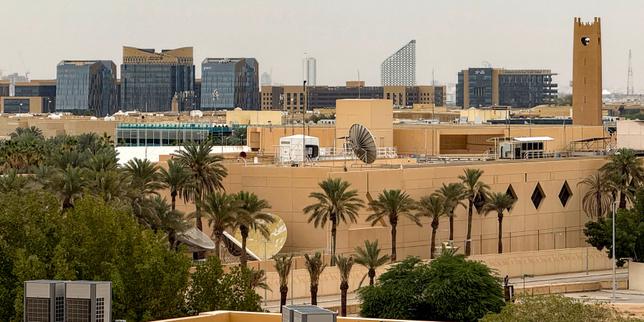
In Riyadh, where desert heat shimmers off glass towers and traffic hums late into the night, a diplomatic compound is supposed to feel permanent. Thick walls. Security checkpoints. Flags snapping in warm breezes. Yet when Washington orders a partial departure of embassy personnel from the Saudi capital, something subtle and heavy moves through the air. It is not yet a full evacuation. It is not a declaration of war. It is a calculated step backward, a quiet narrowing of a presence that usually projects unshakeable reach. Meanwhile, you can read related stories here: Inside the Shadow Fleet Legal Shield Washington Just Tried to Break.
For readers glancing at a headline in French or English, the facts can look cold and procedural. A government adjusts staffing. Non-essential workers or dependents leave. Consular services may shrink or shift. On paper, it reads like an administrative memo.
In reality, a partial departure is an alarm bell wrapped in polite bureaucracy. To see the complete picture, check out the recent analysis by NBC News.
What a Partial Departure Actually Means
Diplomacy runs on presence. When a country keeps hundreds of diplomats, specialists, and support staff inside a foreign capital, it is saying two things at once: we are committed to this relationship, and we judge the environment stable enough for our people to work, shop, send children to school, and sleep soundly.
When the United States orders some of its personnel out of Riyadh, that message changes shape. It does not sever ties, nor does it erase decades of security, energy, and political cooperation between Washington and Saudi Arabia. Instead, it signals a recalibration of risk. Intelligence assessments rarely become public in full, and governments guard their specific threat evaluations closely. Still, a partial drawdown tells observers that Washington sees enough friction, uncertainty, or potential danger to reduce its footprint rather than keep everyone in place.
Think of it like pulling back a few paces on a crowded, unpredictable street. You are not running away. You are creating space so you can see better and react faster if trouble breaks out.
Consider what happens next when that space is created. Every desk that empties inside a compound changes the rhythm of the mission. Political officers who track regional negotiations might still work remotely or from elsewhere, while logistics, public affairs, or family members might be told to pack. Even when the mission insists operations continue, the psychological weight is unmistakable. People begin asking quiet questions over coffee: Why now? What do they know that hasn't hit the evening news? How fast could things escalate?
I have stood inside diplomatic compounds during moments of regional tension, where the fluorescent lights hummed a little louder against the quiet dread of uncertainty. You notice small things first. A colleague's desk looks cleaner than usual. Someone lingers by the doorway a second longer before saying goodbye. Nobody panics—diplomats and civil servants are trained not to—but everyone feels the shift in gravity.
The People Behind the Cable
To understand why a partial withdrawal matters beyond geopolitical chessboards, we have to look past the ministries and map rooms. (Note: The following character is a hypothetical composite created to illustrate the human stakes of diplomatic drawdowns.)
Call her Nadia. She has spent two years in Riyadh working on regional economic coordination, learning which bakeries stay open past midnight and which routes choke with traffic before dusk. Her apartment has become home. Her routine has a rhythm. Then comes the guidance: certain categories of staff and family members are directed to depart.
Maybe Nadia is asked to leave while her colleagues in security or senior policy stay behind. Or maybe she stays while friends pack suitcases with a mix of relief and guilt. Either way, her life splits in two overnight. There is the practical scramble—booking flights, sorting documents, deciding what fits in two bags when you cannot tell if you are leaving for two weeks or six months. Beneath that is a harder emotion: confusion.
When an order is partial, ambiguity becomes part of the burden. Leaving completely feels like a clean break, however painful. Staying feels like a test of nerve. Being told some people must go forces everyone left behind to measure their own exposure against an unseen scale.
Families feel this most sharply. Diplomats and embassy employees are not machines moving across a chessboard; they are partners, parents, and neighbors. A child pulled out of school mid-year does not care about deterrence theory or regional flashpoints. They care about their friends, their routine, and the sudden seriousness in their parents' voices.
And what about the local staff who keep embassies running—drivers, translators, administrative assistants, guards? They are often the quiet backbone of foreign missions. When foreign personnel depart, local employees are left behind in the city they call home, watching the gates with their own worries about stability, employment, and safety.
Why Riyadh Carries Outsized Weight
Riyadh is not just another capital on a map. Saudi Arabia sits at the crossroads of Gulf security, global energy markets, and shifting Middle Eastern alliances. When tension rises anywhere near the Arabian Peninsula or broader regional flashpoints, eyes turn quickly to Riyadh and its neighboring capitals.
Historically, periods of heightened regional strain have often prompted governments to trim diplomatic staff first, long before any military posture changes become visible. Sometimes those precautions turn out to be overly cautious—storms gather, thunder rolls, and the worst never hits. Other times, a partial departure is the earliest visible sign of a crisis widening.
That uncertainty is the hardest part for ordinary people to sit with. Uncertainty makes our minds race. We want a clear binary: safe or unsafe, escalating or calming down. Real-world crises rarely oblige us. They move in gray zones, partial measures, and quiet signals.
Let me admit something plainly: even people who follow foreign policy for a living find moments like this unsettling. You can read every analyst thread and still feel the gap between public information and private reality. Governments rarely lay every card on the table while sensitive negotiations or security measures are underway. Readers are left to piece together clues from official statements, flight patterns, and regional headlines.
That gap invites rumor. In moments of tension, social media fills with dramatic claims—some rooted in truth, many exaggerated or invented. When an embassy orders a partial departure, misinformation spreads fast because people are hungry for certainty. A sensible precaution gets spun into an imminent collapse, or a serious warning gets dismissed as routine overreaction.
Reading Between the Lines Without Losing Your Head
If you are following news about a partial embassy departure in Riyadh, how should you read it?
First, separate the action from the worst-case fantasy. A partial departure is a defensive measure to lower risk and reduce vulnerability. It is a sign of concern, not proof of catastrophe. Treating every diplomatic precaution as a guaranteed worst-case scenario only breeds panic without adding clarity.
Second, pay attention to what stays intact. Embassies rarely shut their doors completely unless conditions deteriorate dramatically. Core diplomatic channels, security coordination, and essential functions usually remain active, even when staffing is thinned. Communication between capitals matters most when tensions rise, not least.
Third, watch the broader context. A single embassy move does not happen in a vacuum. It sits alongside regional rhetoric, security alerts, travel advisories from other countries, and diplomatic activity behind closed doors. Looking at the wider picture keeps one headline from distorting the entire scene.
Metaphorically speaking, a diplomatic mission is like a lighthouse on a rocky coast. When fog rolls in and visibility drops, the light does not vanish—sometimes the crew adjusts operations or brings non-essential hands ashore while keeping the beam turning. The goal is to guide ships safely through dark water without losing the beacon itself. (This lighthouse comparison is a metaphor for how states balance risk and continuity during periods of strain.)
The Quiet Ripple Far From the Desert
Even if you live thousands of miles away from Riyadh, a move like this touches more than you might think. Energy markets watch Gulf stability closely. Shipping lanes and regional diplomacy affect prices, supply chains, and international alliances far beyond the Middle East. A shift in posture in the Saudi capital ripples outward through markets and ministries around the world.
Yet the truest measure of the story is still human. Behind every diplomatic cable about ordered departures are real people packing bags, checking phones, hugging loved ones a little tighter, and waiting for word on what comes next.
Out on the tarmac, jet engines spool up against a bright sky, carrying away a fraction of the people who yesterday walked the same hallways, while those who remain look out toward the horizon and listen for what the silence is trying to say.


