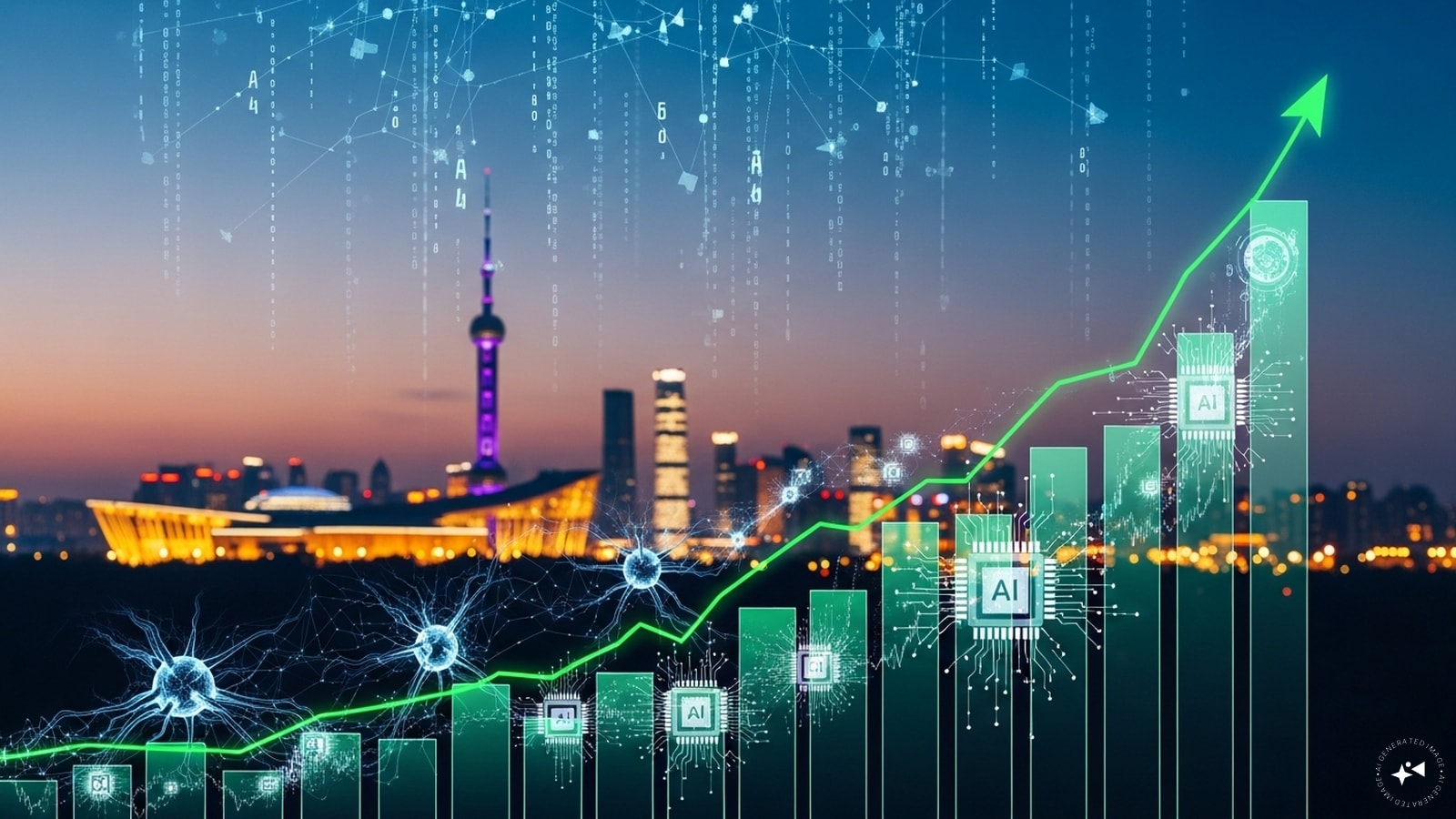
Mr. Zhou does not look at the stock tickers anymore. They move too fast, flashing green across the dual monitors in his cramped Shanghai office, a frantic strobe light that mimics the heartbeat of a city running on pure adrenaline. Instead, Zhou looks at his coffee cup. The paper sleeve is damp with condensation. Outside, the neon signs of Jiangwan Stadium blur through a heavy summer mist.
For six months, Zhou’s small logistics firm was dying.
He had twenty trucks, thirty-two drivers, and a mountain of data that resembled a tangled ball of yarn. Fuel costs were eating his margins raw. Customers wanted packages delivered across provinces in timeframes that defied the laws of traffic and human endurance. Every night, Zhou went to sleep feeling like a man trying to hold back a flood with a plastic spoon.
Then, he plugged into the grid. Not the electrical grid, but the unseen infrastructure of Beijing’s newly subsidized artificial intelligence clusters.
Within forty-eight hours, an algorithm he didn't fully understand re-routed his entire fleet. It predicted a bottleneck at a toll booth outside Suzhou three hours before it happened. It saved him twelve percent on diesel in a single week.
Zhou is not a tech visionary. He is a fifty-four-year-old man with bad knees who worries about his daughter’s university tuition. But when the markets opened last Tuesday, and a tidal wave of capital rushed into Chinese AI stocks, driving shares up by double-digit percentages across the board, Zhou didn't see numbers on a screen. He saw his drivers getting home in time for dinner.
The financial pages called it a rally driven by "demand optimism" and "policy support."
Those words are cold. They taste like cardboard. They miss the entire point of what is happening on the ground in Shenzhen, Hangzhou, and Beijing. This is not a story about market capitalization or venture capital exit strategies. This is a story about survival, national pride, and the desperate, breathless race to automate a society before it grows too old to work.
The Quiet Mandate
To understand why investors suddenly threw billions of yuan at domestic software companies last week, you have to look past the trading floors. You have to look at the documents coming out of local municipal offices.
They are dry reading. They are filled with phrases like "computational power subsidies" and "enterprise integration initiatives." But if you translate the bureaucratic dialect into human terms, the message is simple: We will pay for the brains, if you build the muscle.
Consider how a traditional business in China operates. For decades, growth was a matter of headcount. If you wanted to manufacture more toys, process more invoices, or ship more solar panels, you hired more people. The human engine was inexhaustible.
But the engine is slowing down. The demographic dividend is spent.
Walk into a textile mill in Zhejiang today, and you will not see rows of teenagers operating looms. You will see forty-somethings. The younger generation wants to create content, design video games, or deliver food on slick app platforms; they do not want to sweat on a factory floor.
This creates an existential friction. How does a country remain the world’s workshop when the workers are disappearing?
The government’s answer has been a massive, top-down injection of cash directly into the veins of the tech sector. If a small business owner like Zhou wants to use an advanced language model or a predictive analytics suite, the local government often picks up a significant portion of the tab. They call it a "computing voucher." It functions like a food stamp for processing power.
When the state promises to foot the bill for your customer base, your stock tends to go up. Investors aren't stupid. They saw the policy notices and realized that the demand wasn't just theoretical anymore. It was guaranteed by the state treasury.
Inside the Silicon Valley of Haidian
Step out of the subway station at Zhongguancun in northwest Beijing, and the air feels different. It smells like roasted chestnuts and ozone from the e-bike batteries. This is the historic heart of China’s tech industry, a place where billionaires were made in gray electronics markets selling pirated software thirty years ago.
Today, it is a canyon of glass towers.
Inside one of these towers, a twenty-six-year-old programmer named Li sits under a fluorescent light that has been buzzing since 2022. Li works for a company that specializes in computer vision—teaching cameras to see and understand the world.
For the past year, Li’s life has been an endless cycle of instant noodles and code reviews. The Western media often portrays Chinese tech companies as monoliths of stolen IP and cheap clones. Li finds this hilarious, mostly because he hasn't slept more than five hours a night in six months, trying to optimize an open-source model to run on domestic graphics chips that aren't quite as fast as the American ones they can no longer import.
"We don't have the luxury of elegance," Li says, his eyes bloodshot as he stares at a terminal window. "The American models are like luxury sports cars. They require perfect fuel and immaculate roads. Our models have to be like farm tractors. They have to run on whatever mud we have available."
This is the hidden friction of the rally. The optimism is real, but it is born of necessity.
When Washington restricted access to top-tier Nvidia chips, it didn't kill the Chinese AI industry. It just made it angry. And more importantly, it made it local.
Before the restrictions, a Chinese corporation might have looked at a local AI startup and thought, Why risk it? We will just buy the Western standard. Now, that choice is gone. The domestic market has become a closed ecosystem where every bank, every hospital, and every state-owned enterprise is forced to buy local.
That shift created a captive market of 1.4 billion people. The recent stock surge is the financial realization of that captivity. It is the moment the market looked at companies like Cambricon, Inspur, and iFlytek and realized that their order books were full for the next decade, not because they are inherently better than their global rivals, but because they are the only option left.
The Factory Floor Agrees
Let us leave the programmers and the traders behind for a moment. Go three hundred miles south, to an industrial park on the outskirts of Hefei.
Here, a company manufactures refrigerator compressors. It is a noisy, brutal environment. Every few seconds, a heavy press slams down on a sheet of steel with a sound that rattles your teeth.
In the center of this chaos stands Chen, a quality control inspector. For twenty years, Chen’s job was to listen. He would stand at the end of the line, hold a finished compressor to his ear, and strike it with a small brass hammer. A perfect compressor rang with a clear, bell-like tone. A flawed one had a microscopic rattle, a tiny hitch in its breath that only an expert could detect.
Chen’s ears are failing him now. Tinnitus hums in his head like a distant cicada. He thought he would be forced out, replaced by a younger man with sharper senses.
Instead, they installed a black box above his station. It contains a cheap microphone and a specialized audio-processing chip designed by a company whose stock just jumped forty percent on the Shenzhen exchange.
Now, the machine listens. It analyzes the frequency of every strike in milliseconds. If it detects a flaw, a red light flashes on Chen’s dashboard. Chen doesn't strike the metal anymore; he watches the lights and moves the defective units off the belt with a hydraulic hoist.
"The machine knows the sound better than I did when I was thirty," Chen says, looking at the box with a mixture of reverence and slight resentment. "It doesn't get tired. It doesn't have a fight with its wife before the shift starts."
This is the demand optimism that the financial analysts write about in their neat, bulleted reports. It isn't the demand for chatbots that write mediocre poetry or generate surreal images of cats in spacesuits. It is the demand for a machine that can listen to a piece of metal and save a factory fifty thousand yuan a day in warranty claims.
It is pragmatic AI. It is blue-collar intelligence.
The Uncertainty of the Bull Run
Yet, any investor who believes this trajectory is a straight line upward is fooling themselves.
The atmosphere in the tea houses around the Shanghai Stock Exchange is cautious, even amidst the green arrows. Old timers remember the crashes of 2015 and 2018. They know how quickly a government-backed mania can turn into a graveyard of empty shell companies.
The risk lies in the plumbing.
Building an AI infrastructure is immensely expensive. It requires billions of kilowatt-hours of electricity and mountains of silicon. Right now, the state is providing the liquidity, but if the broader economic slowdown deepens, those subsidies might dry up. If the government stops buying the computing vouchers, small businesses like Zhou’s will go back to their paper ledgers and Excel spreadsheets.
There is also the question of data quality. China has an unimaginable volume of information, but much of it sits in siloed, incompatible databases owned by competing ministries or corporate giants who refuse to share.
"We are building a beautiful palace on a foundation of sand," says a venture capitalist who asked to remain anonymous, speaking over a plate of cold duck in a Beijing restaurant. "Everyone is buying the shares because they see everyone else buying them. It is momentum, not mathematics. We have too many companies doing the exact same thing, competing for the same pool of government grants."
He is right to worry. The duplication of effort is staggering. There are currently over a hundred distinct large language models being developed in China, a phenomenon the local press has dubbed the "Battle of a Hundred Models." Most of them will die. Their stock prices will hit zero, and their office furniture will be sold at auction.
But the winners? The winners will reshape the daily texture of Asian life.
The Late Shift
It is past 2:00 AM now.
In the Haidian district, Li finally shuts down his terminal. He walks out of the glass tower into the cool night air. A fleet of autonomous delivery pods—small, white, bread-van-shaped vehicles with spinning lidar sensors on their roofs—hums past him, delivering midnight snacks to tech workers who won't go home for another three hours.
These pods run on software developed by companies that were considered penny stocks five years ago.
Back in Shanghai, Zhou’s phone buzzes on his nightstand. It is an automated notification from his company’s dashboard. A shipment of lithium-ion batteries has just cleared customs at the Ningbo port, three hours ahead of schedule, because the customs clearance algorithm anticipated a paperwork discrepancy and corrected it automatically.
Zhou turns over and goes back to sleep. He doesn't think about policy support or geopolitical chip embargoes. He doesn't care about the Shanghai Composite Index.
He just breathes easier because the world makes a little more sense tonight than it did yesterday. The algorithms are awake, consuming electricity, crunching numbers, and holding up the corners of a world that is too tired to carry itself. The money on the stock market is just a reflection of that heat—the financial steam rising from a engine that cannot afford to stop turning.