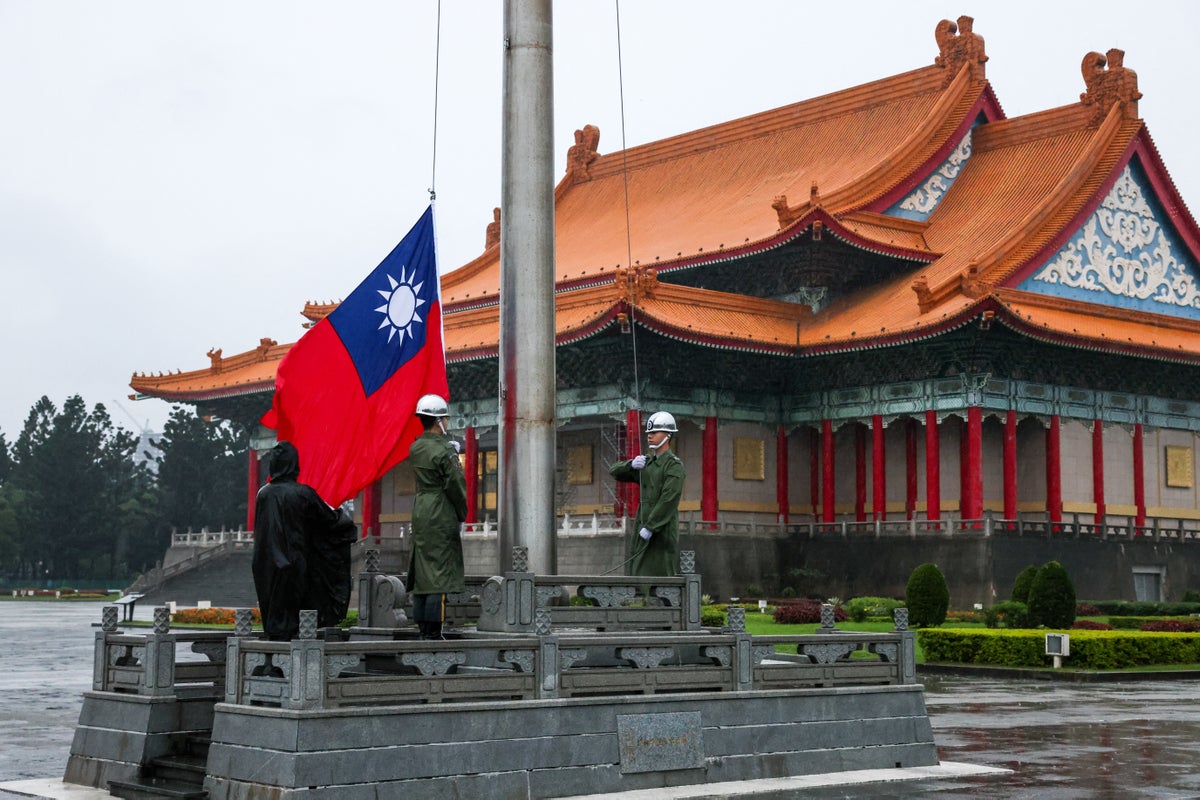
In a small noodle shop in Taipei’s Xinyi District, the steam from a bowl of beef broth rises to meet the cool hum of an air conditioner. A young woman named Mei—hypothetically representative of a generation born into a status quo they didn't create—scrolls through her phone. On the screen, headlines flicker with words like "red lines," "strategic ambiguity," and "reunification." To the outside world, these are the chess moves of superpowers. To Mei, they are the background noise of her entire life. She lives in a place that has its own passport, its own currency, its own president, and its own army. Yet, on most maps printed in Beijing, her home is simply a province.
This is the central friction of the Taiwan Strait. It is not just a dispute over a 110-mile stretch of water. It is a collision between two incompatible definitions of reality.
The Paper Fortress
The history of this tension is often told as a dry sequence of dates, but it is better understood as a family feud that never officially ended. After the Chinese Civil War concluded in 1949, the defeated Nationalist government fled to Taiwan. They stayed. They built. They transformed. For decades, both sides claimed to be the "true" China. Eventually, the world shifted its gaze toward the massive economic engine of the mainland, and Taiwan was pushed into a unique kind of geopolitical purgatory.
Think of it as a house where the tenant has lived for seventy years. They pay the bills, they painted the walls, and they raised their children there. But the landlord insists the lease expired decades ago and that, legally, the house belongs to the mansion next door.
In the eyes of the People’s Republic of China (PRC), Taiwan is a breakaway territory. Beijing’s "One China" principle asserts there is only one China, and Taiwan is an inseparable part of it. Xi Jinping has been remarkably clear: this is a "historical mission" that cannot be passed down from generation to generation. He has not ruled out the use of force. To Beijing, any move toward formal independence is a declaration of war.
But walk the streets of Taipei, and you see a different truth. You see a vibrant democracy that emerged from the ashes of martial law. You see a society that was the first in Asia to legalize same-sex marriage. You see a people who, according to consistent polling, increasingly identify as "Taiwanese" rather than "Chinese." They aren't looking for a fight, but they are living a life that is already independent in every practical sense.
The Silicon Shield
The stakes are higher than just national pride or historical grievances. If Taiwan were merely a quiet island of fishermen and poets, the world might look away. But Taiwan is the beating heart of the modern world.
Deep inside the ultra-clean rooms of Hsinchu Science Park, machines the size of double-decker buses use extreme ultraviolet light to etch patterns onto silicon wafers. This is the home of TSMC—the Taiwan Semiconductor Manufacturing Company. They produce roughly 90% of the world’s most advanced microchips.
These chips are the nervous system of the 21st century. They are in the smartphone in your pocket, the medical imaging hardware in your local hospital, the servers running the world's artificial intelligence, and the guidance systems of the very missiles that point across the Strait.
If a conflict were to erupt, the global economy wouldn't just stumble; it would flatline. Estimates suggest a blockade or invasion could cost the world $10 trillion—about 10% of global GDP. That is a price tag higher than the Great Recession and the COVID-19 pandemic combined. This "Silicon Shield" is Taiwan’s greatest defense and its most dangerous burden. It makes the island indispensable to everyone, including China and the United States, yet it also makes the island the ultimate prize.
The Warning from the Mainland
When Xi Jinping speaks to American leaders, the tone is often one of a stern warning. He has famously told Western counterparts that those who "play with fire" on the Taiwan issue will eventually "get burned."
From Beijing’s perspective, the United States is the primary agitator. For years, Washington has maintained a policy of "strategic ambiguity." This is a diplomatic tightrope walk where the U.S. recognizes the PRC as the sole legal government of China but maintains unofficial relations with Taiwan and provides it with the means to defend itself. The goal was to keep both sides guessing: would the U.S. intervene if China attacked? Would the U.S. support Taiwan if it declared formal independence?
Lately, that ambiguity has started to fray. As the U.S. increases its arms sales and high-level visits to the island, Beijing sees a slow-motion abandonment of the original agreements. To China, this looks like the U.S. using Taiwan as a pawn to contain China’s rise.
When Donald Trump was president, his willingness to break protocol—such as taking a congratulatory phone call from Taiwan’s president—sent shockwaves through the diplomatic community. It signaled that the old rules might be discarded. In a second term or under any future administration, the fear in Beijing is that the U.S. might eventually recognize Taiwan as a sovereign state. To Xi, that is the ultimate red line. It is the point where "peaceful reunification" becomes an impossibility, leaving only the "conflict" he warned of.
Life in the Gray Zone
While the world waits for a "Big Bang" moment—an invasion or a blockade—the reality on the ground is a relentless "Gray Zone" campaign.
Mei, our hypothetical resident, sees it every time she turns on the news. It’s the near-daily incursions of Chinese warplanes into Taiwan’s Air Defense Identification Zone. It’s the massive cyberattacks on government infrastructure. It’s the disinformation campaigns designed to sow distrust in democracy. It’s a psychological war of attrition meant to make the people of Taiwan feel that their eventual absorption is inevitable.
Imagine living in a house where someone is constantly rattling the door handles and throwing stones at the windows. You don't call the police every time it happens because, after a while, the rattling becomes part of the atmosphere. You go to work. You buy groceries. You plan for the future. But the tension is always there, a low-frequency hum beneath the surface of daily life.
The complexity lies in the fact that Taiwan’s economy is deeply intertwined with the mainland’s. Thousands of Taiwanese businesses operate in China. Families are split across the water. This isn't a Cold War between two isolated blocs; it is a messy, interconnected relationship where the heart and the wallet are often at odds.
The Missing Word
What is Taiwan?
If you ask the United Nations, it’s not a country. If you ask the 12 sovereign states that still maintain full diplomatic ties with it, it is the Republic of China. If you ask the 23 million people who live there, the answer is usually simpler: It’s home.
The word "independence" is treated like a magic spell that, if uttered incorrectly, could summon a dragon. Taiwan’s current leadership often says there is no need to declare independence because the island is already a sovereign state. This is a linguistic workaround designed to preserve the peace. It is a fragile, beautiful, and terrifying consensus.
The true "Taiwan dispute" is not just about lines on a map or seats in an assembly. It is about whether a people have the right to define their own future, or whether they are merely a historical footnote to be corrected by a larger neighbor. It is a question of whether the world values the chips in its devices more than the people who make them.
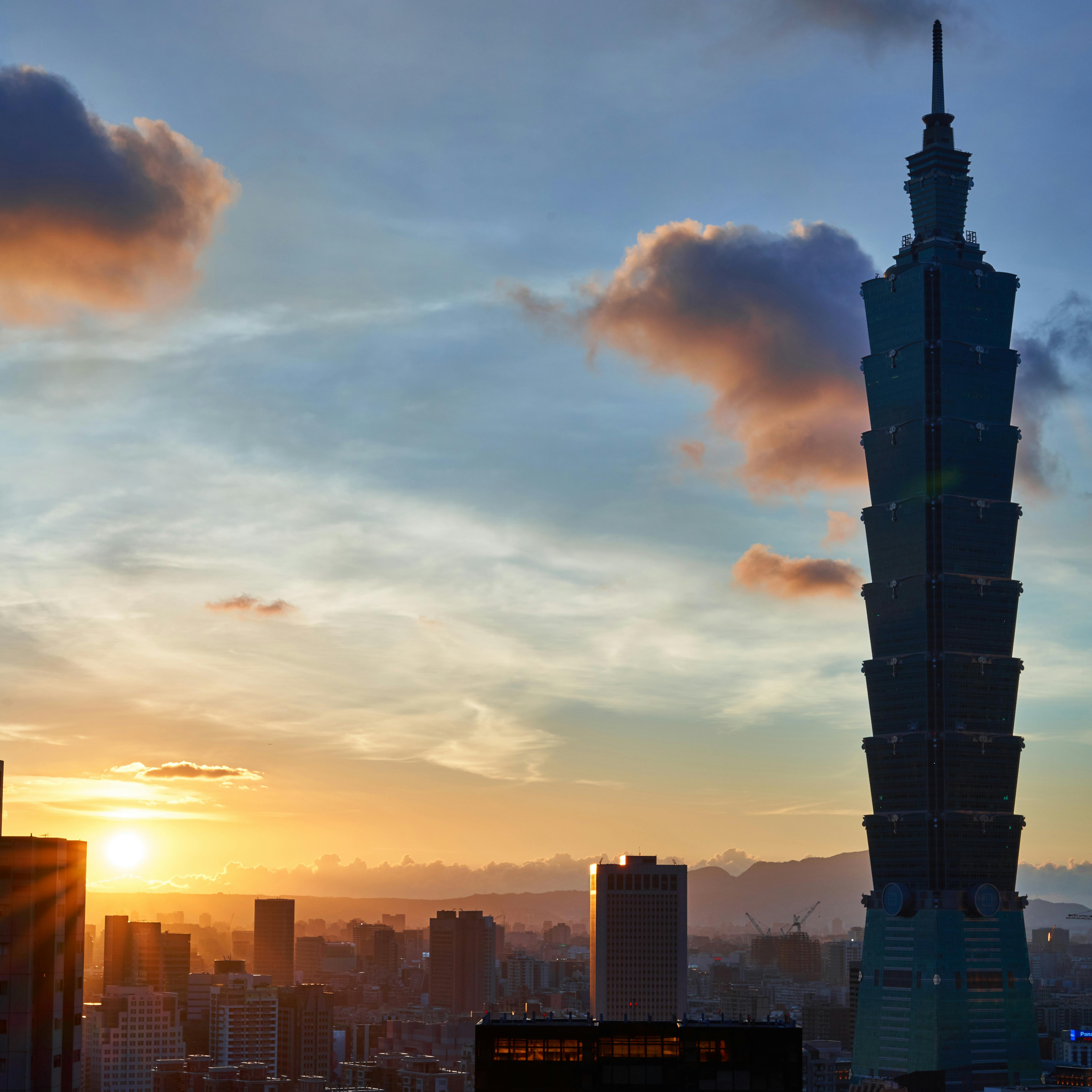
As Mei finishes her noodles and steps out into the humid Taipei evening, the neon lights of the city reflect in the puddles on the sidewalk. Above her, the skyscrapers reach for the clouds, built on a foundation of uncertainty. She isn't thinking about "strategic ambiguity" or "geopolitical friction." She is thinking about her commute, her friends, and the quiet hope that tomorrow will look exactly like today.
The silence between the warnings is where life happens. It is a silence that the rest of the world has a vested interest in maintaining, even as the drums of conflict beat louder from the horizon. The cost of a mistake is not just a dip in the stock market or a change in leadership; it is the erasing of a world that worked very hard to exist.
In the end, Taiwan is a place that shouldn't be possible according to the textbooks, yet there it is—a bright, defiant island holding its breath in the middle of a gathering storm.
:max_bytes(150000):strip_icc():focal(819x186:821x188)/Murdaugh-Family-e90854a716884d608fb6fd925e18d840.jpg)
