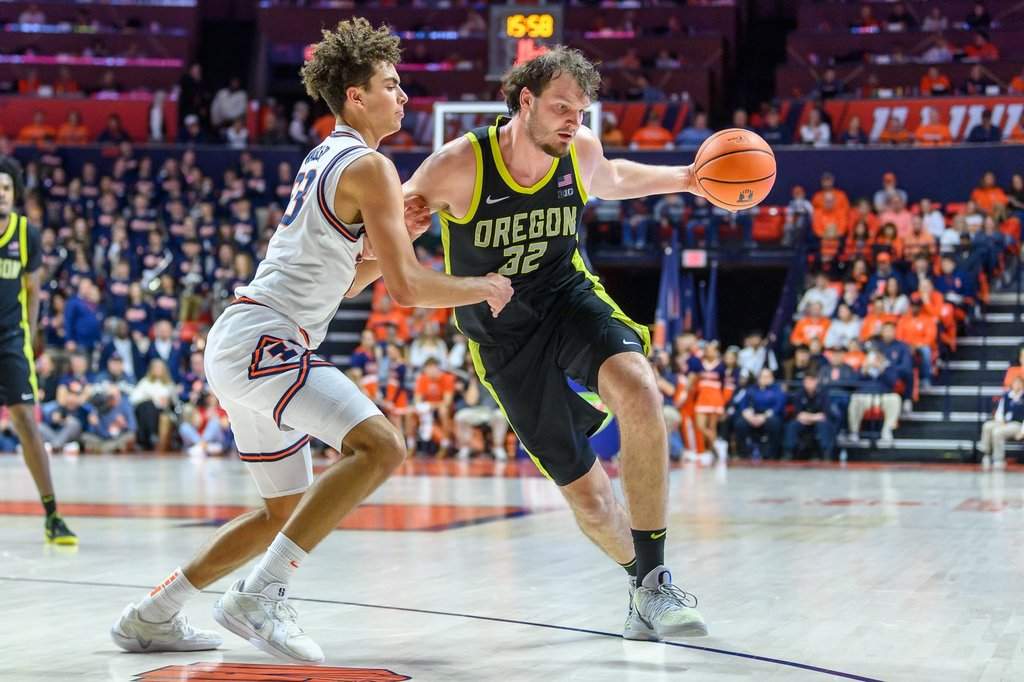
The modern NBA front office evaluates low-risk depth acquisitions through a strict lens of asset optimization and functional utility. The Toronto Raptors signing of undrafted free-agent center Nate Bittle represents a tactical deployment of the organization's remaining roster equity. By securing a 7-foot, 250-pound collegiate center who earned Big Ten All-Defensive Team honors, Toronto is betting on a specific archetypal combination: vertical rim protection and theoretical floor spacing. Rather than evaluating this signing purely on cumulative raw box-score metrics, a rigorous evaluation requires decomposing Bittle's performance indicators into predictable NBA baseline translations and recognizing how his addition alters Toronto's salary-cap flexibility and tactical flexibility.
The Two Pillars of Roster Construction Utility
Evaluating an undrafted signing requires filtering performance through two primary vectors: defensive equity and offensive efficiency variables. Bittle enters the professional ranks following a five-year collegiate career at Oregon, culminating in a senior season where he recorded 16.8 points, 6.9 rebounds, and 1.84 blocks per game across 25 contests.
1. Defensive Equity and Rim Preservation
The primary metric validating Bittle’s inclusion on an NBA summer league and training camp roster is his block rate and positioning data. During his senior campaign, Bittle averaged 1.84 blocks per game in 31.1 minutes of play. This translates to a block percentage that consistently altered interior shot selection within the Big Ten conference.
The cause-and-effect relationship between collegiate block metrics and NBA utility relies on spatial awareness and recovery speed. In a drop-coverage scheme, Bittle's 7-foot frame serves as a secondary line of defense. However, the limitation of this profile hinges on horizontal mobility. When forced into high-pick-and-roll scenarios, traditional centers face a steep drop-off in defensive efficiency due to lateral deceleration mismatches against dynamic NBA guards.
2. Offensive Efficiency and Spacing Mechanics
Offensively, the appeal of a modern center rests on their ability to execute pick-and-pop sequences or operate as a vertical spacer. Bittle attempted 4.52 three-point field goals per game as a senior, converting at a 31.9% efficiency rate.
While a sub-32% clip from beyond the arc does not immediately demand gravity from elite NBA defenses, the volume suggests a willingness to occupy the perimeter, which fundamentally alters paint congestion. The primary structural bottleneck in Bittle's offensive profile is the dichotomy between his two-point and three-point efficiency.
- Two-Point Field Goals: 5.8 makes on 12.48 attempts per game (46.5% total field goal percentage).
- Three-Point Field Goals: 1.44 makes on 4.52 attempts per game.
- Free Throw Reliability: A 73.2% free-throw conversion rate over 93 attempts indicates mechanically sound shooting forms, which scouts view as a more reliable indicator of long-term professional shooting development than raw collegiate three-point percentages.
Financial Risk Mitigation and Roster Mechanics
The terms of the agreement remain undisclosed, signaling a standard exhibit 10 or non-guaranteed training camp contract structure. This allows the Toronto front office to evaluate Bittle during the Las Vegas Summer League and subsequent training camp blocks without incurring long-term dead money on the luxury tax ledger.
This transactional design yields three operational pathways:
- Direct Roster Inclusion: Converting the contract to a standard minimum salary or a two-way slot if Bittle outperforms incumbent reserve big men during internal scrimmages.
- G-League Allocation: Waiving the player post-camp to retain his domestic rights for the Raptors 905 affiliate, thus preserving internal positional depth.
- Asset Liquidation: Releasing the asset entirely if physical testing or pick-and-roll diagnostic data reveals immediate unviability against professional speed.
The primary constraint facing Bittle is durability. His collegiate historical data shows a clear availability risk, highlighted by a nine-week absence during his junior season following left wrist surgery and appearing in only 25 games as a senior. For a 250-pound frontcourt player, upper and lower extremity structural integrity directly impacts baseline career longevity and performance consistency.
Scheme Integration Diagnostics
To project Bittle’s actualized value within Toronto's tactical ecosystem, one must analyze how his statistical footprint maps to structural team needs. The Raptors have historically prioritized length, defensive versatility, and transition speed.
Bittle's offensive profile as a senior yielded 2.6 assists per game against 2.2 turnovers. An assist-to-turnover ratio near parity (1.18) for a high-usage collegiate center signals functional passing vision out of short-roll scenarios, which is a vital prerequisite for modern high-post offenses. If Bittle can consistently execute high-low passes or hit weak-side cutters when the defense collapses, his offensive utility scales beyond that of a simple screen-and-roll finisher.
Conversely, his defensive rebounding metric—4.76 defensive boards per game—presents a minor statistical deficit for a player of his physical displacement. Securing defensive possessions is an absolute requirement for transition-heavy teams; a center who fails to clear the glass caps a team's ability to initiate early offense.
The optimal developmental path for the front office involves isolating Bittle's catch-and-shoot mechanics while subjecting his lateral movement to high-repetition defensive drills. The strategic objective is not to manufacture an elite starter, but to build a cost-controlled, analytically sound backup who can execute baseline rim-protection duties across 8-12 minute game segments without compromising floor spacing.