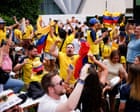
The intersection of global sporting events and highly dense diaspora populations transforms urban centers into highly decentralized economic and cultural engines. While traditional sports tourism relies on centralized infrastructure—such as stadiums, dedicated fan zones, and municipal transit corridors—metropolitan areas like New York experience a localized phenomenon: the spontaneous generation of micro-cultural hubs. These hubs, predominantly small businesses, bars, and community centers, operate as distributed fan zones. They convert cultural affinity into high-velocity local economic activity. Analyzing this system requires moving past sentimental narratives of "immaculate vibes" and instead decomposing the precise structural, economic, and geographic variables that dictate how global affinity assets monetize within a fragmented urban landscape.
The Structural Mechanics of Distributed Fan Zones
The decentralized fan network during a major tournament operates on a clear logistical framework. Unlike a single stadium that centralizes demand, a distributed network relies on high demographic density matched with specific zoning characteristics.
This model depends on three core variables:
- Diaspora Hyper-Localization: The geographic clustering of specific immigrant communities ensures an immediate, built-in base of consumers for matches involving specific national teams. For instance, sections of Queens function as primary demand hubs for South American and South Asian sporting events, while pockets of Brooklyn service European and West African fixtures.
- Commercial Friction Reductions: Traditional stadium attendance involves significant transaction costs, including high ticket prices, transit bottlenecks, and security protocols. Local commercial venues reduce these barriers to near zero, shifting the consumer’s financial allocation from access fees (tickets) to hospitality consumption (food and beverage).
- The Shared Affinity Multiplier: The psychological value of co-presence—watching an event among peers who share the same cultural stakes—creates a distinct premium. Consumers willingly accept higher-than-average premium pricing on goods and services within these venues because the environment cannot be replicated at home.
This structural reality creates a distinct network effect. As a specific venue establishes a reputation for hosting a highly engaged, culturally specific fan base, it attracts secondary and tertiary waves of consumers. This expansion moves beyond the immediate diaspora, drawing in neutral sports consumers seeking high-engagement environments.
The Microeconomic Impulse Function of Match-Day Hospitality
To understand the economic viability of these hubs, one must look at the compressed revenue generation window inherent to tournament schedules. A typical match provides a strict 90-to-120-minute operational window, bookended by short pre- and post-match phases. Local venues must optimize their operational efficiency to maximize throughput during these acute demand spikes.
The economic model shifts from standard hospitality metrics to a high-density volume play.
Inventory Turnover Speed = Total Orders / Service Window Duration
To prevent operational failure when demand peaks, establishments alter their business models through specific mechanisms:
Menu Compression and Velocity Optimization
Venues routinely reduce food and beverage options to high-margin, fast-preparation items. This modification reduces ticket times in the kitchen and accelerates table or bar turnaround, preventing a logjam in fulfillment during critical match breaks like halftime.
Spatial Reconfiguration
Physical footprints are altered to maximize standing-room capacity over seated comfort. Removing tables increases floor density, lifting the upper ceiling of per-square-foot monetization.
Labor Elasticity
Establishments scale their front-of-house staff dynamically, often relying on community networks to handle peak volume without incurring permanent structural overhead.
The revenue generated during these windows does not merely represent a temporary bonus; for many micro-retailers, these tournament cycles act as critical financial stabilizing events that offset seasonal deficits or rising commercial rents.
Geographic Determinants of Cultural Cohesion
The success of an urban distributed fan zone is fundamentally tied to its transit accessibility and structural layout. A neighborhood cannot convert cultural affinity into economic output without the proper physical infrastructure.
Hub Viability = (Diaspora Density * Transit Access Nodes) / Commercial Real Estate Rent Index
Areas characterized by mixed-use zoning, high pedestrian traffic, and proximity to major subway arteries see the highest rate of informal fan zone formation.
Jackson Heights, Astoria, and Bushwick serve as prime examples of this intersection. These environments feature a high concentration of ground-floor commercial spaces situated directly beneath or adjacent to high-density residential units. The lack of geographic distance between the consumer’s residence and the commercial venue minimizes transit friction. This proximity allows for spontaneous economic decisions, such as entering a venue mid-match based entirely on the audible crowd volume filtering onto the street.
Conversely, highly commercialized, low-density sectors—such as traditional financial districts—fail to capture this specific type of organic affinity monetization. The real estate overhead is too punitive to allow for low-margin community gathering spaces, and the commuter-heavy population clears out outside of standard operational hours, severing the link between residential proximity and collective viewing.
Institutional Limitations and Operational Bottlenecks
While the decentralized model offers significant benefits to local economies, it operates under structural constraints that limit its scalable long-term growth.
The primary limitation is regulatory compliance. Micro-cultural hubs frequently operate on the fringes of municipal capacity limits, noise ordinances, and liquor licensing laws. A sudden influx of hundreds of fans into a space zoned for a fraction of that volume introduces severe liability risks. Municipal enforcement of fire codes and sidewalk clearance laws acts as a hard ceiling on the maximum economic output a single venue can achieve.
The second bottleneck is the absolute temporal volatility of sports-driven demand. The economic engine is entirely dependent on team performance. If a national team with a large local diaspora is eliminated early in a tournament, the hyper-localized demand curve drops flat immediately.
Establishments that over-indexed on inventory, staff, or marketing for later stages of the tournament face sudden, unrecoverable capital losses. This introduces a speculative risk element to the business model, forcing operators to hedge their upfront investments against unpredictable athletic outcomes.
Strategic Realignment for Urban Planners and Commercial Alliances
To stabilize and fully leverage the economic value of distributed fan zones, municipal planners and local business improvement districts must move away from laissez-faire management. The informal nature of these hubs should be institutionalized through flexible structural frameworks.
First, cities should implement temporary, match-day pedestrian zoning in recognized cultural corridors. By closing select vehicular streets for specific high-demand match windows, the physical capacity limitations of indoor venues are alleviated. This allows businesses to expand their footprints outward into the public space legally, capturing spillover demand safely while minimizing code violations.
Second, local merchant associations must form multi-venue networks to aggregate purchasing power for broadcasting rights and commercial sponsorships. Currently, independent venues pay steep premium rates for public exhibition licensing. By negotiating as a regional collective, small businesses can lower fixed operational costs and coordinate programming to distribute crowd density evenly across a neighborhood, mitigating dangerous over-capacity bottlenecks at single flagship locations.
The future optimization of urban sports tourism lies not in building larger centralized arenas, but in refining the regulatory and physical infrastructure supporting the decentralized hubs already embedded within the city's fabric. Maximize the efficiency of these existing networks to turn cultural diversity into a resilient, predictable asset for local economic growth.


