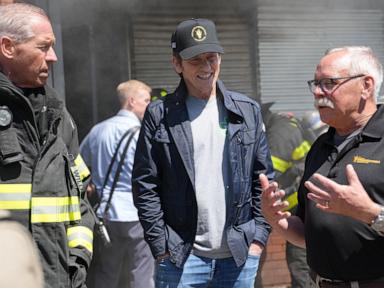
Traditional philanthropic models rely on passive capital transfer where donors provide liquidity in exchange for tax mitigation and social signaling. Denis Leary’s Leary Firefighters Foundation (LFF) disrupts this linear exchange by utilizing High-Friction Experiential Philanthropy. By placing civilians into FDNY training simulations, the foundation converts emotional resonance into capital through a three-factor mechanism: tactical immersion, operational transparency, and the monetization of specialized physical infrastructure.
The Cognitive Dissonance of Emergency Response Funding
Municipal budgets often prioritize visible infrastructure over the "invisible" maintenance of elite specialized skill sets. This creates a funding gap where the public assumes high-competency response is a baseline constant, failing to account for the depreciation of equipment and the high cost of continuous tactical training. If you liked this article, you should read: this related article.
The LFF model addresses this by forcing a confrontation with the physical realities of the profession. When a donor participates in a simulated "backdraft" scenario or handles a 175-pound rescue mannequin, the abstract concept of "firefighting" is replaced by a granular understanding of physiological stress and technical requirements. This transition from sympathy to empathy functions as a primary driver for high-net-worth individual (HNWI) retention.
The Three Pillars of Specialized Resource Allocation
The efficacy of the Leary model is defined by its ability to bridge the gap between civilian perception and operational necessity. This is achieved through three distinct pillars: For another angle on this event, check out the latest update from Reuters Business.
- Tactical Immersion: Participants engage in low-frequency, high-consequence activities. This is not "disaster tourism"; it is a controlled exposure to the stressors that define the occupation.
- Infrastructure Visualization: By utilizing FDNY training grounds, the foundation makes the "cost of readiness" visible. Donors see exactly what a $500,000 heavy-rescue vehicle or a $50,000 thermal imaging unit does in a live environment.
- Human Capital Proximity: Breaking the barrier between the civilian and the first responder allows for the transfer of "institutional ethos." The donor is no longer funding a department; they are funding a specific individual's ability to survive a flashover.
The Cost Function of Elite Preparedness
First responder organizations operate under a Zero-Failure Mandate. Unlike private enterprises where a 5% error rate might be acceptable within a risk-management framework, the cost of failure in fire and rescue is measured in mortality and catastrophic property loss.
The LFF identifies the "Equipment-Training Gap." If a department receives a grant for state-of-the-art hydraulic extraction tools (the "Jaws of Life") but lacks the budget for the 100 hours of training required to use them safely on modern carbon-fiber vehicle frames, the tool is a liability. The foundation’s strategy focuses on Total System Integration—ensuring that the hardware (equipment) is matched by the software (personnel training).
Revenue Generation vs. Operational Impact
In most non-profits, the "overhead ratio" is the primary metric of health. However, in the LFF model, the metric shifts to Readiness Multipliers.
- Linear Giving: A $10,000 donation buys basic supplies.
- Multiplier Giving: A $10,000 donation funds a specific certification for a lead trainer, who then trains 40 firefighters, effectively scaling the impact of the capital by 4,000%.
The Leary Firefighters Foundation targets these multipliers. By funding training facilities like the FDNY’s specialized burn buildings or the High-Rise Simulator, the foundation ensures that every dollar spent has a compounding effect on city-wide safety.
Scaling the FDNY Training Experience for Civilians
The "crazy idea" mentioned in the source material—subjecting donors to the rigor of the "Rock" (the FDNY Academy)—is a sophisticated play in Extreme Brand Alignment.
The FDNY brand is one of the few global identifiers of localized heroism. By inviting civilians into this "sanctum," the foundation creates a high-barrier-to-entry event. This scarcity increases the perceived value of the invitation, allowing the foundation to command higher donation tiers without increasing the marginal cost of the event itself.
Risk Mitigation in High-Impact Fundraising
The primary bottleneck in experiential philanthropy is the liability profile. Training civilians in environments involving open flame, heavy machinery, and high-intensity physical exertion requires:
- Operational Shadowing: Assigning active-duty professionals to a 1:1 or 1:2 ratio with participants to prevent injury and maintain the tempo of the simulation.
- Controlled Complexity: Scenarios are designed to look and feel chaotic while being strictly modulated by safety officers.
- Psychological Safety: Ensuring participants feel the "heat" without reaching the threshold of genuine trauma or physical exhaustion.
The "Leary Effect" and Celebrity-Led Systemic Change
Celebrity involvement in philanthropy usually follows a "Face of the Campaign" logic. Denis Leary’s approach differs because it is rooted in personal loss (the 1999 Worcester Cold Storage Warehouse fire) and operational interest. This provides the foundation with Authenticity Equity, which is more durable than standard celebrity endorsements.
The foundation does not just "raise awareness"—a vague and often useless metric. It executes Targeted Capital Infusion. By identifying specific deficits in specialized units (e.g., the FDNY’s Special Operations Command or the Worcester Fire Department’s scuba units), the LFF acts as a flexible, fast-moving alternative to the rigid, bureaucratic procurement processes of municipal government.
Identifying Systemic Inefficiencies in Municipal Procurement
City governments are often hamstrung by multi-year procurement cycles and political friction. If a new technology emerges—such as AI-driven fire modeling or advanced exoskeleton supports for heavy lifting—a city fire department may wait 3–5 years for budget approval and testing.
The LFF operates as a R&D and Rapid Deployment Arm.
- Identification: Firefighters on the ground identify a specific tool or training need.
- Validation: The foundation’s board, often composed of active or retired experts, vets the requirement.
- Procurement: The foundation purchases the equipment directly, bypassing the municipal bidding wars.
- Deployment: The equipment is donated directly to the unit, drastically reducing the time-to-implementation.
This creates a "Shadow Supply Chain" that keeps elite units at the cutting edge of technology while the municipal budget catches up to the baseline.
Limitations and Ethical Considerations of Private-Public Partnerships
While the LFF model is highly effective, it introduces specific risks to the ecosystem of public service:
- Funding Asymmetry: Departments in high-visibility cities (New York, Boston) or those with celebrity connections receive disproportionate funding compared to rural departments with higher per-capita risk.
- Dependency Risks: Municipalities may begin to under-fund specialized units, assuming that private foundations will fill the gap.
- Mission Creep: The foundation must ensure its goals align with the strategic priorities of the department leadership to avoid creating "islands of excellence" that aren't integrated into the broader fire-response grid.
The Strategic Shift: From Event to Ecosystem
The future of the Leary Firefighters Foundation lies in its ability to export this model. The FDNY training experience is the flagship, but the underlying logic—Monetizing Expertise for Infrastructure Support—is a repeatable framework for any high-skill, under-funded public sector.
To maximize the next phase of growth, the foundation must pivot from "Events" to "Platforms." This involves:
- Digital Immersion: Using VR/AR to bring the FDNY training experience to a global donor base, removing the geographic and physical capacity constraints of the New York training grounds.
- Data-Driven Impact Reporting: Moving beyond anecdotes of "helped firefighters" to hard metrics—reduction in response times, decrease in firefighter injury rates, and increased equipment uptime in funded districts.
- The First Responder Network: Creating a cross-departmental hub where the LFF facilitates the sharing of best practices and equipment between the FDNY and smaller, under-resourced departments.
The strategic play is to treat the foundation not as a charity, but as a Venture Philanthropy Fund for emergency services. This requires a move away from the "crazy idea" narrative toward a "critical infrastructure" narrative. Investors (donors) should see their contributions as a hedge against urban instability and a direct investment in the resilience of the civil social contract. The ultimate goal is a self-sustaining loop where the prestige of the training attracts the capital, and the capital ensures the prestige of the department is maintained through world-class capability.