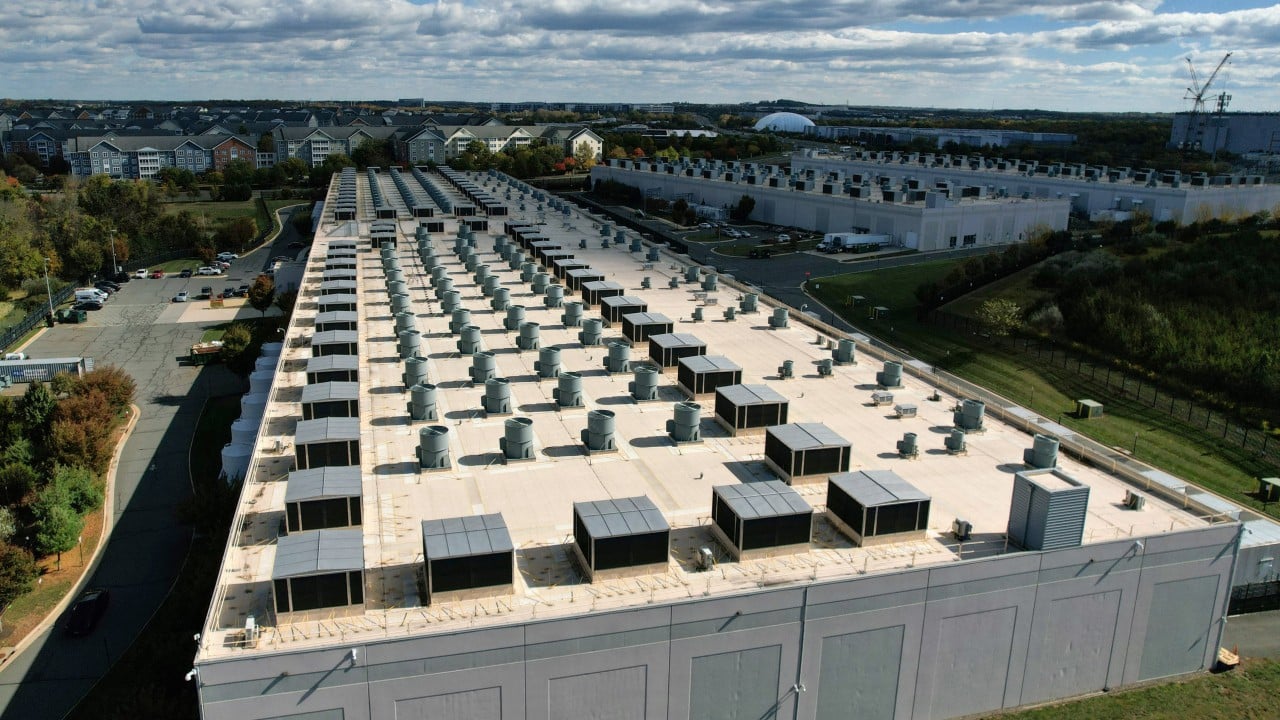
Threatening a punitive tariff on U.S. technology firms that build artificial intelligence data centers abroad introduces a structural shock to global capital expenditure models. When political rhetoric targets the geographic placement of compute infrastructure, hyperscalers face an immediate conflict between physical resource constraints and cross-border tax liabilities. Understanding the viability and operational fallout of this policy requires stripping away political theater and examining the hard engineering, tax law, and electrical grid economics governing modern AI infrastructure.
The Structural Drivers of Offshore Compute Deployment
Hyperscalers—specifically Microsoft, Alphabet, Amazon, and Meta—do not allocate billions of dollars to foreign data centers for labor arbitrage. Modern hyperscale facilities operate with minimal on-site staff, relying instead on automated orchestration and remote systems engineering. Capital flows overseas because domestic infrastructure faces three severe physical and regulatory bottlenecks. Expanding on this topic, you can find more in: Stop Panicking Over FBI Database Breaches When the Real Vulnerability Is Open Access.
- Baseload Power Scarcity: Training and serving frontier foundation models require continuous, high-density electrical loads ranging from 100 megawatts to over a gigawatt per campus. In primary U.S. hubs like Northern Virginia, Silicon Valley, and Dallas, utility interconnection queues stretch from four to seven years. Transmission infrastructure cannot expand fast enough to match silicon deployment schedules.
- Permitting and Environmental Litigation: Constructing high-voltage substations, water-cooling loops, and backup diesel or natural gas generation triggers multi-year municipal and federal reviews. Jurisdictions in the Nordic region, the Middle East, and parts of Southeast Asia offer expedited permitting alongside pre-allocated grid capacity.
- Data Residency and Latency Mandates: Sovereign regulations, such as the European Union's General Data Protection Regulation (GDPR) and localized financial compliance laws, legally require enterprise customer data to remain within specific geographic borders. Inference workloads—where trained models generate outputs for end users—must sit physically close to population centers to keep network latency below perceptual thresholds.
A border-adjusted tax on foreign data center construction directly penalizes firms for bypassing domestic grid failures. Instead of accelerating U.S. construction, a punitive levy functions as a deadweight cost on capital allocation unless paired with federal preemption of local utility and permitting bottlenecks.
Deconstructing the Tariff Mechanism on Intangible Compute
Applying traditional trade tariffs to physical goods relies on customs valuation at a port of entry. When an automaker manufactures a vehicle in Mexico and imports it into Texas, customs officials assess a levy against the declared value of the physical asset. AI data centers break this customs framework because the capital asset remains stationary overseas while the economic output—computed tokens, model weights, and cloud API calls—transmits across fiber-optic cables as weightless data packets. Observers at Wired have provided expertise on this situation.
To enforce a "tremendous tax" on U.S. firms building foreign compute clusters, policymakers would have to deploy one of three distinct legal and fiscal mechanisms, each carrying severe operational complications.
Mechanism 1: Capital Expenditure Excise Penalties
The federal government could tax the outbound flow of capital or the purchase of U.S.-designed semiconductors (such as Nvidia GPUs or custom ASICs) destined for foreign subsidiaries of U.S. parent companies. Under this model, a hyperscaler buying $5 billion in accelerators for a facility in Ireland or the United Arab Emirates would pay a direct surcharge to the U.S. Treasury.
The immediate consequence is a distortion of corporate structure. U.S. hyperscalers would cease direct ownership of foreign facilities, shifting instead to long-term leasing agreements with sovereign wealth funds or local colocation providers. By converting capital expenditures (CapEx) into operational expenditures (OpEx), firms could legally distance their balance sheets from the physical construction while retaining exclusive access to the compute capacity.
Mechanism 2: Digital Service and Compute Import Tariffs
Tax authorities could attempt to measure the volume of compute processed abroad and consumed by U.S. enterprises or consumers, levying a tariff on the value of the cross-border API traffic.
Tracking intangible compute consumption presents an insurmountable auditing problem. Distributed AI workloads routinely split tasks across multiple global regions. A single user query might undergo prompt preprocessing in Iowa, vector database retrieval in Frankfurt, and token generation in Singapore. Assigning a precise taxable origin to a fractional millisecond of distributed matrix multiplication invites endless transfer-pricing litigation and accounting obfuscation.
Mechanism 3: Modifications to Global Intangible Low-Taxed Income (GILTI)
The most legally viable pathway involves modifying existing corporate tax code provisions, specifically the GILTI regime established under the 2017 Tax Cuts and Jobs Act. Congress could eliminate foreign tax credits for revenues generated by overseas data centers or establish a punitive minimum effective tax rate on profits derived from foreign compute assets.
While administratively feasible through the Internal Revenue Service, altering GILTI requires legislative action rather than unilateral executive order. Even if enacted, this approach only captures profits repatriated or attributed to controlled foreign corporations, leaving domestic compute deficits unresolved.
The Hardware Supply Chain Paradox
A punitive tax on U.S. firms building foreign data centers creates an immediate competitive asymmetry in the global semiconductor market. Currently, U.S. cloud providers dominate global compute infrastructure, capturing the majority of enterprise AI workloads worldwide. This dominance ensures that American software ecosystems, security standards, and hardware architectures remain the global default.
If U.S. hyperscalers face a 25% to 50% tax penalty on foreign expansion, their return on invested capital (ROIC) for international regions collapses. Foreign competitors—including state-backed telecommunications firms in Europe, sovereign AI initiatives in the Gulf states, and Chinese cloud providers—face no such U.S. tax penalty.
This dynamic produces two counterintuitive outcomes:
- Erosion of U.S. Cloud Market Share: Foreign enterprises seeking local AI hosting will abandon AWS, Azure, and Google Cloud in favor of domestic sovereign clouds that do not pass punitive U.S. tax surcharges onto their customers.
- Unchecked Hardware Flows to Non-U.S. Entities: Unless accompanied by strict export controls, chipmakers will simply sell the exact same GPUs to foreign data center operators instead of U.S. hyperscalers. The compute capacity still gets built overseas, the U.S. grid still lacks power, and American firms lose control over the global infrastructure layer.
Quantifying the Cost Function of Domestic Reshoring
Forcing compute capacity back to the continental United States through tax penalties alters the unit economics of AI deployment. Hyperscalers evaluate data center locations using a Total Cost of Ownership (TCO) function dominated by four variables: server hardware depreciation, electrical power cost, cooling efficiency, and cost of capital.
Hardware represents roughly 60% to 70% of a modern AI cluster's TCO. Because GPU prices remain relatively fixed globally, power and speed-to-market dictate regional competitiveness. In regions with abundant hydroelectric, geothermal, or solar generation, industrial electricity rates frequently fall below $0.03 to $0.04 per kilowatt-hour (kWh). In constrained U.S. markets like California or the Northeast, industrial rates exceed $0.12 to $0.18 per kWh, alongside steep demand charges.
Running a 100-megawatt AI data center continuously consumes 876,000 megawatt-hours annually. A $0.08 per kWh differential adds $70.08 million in pure operating expense every single year, before accounting for the higher cooling loads required in warmer U.S. climates. When a tariff forces a firm to build in a high-cost, grid-constrained domestic market, the resulting inflation in compute pricing cascades directly down to every enterprise purchasing cloud AI services.
Operational Limitations of Protectionist Compute Policy
Strategists analyzing this policy must distinguish between manufacturing reshoring and compute reshoring. Manufacturing tariffs aim to protect domestic blue-collar employment and preserve industrial supply chains. Data centers generate minimal permanent operational employment relative to their capital footprint; a $1 billion facility typically employs fewer than 50 full-time technicians once construction concludes.
The primary strategic rationale for domesticating AI compute is national security—ensuring that frontier model weights and massive training clusters remain under U.S. jurisdiction and physical protection. However, national security objectives only apply to frontier training runs and sensitive government workloads, which represent a fraction of total global data center capacity.
The vast majority of global data center expansion supports commercial inference—running existing models to serve local users, process regional business workflows, and handle localized data storage. Penalizing U.S. firms for building commercial inference facilities in London, Tokyo, or Frankfurt achieves zero national security benefit while actively degrading the global competitiveness of the American technology sector.
Strategic Execution for Enterprise Infrastructure Leaders
Technology executives, infrastructure architects, and capital allocators cannot afford to wait for legislative clarity or judicial challenges to resolve tariff threats. Enterprise and hyperscale infrastructure strategies must adapt immediately to insulate operations from sudden cross-border tax shocks.
- Decouple Training from Inference Architectures: Centralize all foundational model training and sensitive intellectual property within domestic U.S. jurisdictions where power can be secured—specifically targeting behind-the-meter nuclear, natural gas, or stranded wind/solar assets in Texas, the Midwest, and the Pacific Northwest. Restrict international deployments strictly to localized inference endpoints.
- Shift Foreign Expansion to Asset-Light Colocation: Halt direct greenfield land purchases and wholly owned subsidiary construction in foreign jurisdictions. Execute long-term capacity leases with sovereign infrastructure funds and local real estate investment trusts (REITs). Structuring foreign compute as a service contract rather than a foreign capital asset insulates the parent balance sheet from CapEx-targeted tariffs.
- Establish Multi-Region Workload Routing: Architect inference pipelines using dynamic traffic management that can shift non-sovereign, latency-tolerant batch processing back to domestic U.S. clusters if cross-border digital service taxes are enacted. Keep only legally mandated, latency-critical workloads on foreign soil.
- Lock In Domestic Behind-the-Meter Power Agreements: Bypass municipal utility interconnection queues by contracting directly with independent power producers (IPPs). Acquiring equity stakes in or signing 15-year power purchase agreements (PPAs) with existing nuclear or combined-cycle gas plants secures domestic gigawatt-scale expansion without waiting for grid transmission upgrades.