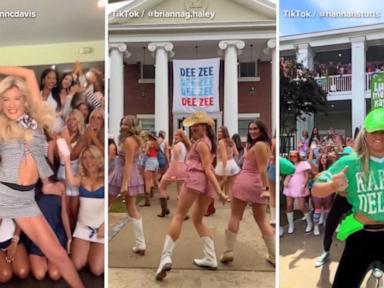
University-level Greek recruitment at major southern institutions operates as a high-stakes decentralized market failure disguised as social tradition. The annual migration of prospective new members through the machinery of sorority rush at the University of Alabama functions not as casual collegiate socializing, but as a rigid allocation system of social and digital capital. Observers frequently reduce this phenomenon to viral video trends and superficial consumerism. Beneath the aesthetic layer of outfit-of-the-day broadcasts and ring lights lies a disciplined economic ecosystem governed by matching theory, explicit capital expenditure curves, and platform monetization channels.
Understanding this system requires dismantling three core components: the cost function of recruitment participation, the microeconomics of the matching market mechanism, and the digital arbitrage that converts social exclusivity into creator economy equity. You might also find this related article interesting: Structural Asymmetry in Sino-Indian Trade The Anatomy of a Sixty Seven Billion Dollar Deficit.
The Cost Function of Sorority Recruitment
Participation in institutionalized Greek life incurs substantial upfront and recurring capital requirements. At the University of Alabama, new member fees range between four thousand one hundred and forty dollars to nearly five thousand dollars per semester, while live-in house fees escalate from seven thousand four hundred to over nine thousand dollars per term. When factoring in the mandatory wardrobe acquisition required to remain competitive across successive rounds—philanthropy, sisterhood, and preference rounds—the first-year total capital outlay frequently exceeds eight thousand dollars independent of standard university tuition.
This financial barrier acts as an initial economic filter. However, raw capital represents only one variable in the cost function. The secondary expenditure is psychological and temporal labor. Prospective new members invest hundreds of hours into specialized curation, physical presentation preparation, and emotional management. The cost function can be expressed as total participation friction, where financial outlays combine with strict adherence to normative behavioral codes to determine access probability. As discussed in recent articles by Harvard Business Review, the effects are notable.
Sororities maintain distinct overhead expenses, including facility debt service, national chapter dues, risk management insurance, and social event production. These chapters function as high-fixed-cost real estate entities. The physical chapter houses on campus represent multi-million dollar assets requiring continuous capital injections. Consequently, the pricing mechanism of membership dues directly reflects the operational overhead of maintaining elite physical infrastructure on a major public university campus.
The Matching Market Mechanics
The structural core of recruitment week operates on economic matching theory rather than traditional price-clearing market dynamics. In a standard commodity market, price adjusts until supply equals demand. In the sorority recruitment structure, prices are fixed by chapter rules, and allocation occurs through ordinal preference matching.
Prospective new members and individual chapters engage in a multi-stage sequential elimination process. Both sides submit rank-ordered preference lists following structured interaction periods. An algorithmic clearinghouse processes these lists, attempting to optimize matches based on mutual preference stability.
This environment creates severe market friction:
- Information Asymmetry: Prospective members possess incomplete data regarding internal chapter quotas, alumni influence weights, and scoring rubrics.
- High Rejection Rates: With nineteen chapters and thousands of participants, structural capacity limits dictate that a significant percentage of candidates face systematic attrition across successive rounds.
- Monopsonistic Control: Chapters hold disproportionate leverage in setting behavioral compliance standards, leaving candidates with binary outcomes of total inclusion or total exclusion.
This matching structure explains why monetary wealth alone fails to guarantee success. While capital funds the surface-level presentation layer, the matching algorithm relies heavily on peer validation, legacy status, and behavioral conformity to institutional norms. Candidates who deviate from established micro-expressions, conversational pacing, or stylistic parameters experience high rejection rates regardless of their financial capacity to pay dues.
Digital Arbitrage and the Attention Economy
The emergence of short-form video platforms transformed localized recruitment rituals into a decentralized media enterprise. Prior to digital distribution, the operations of southern Greek systems remained opaque and insular. The shift to platform-based documentation changed the strategic calculus for participants, introducing digital arbitrage into an otherwise closed system.
When candidates broadcast their recruitment preparation online, they decouple their personal utility from the local matching market outcome. A candidate who receives a rejection from a top-tier chapter traditionally suffered a localized social penalty. By broadcasting the journey to millions of external viewers on short-form video feeds, that same candidate can convert localized social failure into audience acquisition.
This dynamic alters the return on investment for participating in the process. The monetization mechanics operate through three distinct channels:
- Direct Brand Partnerships: Apparel, cosmetics, and lifestyle brands capitalize on the concentrated attention of demographic cohorts by executing high-frequency product placement deals with viral participants.
- Platform Revenue Sharing: High-volume view counts generate direct creator fund disbursements and live-stream monetization capabilities.
- Long-Term Equity Conversion: Temporary viral attention transitions into permanent personal brand equity, enabling post-collegiate careers in digital marketing, modeling, and entertainment media.
The algorithm rewards high-contrast emotional narratives, strict adherence to visual formulas, and high-frequency publishing schedules. Consequently, the content production pipeline during rush week mirrors professional television production, driven by teenagers operating as independent media entities.
Strategic Outlook
The intersection of institutional Greek infrastructure and algorithmic media distribution creates a resilient economic hybrid. As long as universities maintain large residential campuses with decentralized social hierarchies, the demand for structured belonging will remain inelastic. Chapters will continue to leverage real estate and social exclusivity to command premium dues, while participants will utilize digital distribution channels to hedge against the inherent volatility of the matching market. The system survives not despite its high friction and exclusivity, but because those exact barriers generate the attention required for modern digital monetization.
The Economics of Bama Rush
This video provides a granular breakdown of the real financial figures and structural costs associated with navigating the recruitment process at major southern universities.
http://googleusercontent.com/youtube_content/1