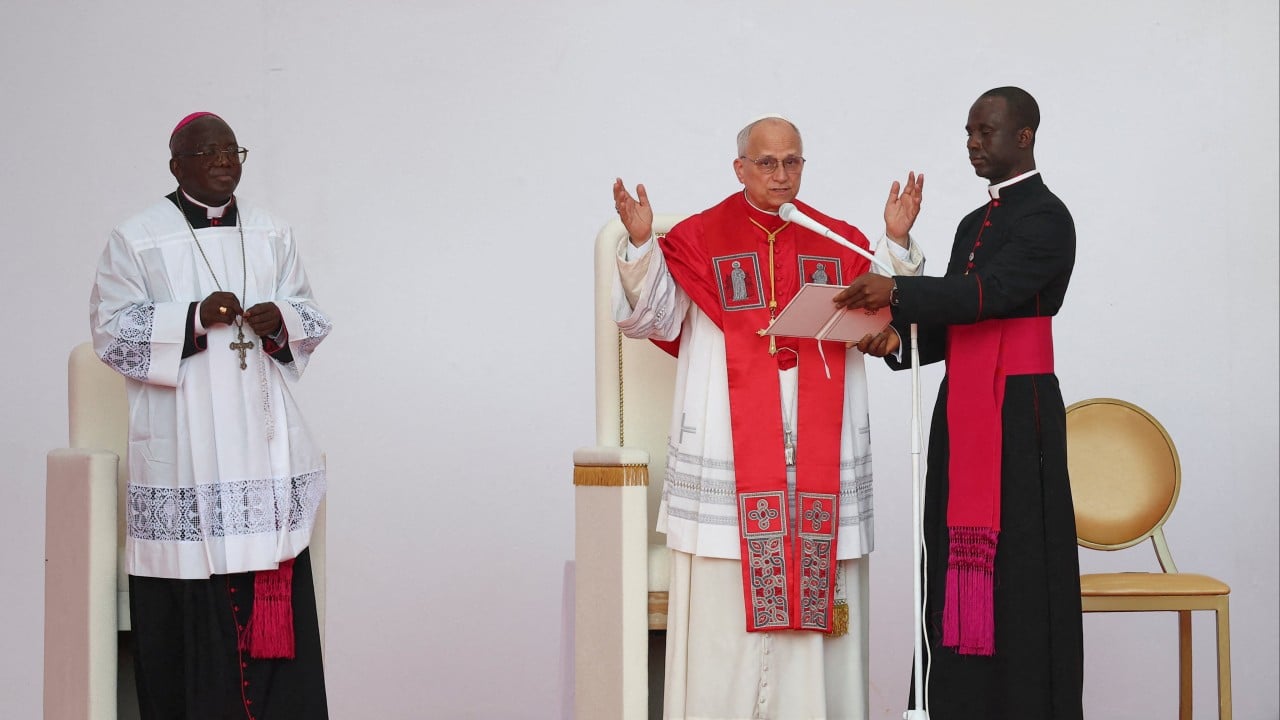
The visit of a Roman Catholic Pontiff to the Church of Our Lady of Victories in Luanda, Angola, represents a sophisticated exercise in geopolitical positioning that transcends simple religious observance. This site, a 16th-century edifice situated at the nexus of the former Atlantic slave trade, serves as a laboratory for observing the Church’s current strategy: the systematic conversion of historical liability into moral authority. By analyzing the intersection of institutional memory, the economics of the slave trade, and modern African demographics, we can map the structural transformation of the Catholic mission in the Global South.
The Tripartite Architecture of Slave Trade Logistics
The Church of Our Lady of Victories was not merely a spiritual outpost; it was a functional node in the logistical chain of the transatlantic slave trade. To understand the gravity of a papal visit to this site, one must deconstruct the three operational pillars that defined the era of Luanda’s peak activity between the 16th and 19th centuries.
- Sacramental Legitimization: The Church provided the legal and moral framework required for the mass export of human labor. Historical records indicate that enslaved individuals were often baptized in mass ceremonies at the Luanda harbor before embarkation. This was a bureaucratic necessity; Portuguese law frequently mandated that "chattel" be Christianized to ensure their souls were "saved" before the high-mortality Middle Passage. This created a dual-purpose ritual: spiritual salvation and a customs-clearing function.
- Economic Integration: The Jesuit and Dominican orders in Angola were deeply embedded in the colonial economy. The Church owned land and used enslaved labor to maintain missions, creating a feedback loop where evangelical expansion was funded by the very systems of extraction the Church now seeks to address through "purification of memory."
- Territorial Sovereignty: The construction of stone churches in Luanda served as a "flag-planting" exercise. These structures were the first permanent European footprints in the region, signaling to rival powers (namely the Dutch and the British) that the Portuguese Crown—backed by the Papacy—claimed a monopoly over both the territory and the human capital within it.
The Mechanism of Moral Arbitrage
The current Papal strategy utilizes a framework often described as the "Purification of Memory." This is not a vague apology but a calculated recalibration of the Church's brand equity. By acknowledging the complicity of the institution in the Atlantic trade, the Papacy performs a "write-down" of historical debt to secure future growth in the African market.
Africa currently represents the fastest-growing demographic for the Catholic Church. While European congregations face a terminal decline in participation rates, African dioceses are expanding. The visit to Luanda is a targeted investment in this demographic. The logic follows a clear causal chain:
- Identification: The Pontiff identifies with the historical suffering of the local population.
- Dissociation: By praying at the shrine, the current administration dissociates the modern Church from the "sins" of its colonial predecessors.
- Re-engagement: This creates a clean slate that allows the Church to act as a moral arbiter in contemporary Angolan issues, such as wealth inequality and post-civil war reconciliation.
Structural Constraints of Institutional Atonement
While the optics of a papal prayer at a slave-trade hub are potent, the efficacy of this "diplomacy of sorrow" is limited by two primary bottlenecks.
The first is the Archival Gap. The Church remains protective of its internal colonial-era records. A prayer is a symbolic gesture, but it does not equate to a full forensic audit of the wealth accumulated through mission-led agriculture and trade during the 1700s. Without the release of these records, the "Purification of Memory" remains an intellectual exercise rather than a restorative one.
The second is the Theological Conflict. The Church of Our Lady of Victories was named to celebrate Portuguese military triumphs over local African kingdoms. The name itself is a monument to conquest. The Papacy faces a linguistic and symbolic dilemma: to rename the site would be to erase history, but to maintain the name requires a complex theological gymnastics to explain how a "victory" for the 16th-century Church was a catastrophe for the ancestors of the current 18th-century congregation.
The Geopolitical Pivot to the Global South
The visit must be viewed through the lens of the "Global South Pivot." The center of gravity for Catholicism has shifted from the Mediterranean to the Congo Basin and the Andes. Angola, as a major oil producer and a nation with significant Portuguese-speaking ties, is a strategic anchor in Southern Africa.
Demographic Weight and Influence
The Vatican’s interest in Angola is driven by the following variables:
- Fertility Rates: High birth rates in sub-Saharan Africa ensure a steady supply of new congregants, contrasting sharply with the demographic winter in the Church’s traditional European heartland.
- Vocational Growth: Africa is producing a surplus of priests who are now being exported to "missionize" a secularized Europe. Angola is a key contributor to this "reverse mission" phenomenon.
- Political Mediation: In a country like Angola, where the ruling MPLA has historically had a complex relationship with religion due to its Marxist-Leninist roots, the Church acts as the only viable civil society counterbalance.
The Cost Function of Silence vs. Engagement
For the Papacy, the risk of not visiting Luanda’s slave shrines was higher than the risk of addressing the history. In the information age, institutional silence is interpreted as endorsement. Competitors—specifically Pentecostal and Evangelical movements—are rapidly gaining ground in Luanda’s urban centers by offering a "prosperity gospel" that ignores colonial history in favor of immediate financial or spiritual breakthrough.
The Catholic Church cannot compete on the "prosperity" front without appearing crass. Instead, it competes on Depth and Continuity. By leaning into the 500-year history of the Luanda shrine—even the dark chapters—the Church positions itself as the only institution with the "historical mass" to provide a coherent identity for the Angolan people. It is a play for the long-term cultural subconscious rather than the short-term emotional high of a revival tent.
Logic of the Liturgical Gesture
The act of kneeling or praying at a site of historical trauma functions as a "de-escalation" tactic in the discourse of reparations. By framing the slave trade as a "sin" requiring "divine forgiveness," the Church moves the conversation from the legal realm (reparations, lawsuits, asset returns) to the metaphysical realm (grace, prayer, soul-searching).
This shift is critical for the Vatican’s legal department. If the Church’s involvement in slavery is viewed primarily as a theological failure, the solution is theological. If it is viewed as a criminal enterprise, the solution is financial. The Papal visit is designed to ensure the former remains the dominant narrative.
Strategic Recommendation for Institutional Positioning
To maximize the impact of this diplomatic maneuver, the Church must transition from symbolic prayer to Structural Transparency. The next logical phase in this strategy involves three specific actions:
- The Decentralization of Archival Access: Establishing a research center in Luanda that houses digitized records of the Portuguese missions, allowing African historians to reconstruct their own lineage without traveling to the Vatican Secret Archives.
- Liturgical Inculturation: Moving beyond Latin-influenced ceremonies to integrate Angolan linguistic and musical traditions into the core of the mass at Our Lady of Victories. This effectively "reclaims" the space from its colonial origins.
- Economic Circularity: Directing Vatican-affiliated development funds specifically toward the communities descended from the populations once processed through the Luanda port. This moves the "Purification of Memory" into the realm of tangible social utility.
The future of the Catholic Church in Africa depends on its ability to navigate these historical scars without flinching. The Luanda visit is not the end of a process, but the deployment of a new operating system for the Church in the 21st century—one where historical culpability is the very platform upon which new authority is built.