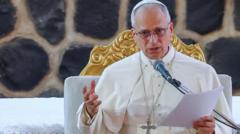
The convergence of religious authority and secular nationalism creates a volatile feedback loop that reshapes geopolitical risk. When a religious leader like the Pope critiques defense expenditures following a direct diplomatic friction with a head of state, the event transcends simple rhetoric. It represents a clash between two competing models of resource allocation: the Moral-Humanitarian Framework and the Nationalist-Security Framework. Understanding this friction requires a breakdown of the structural incentives, the opportunity costs of military spending, and the specific mechanisms of "Soft Power" utilized by the Holy See to challenge the "Hard Power" of sovereign states.
The Bifurcation of Sovereign Priorities
The tension between the Vatican and the Trump administration functions as a case study in misaligned strategic objectives. One entity operates on a multi-century timeline focused on demographic stability and ethical continuity, while the other operates on a four-year electoral cycle focused on domestic industrial protectionism and immediate military deterrence. Discover more on a related topic: this related article.
The "billions spent on wars" mentioned by the Pope refers to a specific economic diversion known as the Opportunity Cost of Militarization. In economic terms, every dollar allocated to defense systems represents a dollar removed from social infrastructure, public health, or climate mitigation. This is not merely a moral complaint; it is a critique of the Capital Efficiency of Nations.
The Defense-Social Trade-Off Mechanism
The logic follows a three-step cycle that religious entities frequently challenge: More analysis by NBC News explores related views on this issue.
- Threat Perception and Procurement: A state identifies a real or perceived threat, leading to massive capital injections into the military-industrial complex.
- Resource Displacement: To fund these injections, the state either increases debt or reduces spending on non-defense sectors.
- Social Instability: The reduction in social safety nets or basic infrastructure can lead to internal domestic unrest or mass migration—the very issues religious leaders are then tasked with managing on a humanitarian level.
When the Pope uses the term "tyrant," he is not necessarily referencing a specific dictator, but rather a system of governance that prioritizes the Security Dilemma over the Common Good. The Security Dilemma is a fundamental concept in international relations where one state's attempt to increase its security (by building up its military) causes other states to respond with similar measures, leading to a net decrease in global stability despite increased spending.
The Mechanics of Religious Influence in a Securitized World
The Vatican occupies a unique position in the global hierarchy as a non-state actor with the diplomatic status of a sovereign state. This allows it to bypass traditional trade-based diplomacy in favor of Normative Power.
Disruption of the Nationalist Narrative
Nationalist strategies rely on a clear "Us vs. Them" dichotomy to justify high military spending. By framing the issue as "Humanity vs. The Machine of War," the Pope disrupts this binary. This is a tactical maneuver designed to:
- Undermine Moral Legitimacy: It forces the state to defend its spending not just on the grounds of "safety," but on the grounds of "priority."
- Leverage Global Distribution: The Catholic Church operates through a decentralized network of bishops and parishes. When the central authority issues a critique, it is amplified through thousands of local channels, influencing voter bases in the very countries being criticized.
- Redefine the "Tyrant": In this context, tyranny is defined as the subordination of human life to the preservation of power structures.
Quantifying the Cost of Modern Warfare
To move beyond the "vague statements" often found in news reporting, one must look at the specific fiscal pressures that trigger such ecclesiastical rebukes. Global military expenditure has surpassed $2.4 trillion annually. For a religious institution that oversees extensive global charities, this figure represents a massive failure in Global Resource Optimization.
The Multiplier Effect of Conflict
Conflict does not just cost the money spent on weapons. It creates a secondary and tertiary wave of economic destruction:
- Primary Cost: Direct procurement of hardware (tanks, jets, missiles).
- Secondary Cost: Human capital destruction (loss of workforce, displacement of skilled labor).
- Tertiary Cost: Long-term reconstruction and refugee management, which often falls to NGOs and religious organizations.
The Vatican's criticism is effectively a "Cost-Shift" argument. Governments start the wars and buy the weapons (Profit-driven/Security-driven), while religious and humanitarian organizations are expected to manage the fallout (Cost-driven/Ethics-driven).
The Friction Point: Nationalism vs. Universalism
The "spat" with the Trump administration is a symptom of a deeper philosophical divergence. The Trump "America First" policy is a Zero-Sum Game strategy. It posits that for one nation to win, others must lose, or at least contribute more to the collective defense (e.g., the demand for higher NATO contributions).
In contrast, the Vatican promotes a Positive-Sum Game. Their logic suggests that if resources were diverted from military budgets to global health or education, the total global utility would increase, eventually reducing the need for military intervention by alleviating the root causes of conflict (poverty, resource scarcity).
The Bottleneck of Sovereign Debt
Many of the "tyrannies" criticized by the Pope are currently trapped in a debt-security cycle. They borrow money to buy arms to maintain power, but the debt itself makes the nation more fragile, leading to more internal dissent, which then requires more spending on internal security. This creates a Negative Feedback Loop that eventually leads to state failure.
The Pope’s rhetoric targets the Incentive Structures of these leaders. If a leader’s survival depends on military strength rather than social stability, they will always choose the gun over the grain.
The Role of Technology in Modern Rhetoric
The speed at which these "spats" occur is accelerated by digital communication. A statement made in a morning address in Rome can influence political polling in the United States or Brazil by the afternoon. This is Asymmetric Information Warfare. The Vatican does not have a standing army, but it has one of the world's oldest and most effective communication apparatuses.
By framing high-spending leaders as "tyrants" shortly after a diplomatic disagreement, the Pope uses Strategic Labeling to damage the "Brand Equity" of the leader in question. For a leader who relies on a religious or conservative base, being publicly rebuked by the head of the Church creates a significant Cognitive Dissonance among their supporters.
Limits of Ecclesiastical Criticism
While the Pope’s platform is expansive, its effectiveness is limited by the Secularization of Policy. In many modern states, economic and military decisions are insulated from moral or religious influence by layers of bureaucracy and lobbyists. The "Moral Masterclass" of the Vatican often hits a wall of Structural Realism, where policymakers believe they have no choice but to participate in the arms race or face irrelevance.
Furthermore, the Vatican itself faces internal critiques regarding its own transparency and historical wealth, which can be leveraged by secular leaders to deflect the "tyranny" label. This creates a "Glass House" dynamic where the credibility of the messenger is attacked to invalidate the message.
The Structural Path to De-escalation
To transition from the current state of "tyrannical" spending to a more stable global economy, three structural shifts must occur:
- Redefinition of National Security: Security must be measured by the Social Resilience Index rather than just firepower.
- Multilateral Disarmament Incentives: Current international law lacks a mechanism to reward a country for reducing its military budget in favor of social spending.
- Decoupling of Defense and Industry: Many economies are reliant on defense manufacturing for jobs. Until these industries are transitioned to green energy or infrastructure manufacturing, the lobby for high military spending will remain insurmountable.
The current geopolitical climate suggests that the friction between nationalist leaders and universalist religious figures will only intensify. As states become more protective of their borders and resources, the voice of the "stateless" moral authority becomes a primary source of friction.
The strategic play for any state leader in this position is to recognize that moral capital is a finite resource. Constant conflict with global moral authorities does not just lose an argument; it erodes the foundational legitimacy required to govern a diverse population. The pivot must be toward a Dual-Purpose Investment Strategy, where military R&D is repurposed for civilian technology, providing a "Security Dividend" that satisfies both the nationalist need for technological superiority and the humanitarian demand for social progress. This transition is the only viable path to mitigating the "tyrannical" label while maintaining a functional state in a fractured global landscape.