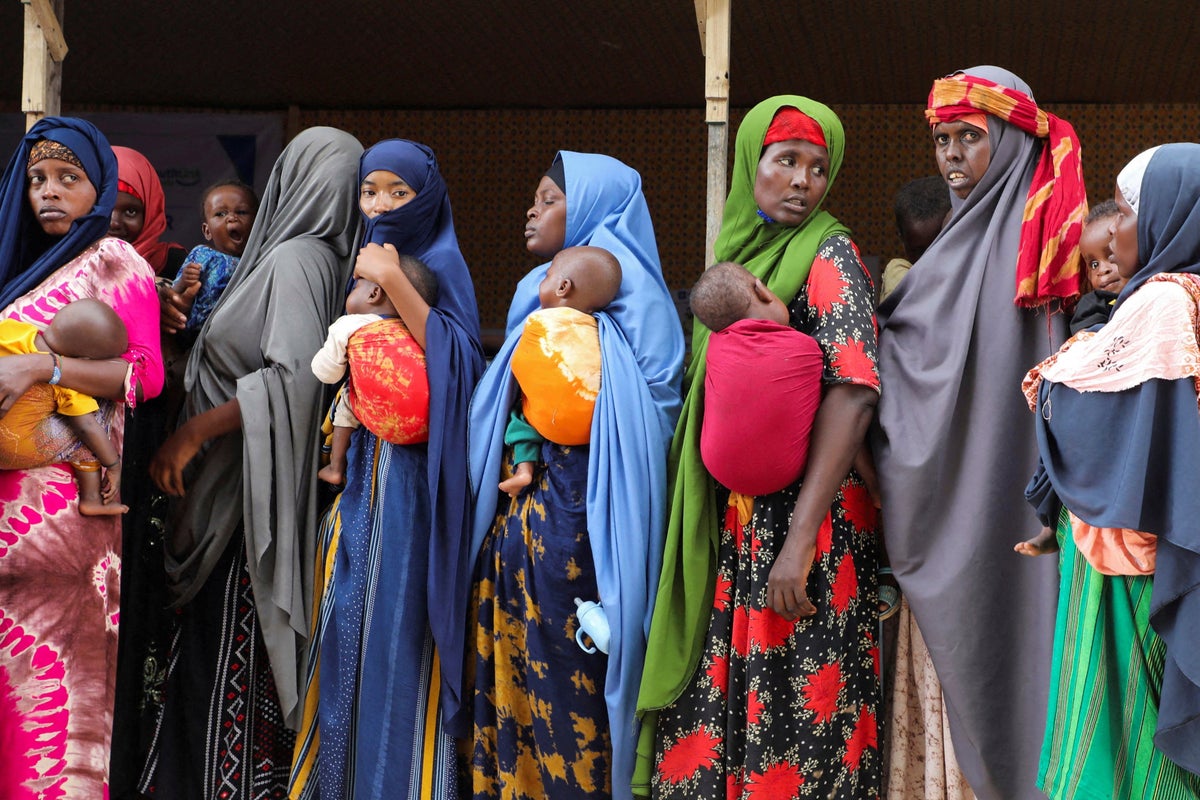
The sky over the Horn of Africa has a cruel clarity. For three years, it has been a perfect, mocking blue, scrubbed clean of any promise of moisture. Below it, the earth has turned into something resembling powdered bone. When the wind kicks up, it doesn’t smell like rain; it smells like the death of a way of life.
Consider a woman named Hawa. She is a composite of a thousand stories currently unfolding in the camps outside Baidoa, but her choices are brutally real. Hawa once owned sixty goats. In the logic of the Somali scrubland, goats are more than livestock. They are a savings account, a dowry, and a life insurance policy. One by one, they stopped producing milk. Then they stopped walking. Finally, they stopped breathing.
When the last kid died, Hawa didn't cry. She didn't have the spare fluids for tears. She gathered her children and began to walk.
The Math of a Dying Well
Somalia is currently enduring its longest and most severe drought in recorded history. We are talking about five consecutive failed rainy seasons, with a sixth currently sputtering into insignificance. The statistics are staggering, yet they often fail to move the needle of human empathy because they are too large to wrap a mind around.
Six million people are facing acute food insecurity. That is roughly half the population of the country.
To understand why this is happening, you have to look beyond the cracked earth. You have to look at the invisible strings of global geopolitics that are being pulled tight thousands of miles away. While the climate provides the spark, human policy provides the fuel.
In Washington, shifts in foreign policy have teeth. When aid budgets are slashed or redirected, the impact isn't felt in boardrooms; it’s felt in the caloric intake of a three-year-old in a displacement camp. There is a direct, measurable correlation between the tightening of international purse strings and the rising circumference of a child’s upper arm as malnutrition sets in.
The Geopolitics of Hunger
The tragedy of the Somali drought is that it isn't just an act of God. It is an act of man, compounded by neglect.
For years, the global focus has shifted. The drums of war in the Middle East, particularly the escalating tensions involving Iran, have acted as a massive vacuum, sucking away both diplomatic attention and financial resources. When a superpower prepares for a potential conflict, the "soft power" budgets—the ones that keep grain silos full in the Global South—are often the first to be sacrificed on the altar of "hard power" security.
But there is a bitter irony here. By pulling back aid to focus on containing rivals like Iran, the West creates a vacuum of its own. Hunger is the most effective recruiter in the world. A man who cannot feed his children will listen to anyone who offers him a bag of rice and a rifle. By cutting the very programs designed to stabilize these regions, we are effectively subsidizing the next generation of instability.
We are trading short-term fiscal "responsibility" for long-term global chaos.
A Chain of Broken Links
The hunger crisis is a Rube Goldberg machine of misfortune.
- The Climate Failure: The Indian Ocean Dipole—a complex weather pattern—has shifted, keeping the rain clouds trapped far to the east.
- The Economic Chokehold: Somalia imports the vast majority of its wheat from the Black Sea region. When the world’s breadbasket is on fire due to European conflict, the price of a loaf of bread in Mogadishu doubles in a week.
- The Aid Gap: As domestic priorities in the US and Europe pivot toward defense and internal inflation, the World Food Programme is forced to "triage" the starving. They are literally choosing which hungry people get to eat so that others don't have to die.
Hawa doesn't know about the Indian Ocean Dipole. She doesn't know about the diplomatic skirmishes in the Persian Gulf or the nuances of the US federal budget. She only knows the weight of her youngest son, which is becoming lighter every day.
He is four years old, but he has the skin of an old man. It hangs loose on his joints, a suit of clothes he has grown too small for. This is what we call "wasting." It is a clinical term for the body consuming itself, muscle by muscle, in a desperate bid to keep the heart beating.
The Cost of Silence
The most terrifying thing about this crisis is how quiet it is.
War is loud. It has the scream of jets and the thunder of artillery. Drought is silent. It is the sound of a goat's bell stopping. It is the sound of a footstep on dry sand. It is the silence of a mother who has run out of lullabies because her throat is too parched to sing.
We often talk about "famine" as if it is a sudden event, like an earthquake. It isn't. It is a slow-motion car crash that we have been watching for years. Experts warned of this in 2021. They shouted it in 2022. Now, in 2026, we are simply documenting the wreckage.
The "invisible stakes" here aren't just about survival. They are about the erasure of a culture. The Somali people are some of the most resilient on earth. They are poets and traders, nomads who have navigated the harshest terrain for millennia. But even the strongest steel snaps if you bend it enough times.
When a nomadic family loses their herd, they lose their identity. They move into the city or a camp. They become dependent. They become "the displaced." They are no longer the masters of the desert; they are the recipients of a plastic bowl of porridge, provided they can wait in line long enough.
The Logic of the Heart
There is a temptation to look at a map of Somalia and see a lost cause. It is easy to let the "compassion fatigue" set in. We tell ourselves that these places are always in trouble, that the problems are too deep, the politics too messy.
But that is a lie we tell ourselves to sleep better.
The crisis in Somalia is a solvable problem. It is a matter of logistics and will. In 2011, a quarter of a million people died in a Somali famine because the world waited too long to act. In 2017, a similar catastrophe was largely averted because the international community moved early and decisively.
The difference between life and death for millions isn't a miracle. It’s a bank transfer. It’s a shipment of fortified peanut paste. It’s a decision to prioritize human life over the high-stakes chess game of international military posturing.
Consider the hypothetical cost of a single day of war in the Middle East. Now, consider that the same amount of money could likely fund the entire humanitarian response for the Horn of Africa for a year.
The Last Horizon
Hawa reached the camp at dusk. The dust was so thick it turned the sun into a bloody smudge on the horizon. She had lost two goats on the way and her dignity long before that.
She stood in a line that stretched toward the darkening sky. She wasn't asking for much. She wasn't asking for a new life, or a house, or a political revolution. She just wanted a cup of clean water and the chance to see her son’s eyes focus on her face again.
The world is currently looking elsewhere. It is looking at the high-tech shadows of drone warfare and the shifting alliances of oil-rich nations. It is looking at screens and tickers and maps of "strategic interests."
But the real map of the world isn't drawn in ink. It is drawn in the tracks of people like Hawa, walking across a scorched earth, carrying the only thing they have left: the hope that someone, somewhere, will remember that they are still there.
The dust is rising. The wind is blowing. And for millions, the silence is becoming deafening.