The air in Gaza does not smell like dust anymore. It smells like history turned to powder. It smells like the pulverized bones of ancient stone, mixed with the acrid sting of sulfur and the copper tang of fresh blood. When the sun goes down over the strip, it does not set behind a horizon; it sinks behind jagged silhouettes of buildings that were apartments yesterday and mass graves today.
Let us talk about a room.
Imagine a child’s room. Not a hypothetical one plucked from a textbook, but a room where the wallpaper peels slightly at the corner because of the coastal humidity. There is a small metal bedframe with a faded blue mattress cover. On the pillow rests a plastic toy—a green truck missing one wheel. A notebook lies open on a low wooden desk, filled with Arabic alphabet practice written in clumsy, earnest handwriting. The pencil is still there, its tip sharp.
Ten minutes ago, a mother was standing in that room folding laundry. A father was downstairs, perhaps arguing playfully with an uncle about the price of tomatoes or the erratic schedule of the municipal generator.
Then, the sky split open.
There was no sound that registered as a warning. Modern ordinance travels faster than the human ear's capacity to process dread. There was only a concussive shockwave that turned the atmosphere into a solid wall, shoving organs against ribs, followed by a deafening, tearing roar as concrete slabs weighing tons sheared like dry crackers.
When the dust settled—though it never truly settles in Gaza, it just hangs suspended like a gray veil over the living and the dead—that room was gone. The blue mattress was buried under three feet of pulverized rubble. The green toy truck was crushed into the cement. The notebook was soaked through with a mixture of grey soot and something darker, warmer, deeply personal.
We are told these events in sterile metrics. A headline flashes across a screen: इज़रायल ने गाज़ा में आवासीय इमारत को बनाया निशाना, बच्चों समेत कई लोगों की बिछ गई लाशें. An airstrike hits a residential building. Children among the dead. The numbers tick upward on a ticker tape in a distant studio. Twelve. Twenty-four. Forty.
Numbers are a conspiracy against empathy. They reduce a human universe to arithmetic.
To understand what happened in that residential block, you have to look past the military communiqués and the strategic justifications whispered in air-conditioned command centers miles away. You have to look at the geometry of survival in a strip of land measuring just twenty-five miles long, where over two million people are compressed like matches in a box. Where do you run when every direction leads to a boundary, a wall, a drone humming like an angry hornet overhead, or the open sea?
There is no shelter here. That is the terror that haunts every waking and sleeping moment of ordinary civilians. In other wars, a home is a sanctuary. It is the one place where the state, the army, and the chaos of geopolitics cannot reach you. You lock the deadbolts. You pull the curtains. You make tea.
In Gaza, the home is a bullseye.
Consider the architectural irony. These buildings were constructed of concrete because concrete feels permanent. Families saved for decades, remittance by remittance, laborer's wage by laborer's wage, to pour the foundations of these multi-story apartment blocks. They built them to last through generations, to house cousins, grandparents, newborns, and newlyweds under one roof. They built them as monuments to endurance.
And in a matter of seconds, those very foundations became their tombs. The heavy reinforced steel and thick concrete slabs—designed to protect against the elements and the insecurities of a fractured life—crushed them with their own weight. The sanctuary became a trap.
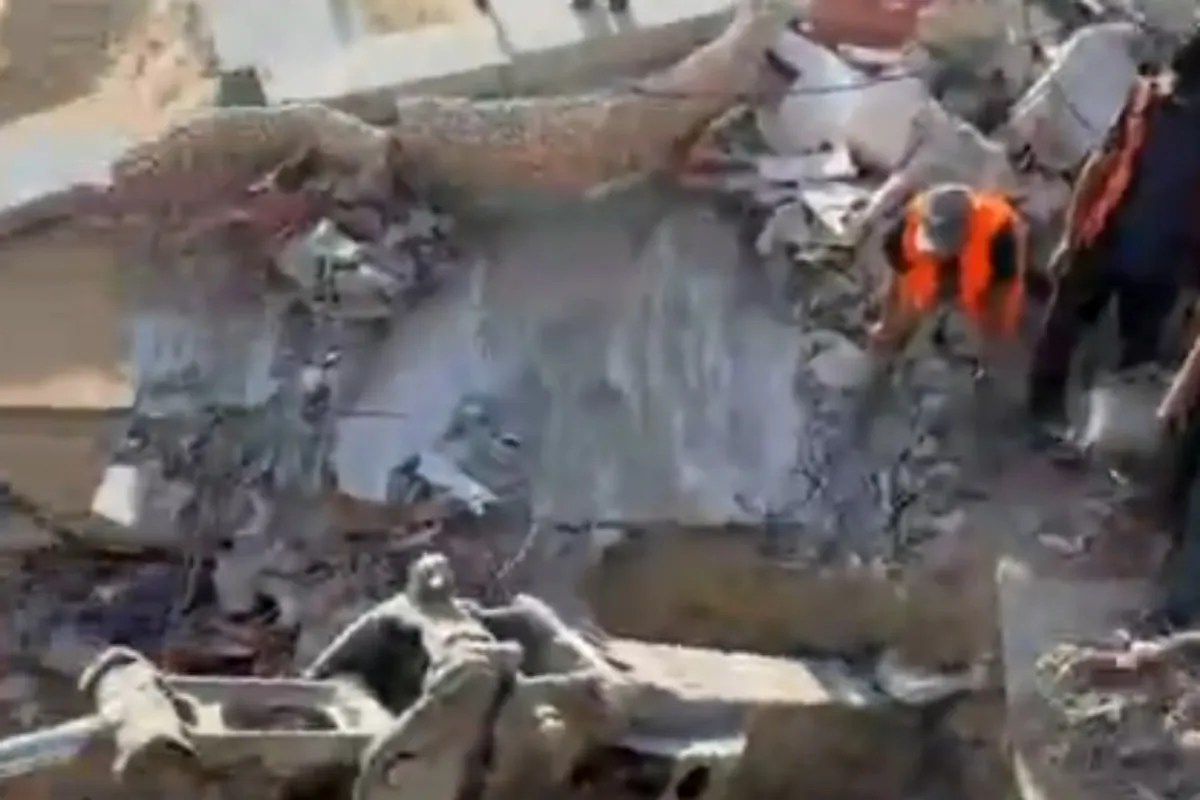
First responders arrived not with heavy machinery, but with bare hands.
This is a detail that statistics omit. When a residential building collapses from a precision strike, there are no cranes rolling down the narrow, rubble-choked alleys. There is no grid of power to run hydraulic rescue jaws. There are neighbors. There are young men with soot-blackened faces, digging with kitchen spoons, shards of broken tile, and their own fingernails.
They dig because they hear a muffled cry beneath five floors of pancake-collapsed concrete. They dig because beneath that slab of concrete is a cousin, a sister, a child who was eating rice and lentils just an hour before.
A rescuer pulls out a small foot. It is wearing a pink sock with a ruffled edge. He does not scream. In Gaza, people have passed beyond the luxury of hysterics; they have entered a state of numbed, mechanical grief. He gently brushes the gray dust from the sock, cradles the small, lifeless limb as if he were holding a sleeping infant, and passes it upward to the chain of hands waiting in the dark.
This is what a military target looks like on the ground. It does not look like a tactical node. It looks like a pink sock. It looks like a school backpack floating in a puddle of muddy water. It looks like an elderly woman’s dentures sitting neatly on a windowsill that now opens into empty air because the wall behind it has vanished into the abyss.
How do we process the routine nature of catastrophe?
We have built a global information ecosystem that processes human suffering like a stock exchange. A crisis spikes; opinions are traded; outrage is monetized; and then the market corrects, shifting its gaze to the next spectacle. Meanwhile, the survivors in that Gaza neighborhood are left sweeping up fragments of glass that used to be their kitchen windows, wondering where they will sleep tonight. Not tomorrow. Tonight. Under the open sky, wrapped in a blanket salvaged from a ruined courtyard, watching the drone lights blink red and green against the indifferent Mediterranean stars.
We must ask ourselves what happens to a world that looks at children pulled from concrete ruins and treats them as acceptable collateral damage in a ledger of power. We must confront the chilling normalization of annihilation.
The dust settles on the street, but it never leaves the lungs of those who remain. It settles in their chests, heavy and gray, a permanent reminder of an afternoon when the sky fell down and crushed a green toy truck, a notebook, and a future that was never given the chance to be written.