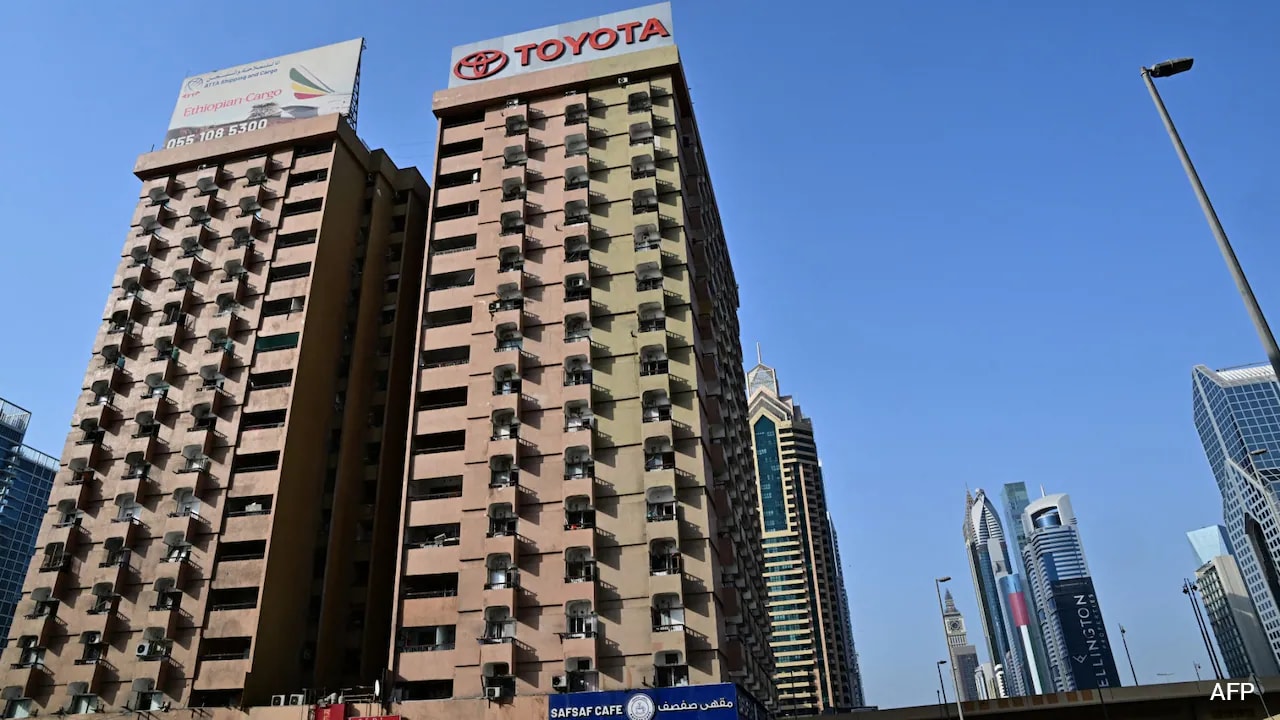
Dubai is demolishing the Nasser Rashid Lootah Building—known universally to residents and commuters as the Toyota Building—on Sheikh Zayed Road to make way for modern high-density urban redevelopment. Completed in 1974, the 15-story residential tower stood as one of the earliest high-rises along what was then a barren desert highway connecting Dubai and Abu Dhabi. For decades, its rooftop billboard advertising the Japanese automaker served as the primary geographic landmark for motorists navigating a rapidly expanding metropolis. Now, aging structural infrastructure, soaring land valuations along the city's primary commercial artery, and strict municipal safety and sustainability mandates have rendered the 50-year-old concrete frame economically obsolete.
Cities do not keep buildings out of sentiment. Not in the Gulf, at least. While European capitals wrap their mid-century concrete blocks in heritage protections and tax credits, Dubai operates on an aggressive cycle of creative destruction where plot value routinely eclipses structural utility.
The Anatomy of an Accidental Landmark
To understand why the loss of a relatively modest 15-story apartment block hits a nerve in a city famous for the 828-meter Burj Khalifa, you have to look at what Sheikh Zayed Road actually was in 1974. At the time, the road was known simply as the Defence Roundabout highway—a strip of asphalt flanked by sand dunes, scrub brush, and occasional camels.
The Nasser Rashid Lootah Building was an anomaly. Built during the initial oil boom following the formation of the United Arab Emirates in 1971, it was an audacious bet that Dubai’s urban core would eventually march south away from the Creek. For years, it stood nearly alone. Drivers used it as a compass. Before GPS, before street numbering systems were standardized across the emirate, directions in Dubai were entirely relational. You turned left at the Toyota Building. You met a client two kilometers past the Toyota Building.
The nickname itself is a textbook case of corporate branding outliving architectural identity. The giant red-and-white Toyota neon sign mounted on the roof was maintained by Al-Futtaim Motors, the brand's exclusive distributor in the UAE. Because the tower had no competing skyscrapers blocking sightlines for miles in either direction, that sign was visible from almost anywhere in the emerging business district. Over time, the developer's family name faded from daily parlance, replaced entirely by the emblem on the roof.
Inside, the building was pure 1970s Gulf pragmatism. It featured utilitarian floor plans, central air conditioning systems that were considered luxury amenities at the time, and reinforced concrete facades designed to withstand brutal summer heat and coastal humidity. It housed the first wave of white-collar expatriates, engineers, and merchants who built the modern service economy of the emirate.
The Brutal Math of Sheikh Zayed Road Real Estate
Sentimentality does not pay property yields. When you strip away the nostalgia, the demolition of the Toyota Building comes down to basic land economics and the ruthless arithmetic of floor-area ratios.
Sheikh Zayed Road between the Trade Centre Roundabout and the Dubai Marina is among the most expensive commercial corridors in the Middle East. Every square foot of land along this strip is zoned for massive vertical density. Holding a 15-story building on a prime plot adjacent to the Dubai Metro Red Line is the financial equivalent of parking a 1974 sedan in a Formula 1 pit lane.
Consider the mechanics of how real estate valuation works in mature transit corridors:
- Land-to-Building Value Ratio: In healthy urban markets, the structure represents the bulk of an asset's value. On prime Sheikh Zayed Road plots, the dirt underneath accounts for 80 to 90 percent of the total valuation.
- Floor Area Ratio (FAR) Underutilization: Modern zoning laws along the corridor allow developers to build upward of 50 to 80 stories, depending on plot size and aviation clearance. A 15-story tower leaves millions of square feet of sellable or leasable airspace completely untapped.
- Capital Expenditure Traps: Retrofitting a 1970s concrete structure to meet modern fire safety, accessibility, and energy efficiency standards often costs nearly as much per square foot as tearing it down and starting fresh.
For a private owner or institutional developer, keeping a half-century-old mid-rise running becomes a losing proposition. Rental yields from aging apartments with smaller layouts and dated mechanical systems cannot compete with the revenue generated by a newly constructed mixed-use tower offering Grade-A office space, branded residences, and luxury retail podiums.
Concrete Cancer and the Coastal Climate Problem
There is also a physical reality that rarely makes it into romantic retrospectives about old Dubai. Buildings constructed in the Gulf during the 1970s face severe structural degradation issues that buildings in temperate climates avoid.
During the first major construction boom of the 1970s, local quality control over building materials was still developing. Contractors frequently mixed concrete using unwashed desert sand and brackish water, both of which contain high concentrations of chlorides and sulfates. Combine those internal chemical impurities with Dubai’s ambient environment—where summer temperatures exceed 45 degrees Celsius and coastal humidity regularly saturates the air—and you get a textbook recipe for carbonation and chloride-induced corrosion.
Moisture penetrates the porous concrete. It reaches the steel rebar skeleton inside. The steel rusts, expanding to several times its original volume, which cracks the surrounding concrete from the inside out—a phenomenon engineers call spalling or concrete cancer.
Even with diligent maintenance, a reinforced concrete building from 1974 built under those early conditions has a finite functional lifespan. Once structural columns and load-bearing slabs require continuous, invasive patching just to pass municipal safety inspections, demolition shifts from a financial choice to an engineering necessity.
The Regulatory Squeeze on Aging Towers
Dubai Municipality and the Dubai Land Department have spent the last decade tightening the screws on older building stock. Following a series of high-profile cladding fires across the UAE in the 2010s, the UAE Fire and Life Safety Code underwent sweeping revisions.
Older towers were suddenly required to upgrade sprinkler systems, install modern smoke extraction shafts, overhaul electrical risers, and replace non-compliant exterior panels. Simultaneously, Dubai’s push toward net-zero targets and the Al Sa’fat Green Building System created strict benchmarks for thermal insulation and cooling efficiency.
A 1970s building with single-pane windows and uninsulated concrete walls bleeds cooled air into the desert heat. Retrofitting a central chiller plant and wrapping an entire facade in thermal glazing while tenants live inside is a logistical nightmare. Many landlords do the math, realize the compliance bill runs into tens of millions of dirhams, and apply for a demolition permit instead.
What Vanishes When the Wrecking Ball Swings
The removal of the Toyota Building is not an isolated incident; it is part of a broader generational turnover erasing Dubai’s first-generation modernist architecture. Over the past fifteen years, several pillars of the 1970s and 1980s skyline have either been demolished or radically altered:
- The Metropolitan Hotel: Once the social hub of early expatriate life on Sheikh Zayed Road, demolished in 2012 to make room for the Al Habtoor City mega-development.
- The Chicago Beach Hotel: A defining coastal resort of the late 1970s, torn down in 1997 to build the Jumeirah Beach Hotel and the Burj Al Arab.
- The Pearl Roundabout and Deira Clocktower adjacent blocks: Numerous early commercial blocks in Deira and Bur Dubai have quietly disappeared under urban renewal schemes.
Architecture critics and urban historians have repeatedly warned that Dubai risks suffering from historical amnesia. Every global city needs visual anchors that prove it existed before its latest economic boom. When a city erases its 1970s and 1980s layer entirely, it flattens its own timeline, making it appear as though the metropolis sprang fully formed out of the sand in the early 2000s.
There is a counter-argument, of course, and Dubai’s urban planners make it unapologetically. Dubai never branded itself as a museum city. Its global competitive advantage rests entirely on hyper-modern infrastructure, speed of execution, and frictionless business environments. Preserving a decaying 15-story apartment building purely because commuters used to look at its roof sign would run counter to the exact ethos that turned a regional trading port into a global financial capital in forty years.
The Myth of "Historic Preservation" in Hyper-Growth Cities
To be fair, Dubai has not ignored preservation altogether. The Al Fahidi Historical Neighbourhood (formerly Bastakiya) along Dubai Creek has been meticulously restored, preserving wind-tower courtyard houses from the late 19th and early 20th centuries. Similarly, the Dubai World Trade Centre (formerly the Sheikh Rashid Tower), completed in 1979 just down the road from the Toyota Building, remains protected and celebrated as a crown jewel of the city's architectural heritage.
Why does the 39-story Trade Centre survive while the 15-story Toyota Building falls?
Pedigree and scale. The Trade Centre was commissioned by the late Sheikh Rashid bin Saeed Al Maktoum, designed by British architect John Harris, and inaugurated by Queen Elizabeth II. It was built to monumental standards as a statement of national sovereignty. The Toyota Building, by contrast, was a private commercial speculative project—functional, profitable in its era, and entirely unremarkable in its architectural detailing.
Urban preservation boards worldwide draw a sharp line between monumental heritage and vernacular nostalgia. A building earns legal protection when its design represents a breakthrough in engineering or cultural identity. When a building’s primary claim to fame is a corporate billboard bolted to its roof, municipal heritage committees rarely intervene to block a private owner from redeveloping their own land.
How Demolition Works on a Crowded Highway
Tearing down a 15-story concrete tower on Sheikh Zayed Road is nothing like imploding an abandoned casino in Las Vegas. You cannot use explosives ten meters away from a twelve-lane highway carrying hundreds of thousands of vehicles a day and an elevated metro viaduct carrying thousands of commuters every hour.
Instead, contractors rely on top-down mechanical deconstruction.
Workers erect heavy-duty scaffolding and protective debris netting around the entire perimeter of the structure to contain dust and falling concrete fragments. Cranes lift compact, high-reach hydraulic excavators onto the roof slab. Working floor by floor from the top down, these machines chew through concrete walls and slabs using hydraulic pulverizers and shears, dropping rubble down internal elevator shafts to the ground floor, where loaders haul it away at night.
The process takes months rather than seconds. It requires continuous vibration monitoring on adjacent foundations and strict dust-suppression misting systems so visibility on Sheikh Zayed Road never drops. Even in death, the building has to accommodate the hyper-efficient transit corridor that outgrew it.
The Future of the Plot and the New Skyline
Once the site is cleared to grade, the plot will inevitably join the next wave of Dubai real estate. Current market dynamics along Sheikh Zayed Road point toward ultra-tall, slender towers combining branded luxury residences with boutique commercial floors—projects designed to maximize vertical square footage on tight urban footprints.
As for the giant red-and-white Toyota sign, corporate branding in Dubai has already migrated away from static rooftop neon toward massive digital LED facades, metro station naming rights, and experiential retail hubs. The rooftop billboard was a relic of an era when highway speeds were slower and visual clutter did not exist.
When the last concrete column of the Nasser Rashid Lootah Building is hauled away, long-time residents will lose their favorite geographic reference point, and the city will gain another million square feet of high-yield vertical real estate. Dubai has always traded its past for its future without looking back, and the dust settling over Sheikh Zayed Road is simply the latest invoice coming due.