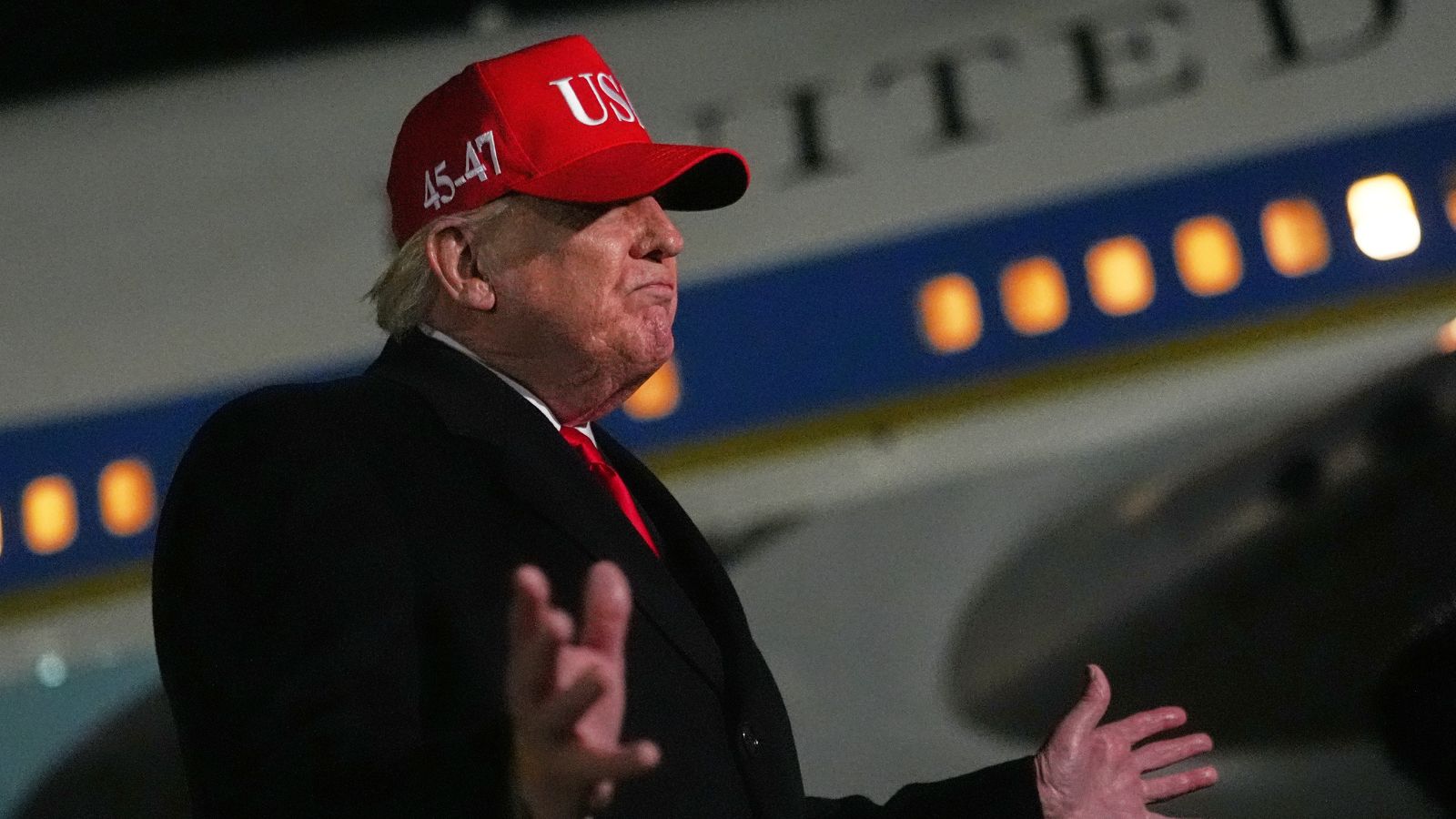
The friction between Donald Trump and the Holy See has escalated beyond mere campaign trail rhetoric, evolving into a fundamental clash between two diametrically opposed visions for Western civilization. While standard news cycles focus on Trump’s characterization of Pope Leo—labeling him "weak" and "terrible" regarding law enforcement—the underlying reality involves a structural breakdown in the long-standing alliance between American conservatism and the Roman Catholic Church. This is not just a disagreement over border security or criminal sentencing. It is a battle for the moral authority to define what "justice" looks like in the 2020s.
Donald Trump’s recent broadsides against the Pontiff represent a strategic pivot. By attacking the head of the Catholic Church on the grounds of domestic safety, Trump is attempting to peel away traditionalist voters who find themselves torn between their religious adherence to the Papacy and their political demand for rigid nationalism. The former President isn't just venting; he is testing the elasticity of religious loyalty in an era where political identity often supersedes faith. If you liked this article, you should read: this related article.
The Architecture of the Disagreement
To understand why a billionaire from Queens is publicly berating a successor to St. Peter, one must look at the specific policy friction points. Trump’s "law and order" platform stands in direct opposition to the Vatican’s current emphasis on restorative justice and the protection of migrants. When Trump calls the Pope "weak on crime," he is specifically referencing the Vatican's recent advocacy for sweeping prison reforms and the abolition of the death penalty.
The Vatican under Pope Leo has leaned heavily into a theology of accompaniment. This means prioritizing the reintegration of the marginalized over the punitive measures favored by the MAGA movement. For Trump, this approach is a "disaster" that invites chaos. For the Pope, it is a non-negotiable tenet of the Gospel. The two men are speaking different languages of power. One sees strength in the sword and the wall; the other sees strength in the open hand and the mercy seat. For another perspective on this event, check out the latest coverage from NPR.
The Border as a Theological Fault Line
No issue has fueled this fire more than the movement of people across the Southern border. Trump’s campaign hinges on the concept of a sovereign, protected perimeter. Conversely, the Pope has frequently stated that a person who thinks only about building walls and not building bridges "is not Christian."
This remark, though years old in its original form, has become the permanent backdrop for their relationship. Trump views this as an interference in American sovereignty. He argues that the Pope’s stance is not just an ecclesiastical opinion but a direct threat to the safety of American citizens. By framing the Pope as "terrible" for the safety of the country, Trump is effectively tellings his Catholic base that their spiritual leader is out of touch with the "brutal reality" of modern crime.
The Strategy of Discrediting Moral Authority
If you want to win a war of ideas, you have to disqualify the other person’s right to speak. Trump’s strategy is a masterclass in this. By labeling the Pope as "weak," he is using a specific type of political shorthand designed to resonate with a base that prizes masculine, uncompromising leadership.
In the eyes of the Trump campaign, the Vatican is acting as a globalist NGO rather than a religious institution. They point to the Holy See's alignment with international bodies on climate change and migration as evidence that the Church has been co-opted by secular, liberal interests. This narrative allows Trump to bypass the discomfort of attacking a religious icon. He isn't attacking the faith, his supporters argue; he is attacking a politician who happens to wear white robes.
The Data of Discontent
While the Vatican maintains its stance, the numbers show a shifting landscape among the American laity. Internal polling within conservative circles suggests that American Catholics are increasingly divided. A significant portion of the population—roughly 40 percent of practicing Catholics in key battleground states—report that they feel more aligned with Trump’s stance on national security than with the Pope’s stance on social justice.
This data emboldens the Trump rhetoric. He knows he has a "permission structure" to criticize the Pope because a large segment of the flock is already doing it in private. The "weak on crime" label is a hook that catches those who feel that the Church has become too soft, too focused on the rights of the accused, and not enough on the protection of the victim.
The Historical Precedent of Church State Friction
We have seen this play out before, though rarely with such vitriol. Historically, American presidents have maintained a respectful, if distant, relationship with the Vatican. Even during the Cold War, when the Church and the U.S. were aligned against communism, there were moments of tension over nuclear proliferation and interventionism in Latin America.
However, the current situation is unique because it is so personal. Previous disagreements were handled through diplomatic cables and carefully worded State Department releases. Trump has brought the fight to social media and rally stages. This eliminates the "mystique" of the Papacy, treating the Pope as just another political opponent to be branded and dismissed. It is a secularization of the religious office by a political leader who thrives on conflict.
The Role of Domestic Catholic Leadership
Caught in the middle are the American Bishops. They are tasked with maintaining loyalty to Rome while tending to a flock that is deeply invested in the Trump movement. Some bishops have quietly signaled support for Trump’s security measures, while others have vocally defended the Pope’s focus on the poor and the prisoner.
This internal fracture is exactly what the Trump campaign seeks to exploit. If the American Church is divided, its ability to act as a unified moral check on Trump’s policies is neutralized. By forcing a choice between "law and order" and "vague globalist mercy," Trump is forcing the hand of every Catholic voter in the country.
Why the "Weak on Crime" Narrative Sticks
The reason this specific attack works is that it touches on a primal fear: the loss of safety. When Trump talks about "terrible" leadership at the Vatican, he is linking it to the perceived rise in urban crime and the fentanyl crisis. He is suggesting that the Pope’s "mercy" is actually "complicity."
It is a hard-edged argument. It ignores the nuance of Catholic social teaching, which has always balanced the need for public order with the dignity of the human person. But Trump isn't interested in nuance. He is interested in the optics of a strongman versus a "weak" priest. He is positioning himself as the true protector of the family and the home, roles traditionally claimed by the Church.
The Economic Undercurrent
Beyond crime, there is an economic tension. The Pope has been a vocal critic of "unfettered capitalism," calling it a "new tyranny." To Trump, whose entire brand is built on the success of the capitalist model, this is an affront. He views the Pope’s economic critiques as an extension of a "socialist" agenda that would weaken the United States.
By combining the "weak on crime" narrative with the "terrible on the economy" subtext, Trump creates a comprehensive indictment of the current Vatican leadership. He is telling the American worker that the Pope’s worldview will make them poorer and less safe. It is a powerful, if reductive, message that resonates in the Rust Belt and the suburbs alike.
The Global Implications of the Feud
This isn't just an American story. The rift between the White House (or the prospective White House) and the Vatican has massive implications for global diplomacy. The Holy See is one of the world's oldest and most effective diplomatic machines. If Trump wins another term, the communication channels between Washington and Rome will be severely strained.
We are looking at a potential future where the United States and the Vatican are on opposite sides of almost every major international issue, from the environment to refugee resettlement to the very definition of human rights. This could lead to a marginalized U.S. influence in parts of the world where the Church remains the primary social and moral authority, particularly in the Global South.
The Counter-Argument: A Necessary Correction?
Trump’s supporters argue that his "attack" is actually a necessary correction. They believe the Church has overstepped its bounds and that someone needed to "call out" the Pope for his political interventions. From this perspective, Trump is standing up for the "silent majority" of Catholics who are tired of being told that their desire for a secure country is somehow sinful.
They point to the fact that the Vatican is a sovereign city-state with its own walls and its own security force. They see the hypocrisy in a leader who lives behind massive stone fortifications telling others to tear theirs down. For them, Trump’s "weak" comment isn't an insult—it's a statement of fact.
The Reality of the "Weak" Label
Is the Pope actually "weak" on crime? In the traditional sense of political power, the Pope has no divisions, as Stalin famously noted. His power is purely moral and persuasive. By attacking this power, Trump is attempting to show that moral persuasion is no match for "real-world" strength.
The Vatican’s approach to crime is rooted in the idea that every person is capable of redemption. This is a hard sell in a political climate defined by "eye-for-an-eye" rhetoric. Trump knows this. He is betting that, when pushed, the American voter will choose the lock and key over the hope for reform.
The Erosion of the Sacred
The most lasting impact of this conflict may be the total breakdown of the "sacred" in public life. When a candidate for the highest office in the land can call the Vicar of Christ "terrible" without immediate and career-ending backlash, it signals a massive shift in the cultural landscape. It means that the religious vote is no longer a monolith that must be courted with hushed tones and deference.
Trump has demystified the Papacy for his followers. He has made it just another "special interest group" to be managed or defeated. This is a "game" that the Vatican is not used to playing. They are used to being the ones who set the moral terms of the debate. Trump has flipped the script, setting the terms himself and demanding the Church justify its "weakness" to him.
The Path Forward for Voters
Catholics and non-Catholics alike are now forced to navigate this friction. There is no middle ground being offered. You are either with the "law and order" of the nation or the "mercy and accompaniment" of the Church. It is a false dichotomy, of course, but in the heat of a political cycle, false dichotomies are the most effective tools available.
The "weak" label will continue to be a staple of the Trump rhetoric as long as it continues to drive a wedge between the religious establishment and the populist base. It is a calculated, cold, and effective strategy.
The real question is whether the Church will respond with its own brand of "strength"—a refusal to back down from its core principles—or whether it will be forced to the sidelines by a political movement that has no room for the complexities of grace. Trump has made his move. He has defined the Pope as an adversary. In the world of high-stakes politics, once that label is applied, it is rarely removed.
The next move belongs to the pews. They will decide if "weakness" in the eyes of a politician is actually the ultimate form of strength in the eyes of their faith.
Stop looking for a truce that isn't coming. The lines are drawn, the rhetoric is set, and the collision is already underway. Determine where your own definition of "strength" lies and prepare for the fallout.
[/article]