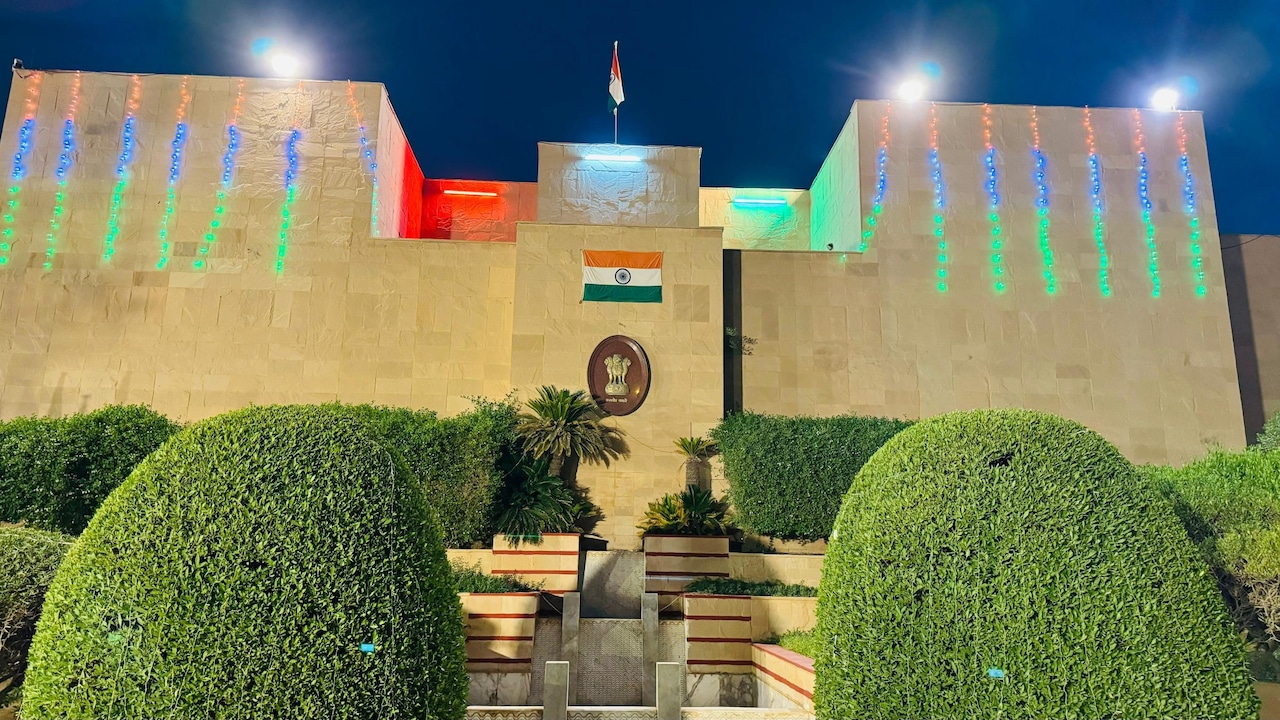
The ink on a diplomatic credential rarely smells like history, but in the summer of 2016, it carried the weight of a tectonic shift.
For decades, an unwritten rule governed the corridor of power between New Delhi and Riyadh. It was a rule born of geographical proximity and religious geography. Saudi Arabia holds the keys to Islam’s holiest sites. India houses the world’s third-largest Muslim population. Therefore, logic dictated that the man sent from India to whisper in the ear of the Saudi King must always share that Islamic faith. It was a comfortable tradition. A safe one.
Then came Ausaf Sayeed’s departure, and the ledger of tradition was abruptly closed.
New Delhi did not choose another conventional name from the standard rolodex. Instead, they selected Suhel Ajaz Khan. He was a seasoned diplomat, a man who had navigated the complex matrices of international relations from Beirut to Nairobi. He was also a Hindu.
To the casual observer scrolling through a news feed, it was a bureaucratic reassignment. A line item in a foreign ministry newsletter. But in the quiet backrooms of global statecraft, it felt like a lightning strike. For the first time since India and Saudi Arabia established formal relations, a non-Muslim would head the mission in Riyadh.
The immediate reaction from pundits was a collective gasp, followed by an anxious question. Why risk it? Why now?
The Weight of the Protocol
To understand the invisible stakes of this decision, you have to picture the daily reality of an ambassador in Riyadh. This is not a posting where you simply attend cocktail parties and sign trade agreements. The Indian ambassador to Saudi Arabia carries a specific, exhausting burden every single year: the Hajj.
Imagine a logistics nightmare multiplied by millions of souls. Every year, over one hundred and seventy thousand Indian pilgrims descend upon the holy cities of Mecca and Medina. They arrive in a state of spiritual intensity, navigating scorching heat, massive crowds, and the inevitable administrative chaos of an international pilgrimage. If a housing contract falls through in Mecca, the ambassador's phone rings. If a medical emergency strikes in the tent city of Mina, the embassy must respond.
Historically, the assumption was simple. Only a Muslim ambassador could effectively manage this because only a Muslim could physically enter the holy precincts of Mecca to inspect the arrangements. A non-Muslim diplomat would be stopped at the city limits, forced to manage a massive humanitarian and logistical operation via remote control.
Consider a hypothetical scenario to understand how this plays out in reality. A sudden flash flood hits the pilgrim camps. Roads are blocked. Communication lines dip. A Muslim ambassador can jump into an SUV, drive straight into the heart of Mecca, and use his personal authority to move local Saudi officials. A non-Muslim ambassador, bound by religious restrictions, would have to sit in an office in Riyadh, three hundred miles away, frantically making phone calls.
On paper, appointing Suhel Ajaz Khan looked like a self-inflicted handicap. It seemed to defy practical logic.
But statecraft is rarely about the obvious logic. It is about the subterranean currents that move empires.
The Paradigm Shift in Riyadh
The explanation for this unprecedented move does not actually begin in New Delhi. It begins in the mind of a young prince in Riyadh.
Crown Prince Mohammed bin Salman looked at his kingdom and saw a magnificent oil tanker heading toward an iceberg of economic irrelevance. The world was changing. Green energy was no longer a distant dream; it was an impending reality. A kingdom entirely dependent on crude oil was a kingdom built on shifting sand.
The response was Vision 2030. It was an ambitious, aggressive blueprint to strip Saudi Arabia of its ultra-conservative armor and transform it into a global hub for investment, tourism, and technology.
To achieve this, the Crown Prince needed to change how the world viewed his country. He needed to signal that the old, rigid rules were flexible. The strict religious police were stepped back. Women were given the right to drive. Concerts were held in the desert.
More importantly, the definition of diplomacy changed. For decades, the relationship between Saudi Arabia and India was viewed almost exclusively through a religious and cultural lens. India sent labor; Saudi Arabia sent oil. India sent pilgrims; Saudi Arabia provided spiritual guardianship.
But as Riyadh looked toward a post-oil future, they realized they needed a different kind of partner. They didn't just need a spiritual connection; they needed an economic engine.
India, with its booming tech sector, its massive consumer market, and its insatiable appetite for energy investment, was the perfect fit. The relationship needed to be secularized. It needed to be dragged out of the prayer hall and into the boardroom.
By sending a non-Muslim ambassador, India was not insulting Saudi sensibilities. They were paying them a profound compliment. New Delhi was effectively saying, "We believe your transformation is real. We believe you are ready to engage with us on the basis of national interest, strategic alignment, and economic synergy, rather than shared religion."
And Riyadh did not blink. They accepted the credentials without a murmur of dissent.
The Pragmatic Machinery of New Delhi
But what about the domestic angle? Politics is never absent from the diplomatic chessboard, especially not in a nation as complex and vibrantly volatile as India.
The government in New Delhi, led by Prime Minister Narendra Modi, has often been viewed through a specific ideological prism by international observers. Critics expected a move like this to be framed in the language of domestic political muscle-flexing. A assertion of majoritarian pride on the global stage.
But the reality of foreign policy under this administration is fiercely pragmatic. It operates on a cold, calculated assessment of national interest.
Look at the numbers. The trade turnover between the two nations had skyrocketed into the tens of billions of dollars. Saudi Arabia was eyeing multi-billion dollar investments in India’s petrochemical and digital infrastructure. Security cooperation, once non-existent due to Riyadh's historical closeness with Pakistan, was suddenly deepening. Intelligence sharing on counter-terrorism had become a vital lifeline.
In this high-stakes environment, the foreign ministry needed the absolute best tool for the job. They could no longer afford to limit their choice of ambassador to a specific demographic pool. They needed a technocrat. A negotiator. A hard-nosed realist who could sit across from Saudi ministers and talk sovereign wealth funds, renewable energy grids, and maritime security in the Indian Ocean.
Suhel Ajaz Khan was chosen not because of his religion, and not despite it. He was chosen because his resume matched the moment.
The message to the internal diplomatic corps was unmistakable. The glass ceiling of identity politics in key postings was shattered. Merit and specific strategic competence were now the sole currency of advancement.
Redefining the Sacred and the Secular
What happens then to the hundreds of thousands of pilgrims? What happens to the human core of the relationship that still relies on those holy cities?
The solution lies in the evolution of modern governance. Long before Khan’s appointment, the Indian consulate in Jeddah—the city just outside Mecca—had grown into a highly efficient, self-sustaining machine. The Consul General and a vast network of dedicated Muslim officers handle the day-to-day grit of the Hajj. They are the boots on the ground.
The ambassador’s role has evolved into that of an architect. He doesn't need to inspect the kitchens in Mecca personally; he needs to ensure that the bilateral treaties governing air corridors, health protocols, and financial transactions are flawlessly executed at the highest levels of the Saudi state.
The appointment of a non-Muslim ambassador did not diminish India’s commitment to its Muslim citizens. It enhanced it by decoupling administrative excellence from religious identity. It proved that a secular state can protect and serve the spiritual needs of its people through professional efficiency rather than symbolic gestures.
The New Horizon
Walk through the diplomatic quarter of Riyadh today, and the air feels different than it did twenty years ago. The old anxieties have evaporated, replaced by a frantic, forward-looking energy.
The appointment of Suhel Ajaz Khan was a quiet revolution. It did not happen with a loud declaration or a dramatic press conference. It happened through the smooth, silent turning of diplomatic gears.
It stands as a monument to a new era of global relations. An era where ancient religious divides are rewritten by the urgent demands of the future. Where two nations, deeply rooted in their respective traditions, looked past the old formulas and decided to meet each other simply as two giants on the modern stage.
The true test of a diplomat is not the prayers they say, but the bridges they build. As the lights twinkle across Riyadh and New Delhi, those bridges look stronger, wider, and more resilient than ever before.