The coffee at a San Jose Denny’s in 1993 tasted like burnt toast and desperate ambition.
Picture three engineers hunched over a sticky laminated menu, scribbling block diagrams on paper napkins while a tired waitress refilled mugs with cheap, acidic roast. No venture capital firm would return their calls. No Stanford endowment backed their play. There were no sleek glass campuses, no artisanal espresso bars, and certainly no leather jackets worn under stage lights in front of thirty thousand screaming developers.
Just Jensen Huang, Chris Malachowsky, and Curtis Priem, trying to convince themselves that a market for three-dimensional graphics chips would actually exist before their meager savings ran dry.
Fast forward thirty-three years.
When Aravind Srinivas, the young chief executive of Perplexity AI, publicly praised Jensen Huang’s thirty-three-year run at the helm of Nvidia, the tech press did what it always does. It summarized the compliment, pasted a few stock performance charts underneath, and moved on to the next news cycle. They treated a three-decade survival story like a victory lap. They missed the terror.
Because to understand why the founder of one of the fastest-growing artificial intelligence companies on earth stopped to bow his head to a sixty-something hardware engineer, you have to stop looking at Nvidia’s market capitalization. You have to look at the sheer, unnatural violence of staying alive in Silicon Valley for thirty-three years without ever losing your nerve.
The Architecture of a Stubborn Bet
Most founders are sprinters. They build a feature, ride a wave, sell to a giant, and spend their forties angel-investing from a coastal patio.
Jensen Huang never left the booth.
Consider a hypothetical founder today—let’s call her Maya. Maya raises twenty million dollars on a Tuesday morning in San Francisco to build an AI workflow wrapper. By Thursday, three competitors launch identical tools. By month six, her board is whispering about a "strategic pivot" because customer acquisition costs are bleeding her dry. In modern tech, three years feels like an eternity. Thirty-three years is geological time.
When Huang co-founded Nvidia in April 1993, the personal computer was a beige box meant for spreadsheets and word processing. Video games were flat, pixelated affairs. The idea that a specialized processor dedicated entirely to rendering polygons could eventually become the central nervous system of human intelligence sounded like lunacy.
And for the first few years, it nearly was.
Nvidia’s first chip, the NV1, was a commercial disaster. It relied on quadratic texture mapping—a mathematical approach to rendering 3D surfaces that the rest of the industry promptly rejected in favor of triangle-based polygons. By 1996, Nvidia was thirty days away from bankruptcy. Huang had to lay off more than half the company. He stood in front of the remaining employees and uttered the phrase that would become internal scripture for the next three decades: "Our company is thirty days from going out of business."
He didn't spin it. He didn't offer corporate platitudes about resilience or market headwinds. He stared at the abyss and asked Sega—their primary customer at the time—for money he hadn't earned yet, admitting their current chip wouldn't work while begging for enough cash to build the next one. Sega’s CEO, Shoichiro Irimajiri, agreed, effectively keeping Nvidia breathing on a ventilator.
That is the texture of leadership Aravind Srinivas was pointing toward when he commended Huang’s thirty-three years. Srinivas is building Perplexity in the eye of a hurricane, fighting against Google’s entrenched search monopoly and OpenAI’s massive capital war chest. When a founder in that position looks at Huang, he isn't admiring a billionaire. He is studying a survivor who survived extinction events by refusing to flinch.
The Invisible Engine Behind the Screen
To understand what Nvidia actually built, step away from the financial tickers and think about a kitchen.
Imagine a traditional central processing unit—the CPU made famous by Intel—as a Michelin-starred chef. That chef is brilliant. He can debone a duck, reduce a complex sauce, balance acidity, and plate a masterpiece. He executes intricate, sequential tasks with breathtaking precision. Put him in a room alone, and he can solve almost any culinary problem you throw at him.
Now, imagine you need to peel ten thousand potatoes before dinner service.
Your Michelin-starred chef will do it faster and cleaner than almost anyone else, one potato at a time. At midnight, you will still have eight thousand potatoes left.
A graphics processing unit—Nvidia’s GPU—is not a Michelin-starred chef. It is an army of ten thousand line cooks standing shoulder to shoulder, each holding a cheap peeler. None of them can make a soufflé. None of them know how to balance a wine pairing. They only know how to do one simple, repetitive mathematical operation.
But they all do it at the exact same millisecond.
In the late 1990s, those ten thousand line cooks were strictly hired to calculate the color and shading of pixels on a computer monitor so teenagers could play Quake at sixty frames per second. Every Wall Street analyst saw a toy company. They saw cyclical demand tied to holiday video game sales.
Huang saw something else. He realized that the math required to bounce light off a virtual surface in a video game was remarkably similar to the math required to simulate fluid dynamics, protein folding, and—eventually—neural networks.
In 2006, he made the decision that nearly got him fired by his own shareholders. He introduced CUDA, a software platform that allowed researchers and scientists to harness those ten thousand line cooks for non-graphics computing.
Wall Street hated it. CUDA cost hundreds of millions of dollars to develop. It bloated the size of every chip Nvidia manufactured, eating directly into gross margins. For years, almost nobody used it. Nvidia’s stock languished, trading flat while smartphone makers and social media platforms captured every ounce of investor euphoria. Analysts openly questioned whether Huang had lost the plot, pouring treasure into an academic curiosity while the world moved to mobile.
I remember sitting in tech briefings during the early 2010s, listening to smart, seasoned engineers dismiss Nvidia as a legacy PC component vendor slowly walking toward irrelevance. Mobile was everything. The cloud was everything. Nobody cared about heavy silicon sitting under a desk. It felt obvious at the time. Even to people paying close attention, Huang’s obsession with parallel computing looked like a stubborn refusal to admit the party had moved to another house.
Then came October 2012.
The Night the Lights Turned On
At the ImageNet computer vision competition, a researcher named Alex Krizhevsky and his advisor Geoffrey Hinton unveiled a deep convolutional neural network called AlexNet. Until that moment, teaching computers to recognize objects in photographs—distinguishing a golden retriever from a muffin—was painfully slow and wildly inaccurate.
Krizhevsky didn't use a supercomputer. He bought two consumer Nvidia GeForce GTX 580 graphics cards off the shelf, plugged them into a desktop computer in his bedroom, and used CUDA to train his neural network across those thousands of parallel cores.
AlexNet crushed the competition, cutting the error rate nearly in half.
Overnight, the entire field of artificial intelligence realized that the bottleneck holding back machine learning wasn't theory. The algorithms had existed since the 1980s. The bottleneck was compute. They needed ten thousand line cooks peeling potatoes in unison. And because Jensen Huang had spent six brutal, thankless years bleeding margin to put CUDA inside every single chip, Nvidia was the only company on earth ready to answer the phone.
It was not luck. Luck is finding twenty dollars in an old coat pocket. Spending billions of dollars a decade before your customer knows they need your product—and enduring relentless shareholder abuse while you wait—is conviction.
Why Aravind Srinivas Is Paying Attention
When Aravind Srinivas praises Huang’s thirty-three-year tenure, he is speaking from the trenches of a very specific war.
Perplexity AI sits at the bleeding edge of how humans retrieve information. Every time a user types a complex question into Perplexity’s interface, the system doesn't just retrieve a list of blue links like a 1998 search engine. It parses intent, searches live indices, synthesizes conflicting sources, and generates a coherent, cited answer in real time.
Every single one of those steps burns compute.
Without Nvidia’s architecture—the Hopper and Blackwell systems that succeeded those early gaming cards—companies like Perplexity could not exist at consumer scale. The latency would be unbearable; the cost per query would bankrupt them before lunch. Srinivas knows firsthand that modern AI software is entirely tethered to the physical reality of silicon, copper, and electricity.
Yet Srinivas’s praise goes deeper than gratitude from a customer to a supplier. It reflects a rare recognition of founder longevity in an era addicted to shortcuts.
Look at the leadership turnover across Silicon Valley over those same thirty-three years. Since 1993:
- Apple cycled through John Sculley, Michael Spindler, Gil Amelio, Steve Jobs, and Tim Cook.
- Microsoft moved from Bill Gates to Steve Ballmer to Satya Nadella.
- Intel burned through six chief executives while losing its manufacturing crown.
- Google’s founders stepped back, handing the reins to Sundar Pichai.
Meanwhile, Jensen Huang has occupied the exact same chair since the Clinton administration.
He has no traditional direct reports in the conventional corporate hierarchy—roughly sixty executives report directly to him, flat and unfiltered, because he refuses to let middle management buffer him from bad news. He still reviews product architectures personally. He still operates with the paranoid urgency of a man who remembers what it felt like to be thirty days away from locking the doors forever.
The Trap of Easy Narratives
There is a dangerous temptation, whenever a company reaches the stratosphere of global valuation, to rewrite its history as an inevitable march of genius. We love clean stories. We love pretending the winner always knew how the movie would end.
The truth is far messier, and far more instructive.
Huang didn't know in 1993 that large language models would consume gigawatts of power to write poetry and debug Python code. He didn't have a crystal ball in 2006 showing him ChatGPT or Perplexity. What he had was a first-principles understanding of where computing physics was hitting a wall.
For decades, software engineers got a free lunch. Every eighteen to twenty-four months, processor clock speeds doubled, and code automatically ran faster without anyone rewriting a single line. Huang saw that thermal limits and atomic physics were going to kill that free lunch. The only way forward was parallel processing—splitting massive workloads into millions of tiny pieces and solving them simultaneously.
He bet his company on physics, not trends.
Think about how rare that is today. Walk through any startup accelerator or corporate boardroom, and you will hear endless chatter about narratives, positioning, quarterly optics, and rapid exits. Founders optimize for the next fundraising round rather than the next decade. Executives trim research budgets to beat earnings estimates by two cents a share, mortgaging their future to appease algorithms on Wall Street.
Huang did the exact opposite. He treated public markets as a noisy distraction and ran a multi-trillion-dollar enterprise with the long-term horizon of a family-owned Japanese manufacturer.
The Weight of the Jacket
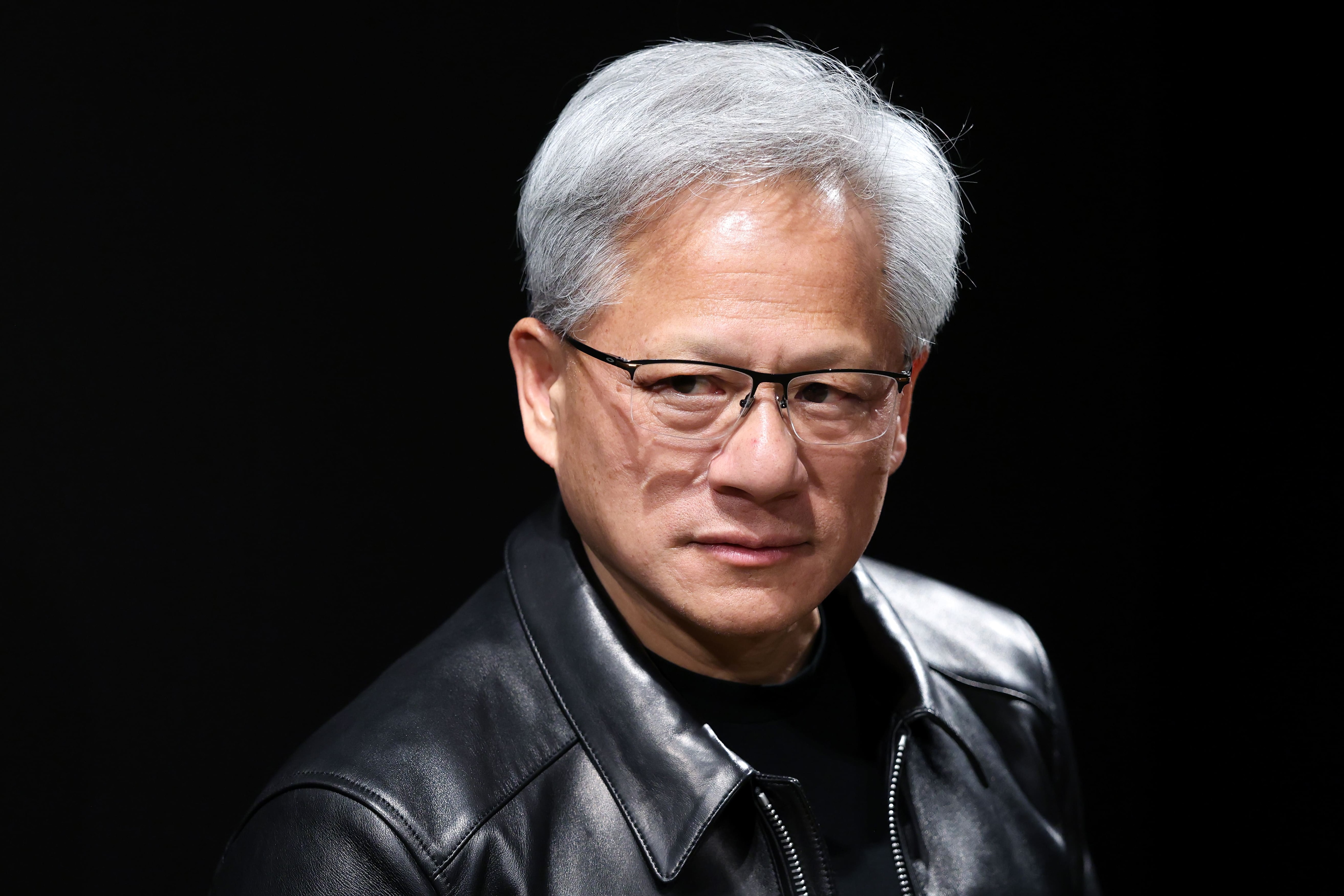
People love to talk about the black leather jacket. It has become shorthand for tech rockstar mythology—the uniform of a man who commands arenas and moves global markets with a single keynote sentence.
Look closer at the man wearing it, though, and you don't see a rockstar. You see an immigrant kid who arrived in the United States from Taiwan at age nine, got sent by mistake to a rough boarding school in rural Kentucky where he cleaned toilets every day after class, and learned early on that nobody was coming to rescue him.
That grit never washed off.
Thirty-three years in the same job changes a person. Most leaders soften. They hire layers of communications handlers to sanitize their words. They stop taking existential risks because they have too much to lose. They start protecting the castle instead of conquering new territory.
Huang’s refusal to protect the castle is precisely why competitors keep failing to catch him. Every time rivals build a chip capable of matching Nvidia’s previous generation, Nvidia isn't defending that turf—it has already abandoned it, moving on to a completely new interconnect architecture, a new networking stack, or a sovereign AI factory model that turns entire data centers into a single unified computer.
When Aravind Srinivas tips his hat to thirty-three years of bold leadership, he is acknowledging a standard that almost nobody else in modern business has been willing to endure. It is easy to be bold when you have nothing to lose in a Denny’s booth with three hundred dollars in the bank. It is infinitely harder to remain bold when the whole world is watching, waiting for you to stumble, and you choose to bet the entire house all over again.
The coffee in San Jose is better now, and the booths are cleaner. Somewhere in a corner diner tonight, three exhausted engineers are probably scribbling diagrams on a damp napkin while investors ignore their emails. The difference between them and everyone else chasing a quick payout won't show up in next quarter's pitch deck. It will show up thirty years from now, when the dust finally settles, and we see who never left the table.