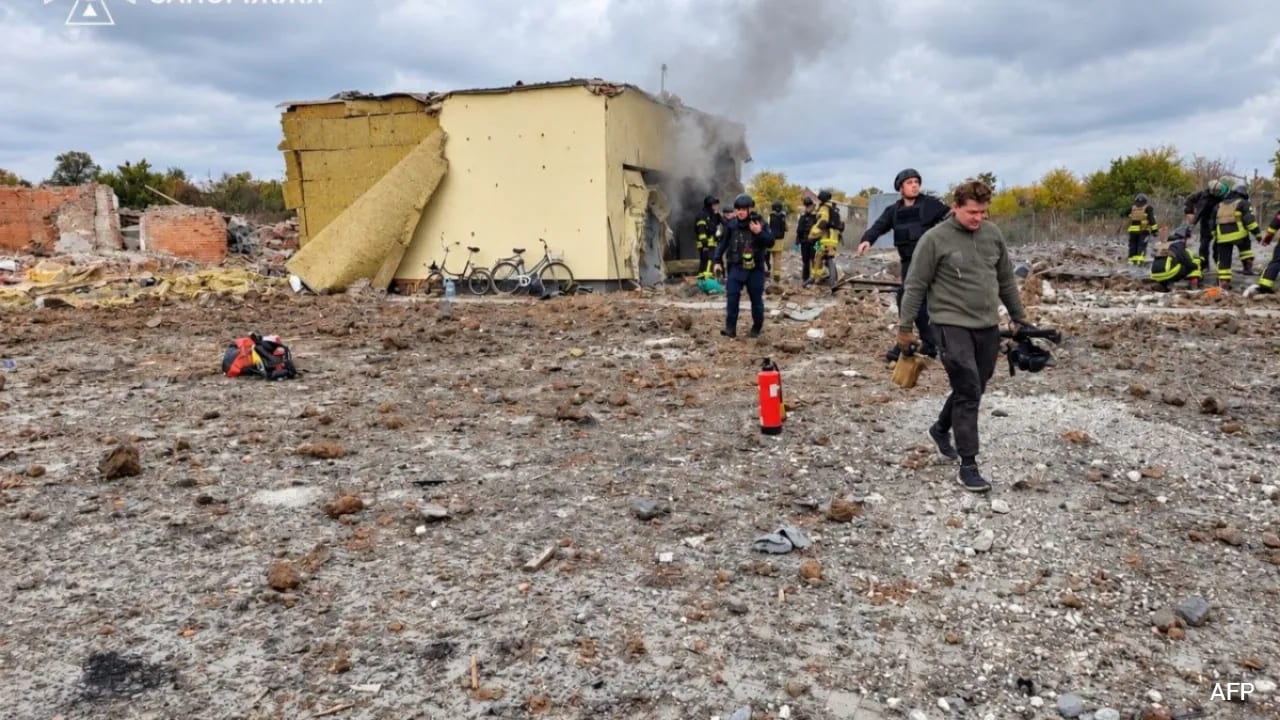
Twenty-six people died waiting in line for basic supplies. That's the brutal reality of what happens when a temporary pause in fighting ends without an actual peace framework behind it.
When news broke of the Russian strike on a Ukrainian aid distribution site—killing 26 civilians right after a ceasefire expired—most coverage focused on the immediate casualty count. You saw the headlines. You read the standard diplomatic condemnations. Also making headlines recently: What Most Coverage Misses About the Foiled Hezbollah Plot at the Homs Oil Refinery.
Yet almost nobody stopped to ask why humanitarian distribution lines keep turning into mass-casualty targets the exact moment a truce runs out. If you've followed conflict reporting or international humanitarian law over the past few years, you already know the pattern. Short-term ceasefires in active war zones don't just fail to protect civilians; they often create predictable crowds that become vulnerable the second the clock hits zero.
The Anatomy of the Strike and the Ceasefire Trap
Let's look at what actually happens on the ground during a temporary truce. People are desperate. Supply chains are broken, power grids are stressed, and local markets are empty. Further insights regarding the matter are explored by TIME.
So when an announcement goes out that the guns will stay silent for 24, 48, or 72 hours, civilians do the only logical thing they can. They come out of their basements. They walk miles to central hubs where humanitarian workers have set up distribution points for food, water, medicine, and winter essentials.
It creates a massive concentration of people in a single, static location.
Here's the problem with temporary pauses in hostilities: they have a hard expiration date, and both sides know it. Without third-party verification, demilitarized buffer zones, or binding enforcement mechanisms, a ceasefire is basically just a countdown timer. Once that timer expires, artillery and drone units already have the coordinates of active gathering spots.
In the case of the Russian strike on the Ukraine aid distribution site that killed 26 people, the timing wasn't an accident. Strikes immediately following the expiration of a truce serve a dual purpose in modern attrition warfare. First, they inflict immediate physical devastation on logistics and civilian morale. Second, they send a psychological message to anyone thinking about leaving shelter during the next announced pause.
Why Humanitarian Sites Keep Getting Hit
You might assume that international law stops armies from firing on food lines. On paper, it does.
Under the Geneva Conventions—specifically Additional Protocol I—parties to a conflict must distinguish between combatants and civilians at all times. Humanitarian relief personnel and objects used for relief operations are explicitly protected. Attacking a clearly marked aid site isn't just a tactical choice; it's a textbook violation of international humanitarian law.
Still, laws don't intercept artillery shells or glide bombs.
In Ukraine, humanitarian operations face a unique set of threats compared to conflicts from twenty years ago. Real-time reconnaissance drones hang over frontline regions 24 hours a day. Any gathering of fifty or a hundred people—even if they're clearly elderly residents carrying plastic bags for bread and canned goods—shows up instantly on an operator's thermal or optical screen.
I've seen how aid organizations try to adapt to this, and honestly, they're stuck in an impossible bind. To hand out aid efficiently to thousands of people, you need a central location with vehicle access. To stay safe from drone surveillance and long-range strikes, you need to scatter into tiny groups in hidden locations. You can't easily do both at the same time.
The Flawed Logic of Short-Term Truces
Politicians love announcing temporary ceasefires because they look like progress on evening news broadcasts. Diplomats get to claim they secured a "humanitarian window."
On the ground, though, experienced aid coordinators view unmonitored, short-term pauses with deep skepticism. Organizations like the International Committee of the Red Cross (ICRC) and the UN Office for the Coordination of Humanitarian Affairs (OCHA) have repeatedly warned that brief pauses without security guarantees often put civilians at higher risk.
Think about the logistics from a civilian's perspective:
- Information gaps: In areas without reliable cell service or electricity, people often don't know the exact hour a ceasefire ends. Many arrive late to aid lines, unaware that the window of relative safety has already closed.
- Bottlenecks: Because the window is so short, everyone shows up at once. Instead of a steady trickle of 20 people an hour, you get 300 people standing shoulder-to-shoulder in an open square.
- No retreat time: When shelling resumes abruptly, crowds in open distribution areas have nowhere to go. Basements nearby fill up in seconds, leaving dozens exposed in the open.
When a Russian strike hits a Ukraine aid distribution site right after a ceasefire ends, it exposes the fatal flaw of treating a truce like a simple on-off switch. War doesn't pause cleanly.
What Most Coverage Misses About Accountability
Whenever 26 civilians are killed in a single strike, the immediate public question is simple: Who is going to pay for this?
The uncomfortable truth is that prosecuting battlefield strikes under international law takes years, and sometimes decades. Investigators from the United Nations Independent International Commission of Inquiry on Ukraine and the International Criminal Court (ICC) have documented thousands of potential war crimes since the full-scale invasion began.
To build a case that holds up in The Hague, investigators can't just rely on news reports or social media videos. They need:
- Munition fragments recovered from the crater to prove the exact weapon system used.
- Satellite imagery showing there were no military vehicles, radar units, or troop concentrations near the aid site at the time of impact.
- Intercepted communications or command logs proving the strike was ordered deliberately or with reckless disregard for civilian life.
- Eyewitness testimonies cross-checked against timestamps and hospital records.
Even with all that evidence, arresting the commanders responsible remains extraordinarily difficult while a conflict is still active. Accountability is a long game, while the threat to aid workers is immediate.
How Aid Delivery Is Changing to Survive
Because central distribution hubs have proven so deadly, humanitarian groups operating near the front lines in Ukraine are quietly rewriting their playbooks. If you look at how local volunteer networks and major NGOs operate today compared to the early days of the war, the shift is dramatic.
Instead of announcing public distribution times at town squares or community centers, teams increasingly rely on decentralized "last-mile" delivery. Volunteers drive smaller, unmarked vehicles directly to individual streets or apartment blocks, dropping off pre-packed boxes in minutes before moving on.
Text message alerts and encrypted local chat groups replace posters on community bulletin boards. Rather than telling 500 people to show up at 10:00 AM, coordinators stagger arrivals in groups of ten, keeping crowds from ever forming in the first place.
It's slower. It burns through more fuel, requires more drivers, and costs significantly more per ton of aid delivered. Yet when 26 lives can be lost in a single blast the moment a ceasefire expires, speed and efficiency take a back seat to basic survival.
Practical Ways to Support Safe Humanitarian Work
If you're reading about strikes on aid sites and wondering how to make sure your support actually helps rather than unintentionally putting people in harm's way, focus on how organizations operate on the ground.
First, look for groups that fund local Ukrainian volunteer networks directly. Local teams know the terrain, understand shifting artillery patterns, and can pivot their delivery methods in hours rather than waiting weeks for headquarters approval.
Second, prioritize organizations that invest in protective gear and armored transport for frontline aid workers. Standard charity overhead metrics often penalize groups for spending money on flak jackets, helmets, jamming equipment, or reinforced vehicles, yet those exact expenses are what keep aid workers alive long enough to deliver food.
Third, pay close attention to the terms of any future diplomatic ceasefires you see celebrated in the headlines. Ask whether the agreement includes independent monitors on the ground, clear buffer zones around civilian infrastructure, and genuine penalties for violations—because without those pieces in place, a temporary truce is just a dangerous illusion.