The pine needles don't burn first. They vaporize.
When the heat hits a certain threshold—somewhere around three hundred degrees Celsius—the volatile oils trapped inside the resin of southwestern France’s maritime pines don't wait for a spark. They ignite into a shimmering wall of orange gas that hovers a meter off the forest floor.
In the dry pine forests of Gironde and along the scorched ridges outside Madrid, that thermodynamic threshold wasn't just crossed; it was shattered. Within forty-eight hours, more than eighty thousand people found themselves running from a horizon that had turned the color of bruised iron.
Consider a tourist named Marc, a hypothetical composite of the thousands who had packed their cars along the Atlantic coast near the Dune of Pilat. He had spent the morning complaining about the humidity. By three in the afternoon, the sky behind his campsite didn't look like sky anymore. It looked like an unlit furnace, thick with soot that tasted faintly of resin and ancient dirt. The campgrounds were ordered clear in minutes. Sirens didn't blare so much as scream, competing against the unnatural roar of a crown fire—a fire that travels not along the brush, but leaping from treetop to treetop at thirty miles an hour.
Panic is quiet before it gets loud. First comes the surreal stillness of packing a suitcase with items that suddenly feel absurd. A swimsuit. A half-read paperback. A charger. Then the realization sinks in: none of this matters. Throw it in the trunk. Drive.
The roads out of Gironde became crawling veins of red taillights under an afternoon sky as black as midnight. Across the border in Spain, the scene played out with tragic symmetry. In the hills surrounding Madrid, dried out by months of relentless heatwaves and drought, the flames tore through shrubland with terrifying speed.
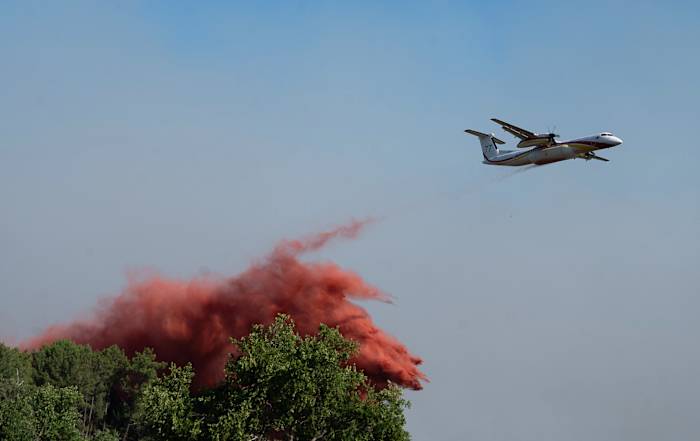
Firefighters fought on two fronts, but fighting a wildfire of this scale is like trying to put out a blast furnace with a garden hose. Water bombers dipped dangerously low over lakes and coastal waters, scoop, lift, drop, repeat, while ground crews cut firebreaks through soil so parched it kicked up dust like flour.
Why now? Why with such ferocious intensity?
The answer lies in the slow accumulation of invisible strain. Europe had been baking under a dome of dry, stagnant air for weeks. Soil moisture levels had dropped to historic lows. When vegetation reaches that level of desiccation, it ceases to act as biomass and begins to act as accelerant. A discarded cigarette butt, a glass bottle acting as a magnifying lens, or a lightning strike—it barely matters what lights the fuse when the entire region has been transformed into tinder.
More than eighty thousand evacuations mean eighty thousand sudden departures from normalcy. Gymnasiums turned into makeshift shelters. Sports halls filled with rows of green cots. Strangers sharing thermal blankets, checking their phones every three minutes for news of a street, a block, a house.
Disaster strips away the non-essential. It forces a brutal math: what can you save in ninety seconds? A pet. A photo album. A child's hand held tight in the smoke.
On the front lines, the work was grueling, suffocating, and unrelenting. Firefighters worked thirty-hour shifts, their yellow jackets blackened, eyes bloodshot behind goggles. They didn't speak of victory; they spoke of containment. Holding a line across a two-lane highway. Praying the wind wouldn't shift before dawn.
When the smoke finally begins to thin—and it eventually does—it leaves behind a landscape changed beyond recognition. Not just charred trunks and ash, but a profound quiet. The birds don't return immediately. The wind sounds different moving through burnt branches than it does through leaves.
The fires in France and Spain were eventually contained through sheer physical effort, tactical backburns, and a long-awaited shift in the wind. But the ash settled over something permanent in the collective memory of those who fled. They learned how quickly the comfortable, predictable rhythms of a European summer can dissolve into a sprint for survival against the raw power of an overheated world.
A car door slams in the quiet evacuation lot. A key turns. And on the horizon, the last thin plume of gray drifts slowly into a clear, mocking blue sky.


