The heat off the asphalt does not care about history. It rises in shimmering waves, distorting the shapes of the thousands huddled along Enghelab Street, turning a massive sea of human grief and political theater into a mirage.
Imagine standing in a crowd so dense that your ribs press against a stranger’s shoulder blade with every collective breath. The air smells of rosewater, exhaust fumes, and the heavy, sweet scent of wild rue burning in small metallic braziers. For hours, the crowd has moved like a slow, dark river. Everyone is wearing black. The sun overhead is relentless, beating down on a city that has effectively paused its heartbeat to witness the passing of an era.
When a head of state dies, the international press scrambles to analyze succession charts, military readiness, and geopolitical friction. They treat nations like massive, abstract chessboards. But on the ground, the reality of a massive state funeral is measured in smaller, bruising details. It is found in the blisters forming on the feet of people who walked through the night from distant villages. It lives in the cracked voice of an old man shouting laments into a megaphone until his throat bleeds. It is visible in the nervous glances of shopkeepers who have pulled down their iron shutters, wondering what the morning after tomorrow will look like.
This is the anatomy of a nation in suspension.
The Architecture of Public Grief
To understand the sheer scale of this moment, one must look at how space changes. Tehran is usually a chaotic metropolis defined by the frantic weaving of motorbikes and the screech of old taxis. Today, the vehicles are gone, replaced by a human carpet that stretches from the university gates down to the grand squares.
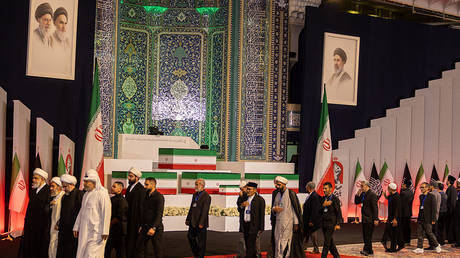
Huge cranes lift massive portraits of the late leader into the sky, suspended above the crowds like silent giants watching over their own mourners. The images are ubiquitous. They look down from the sides of concrete apartment blocks, they flash on giant digital billboards, and they are held aloft on thousands of wooden placards.
Consider a hypothetical family sitting on the curb just outside the main procession path. Let us call the father Reza, a middle-aged mechanic from the southern districts, and his daughter Maryam, a university student born long after the foundational fires of the state were lit. For Reza, the death of the supreme leader is a tremor that shakes the very bedrock of the world he has known for decades. For Maryam, it is a moment of profound uncertainty, a door opening into an blank room. They sit together in silence, sharing a warm bottle of water, watching the tide of mourners pass.
This generational divide is not a statistical abstraction; it is sitting on a concrete curb in the middle of a sweltering afternoon. Reza looks at the portraits with a complex mixture of reverence and memory of past struggles. Maryam looks at her phone, watching how the rest of the world is reacting to the news breaking across their borders. Two distinct versions of one country, standing in the same square, breathing the same smoky air.
The Soundscape of Transition
The noise is a physical force. It begins as a low, rhythmic thumping—thousands of palms striking chests in unison, a traditional cadence of mourning that acts as the metronome for the entire city. The sound echoes off the concrete facades, creating a dull, hypnotic roar that buries individual conversations.
Periodically, the rhythmic chanting breaks. A voice over a massive speaker system, distorted by static and volume, leads the crowd in prayers. The phrases are familiar, ancient, and heavy with theological weight. When the crowd responds, the collective voice is loud enough to vibrate the glass panes of the nearby bookshops.
But the real story of the day is found in the sudden, brief pockets of silence.
Between the organized chants, when the speakers cut out for a moment to transition to another track, a heavy quiet drops over sections of the crowd. In those seconds, you can hear the rustle of plastic water bottles being crushed underfoot. You can hear the sigh of a woman adjusting her chador. You can hear the distant drone of a helicopter circling high above the Alborz mountains, watching the perimeter.
That silence is where the anxiety lives. The chants provide a script, a comfortable rhythm that tells everyone exactly what to do and how to behave. The silence forces everyone to think about the vacuum left behind.
The Mechanics of the Procession
Moving a body through millions of emotional people requires an extraordinary logistical effort. The coffin, draped in the national flag and covered in flowers, is mounted on a heavily reinforced truck that moves at a snail's pace through the human sea.
People surge forward. They want to touch the vehicle. They throw white scarves toward the guards standing on the roof, hoping the fabric will be brushed against the coffin to return to them as a blessed relic. The guards, sweat pouring down their faces under their olive green caps, catch the scarves, press them to the wood, and fling them back into the crowd.
It is a chaotic, desperate ballet.
- The front lines press hard against the metal barriers, creating a crush that requires medics to pull fainting people out by their arms.
- Water trucks move slowly along the margins, spraying fine mists over the crowd to prevent mass heatstroke.
- Volunteers hand out sweet saffron syrup in tiny plastic cups, a traditional gesture to sustain the energy of those who have been standing since dawn.
Behind the religious fervor and the political symbolism lies a massive machine of crowd control and public management. Every street corner has its station, every alleyway is monitored, and every entry point is filtered. The state is demonstrating its ability to maintain order at the precise moment its highest symbol of stability has vanished.
The View from the Sidelines
Away from the main avenues, the city feels like a ghost town. The side streets are completely empty, save for stray cats darting under parked cars and the occasional police officer sitting on a plastic chair, holding a walkie-talkie to his ear.
In these quiet residential neighborhoods, the funeral is something watched on television screens through open windows. The blue light of the broadcasts spills onto empty balconies. You can walk for three blocks and hear the exact same broadcast echoing from house to house, creating a strange, fractured symphony of state media narration.
For those who chose to stay home, the day is not about joining the crowd; it is about waiting out the storm. They stock up on bread, they check the internet connection every few minutes to see if restrictions have tightened, and they talk in hushed tones over kitchen tables. The future is a heavy weight, and nobody wants to make bold predictions.
Consider what happens next: the banners will eventually come down. The iron shutters of the shops will slide back up with a metallic clang. The traffic will return, choking the streets with smoke and noise once again. The foreign journalists will pack their cameras and fly out to the next crisis.
But the city will not be the same. A fundamental pillar has been removed from the architecture of the state, and the new structure has yet to settle into its foundations. The people walking home through the darkening streets, their shoes covered in gray dust and their throats hoarse from shouting, know that they have just stepped across a threshold into an unwritten chapter.
The sun finally dips behind the jagged western mountains, casting long, purple shadows across the empty squares. The black fabrics hanging from the lampposts flap lazily in the cooling evening breeze. The day of mourning is drawing to a close, leaving behind a quiet city holding its collective breath, waiting for the first light of a very different morning.