The Bait and Switch of Cuban State Capitalism
Mainstream media outlets love a "Cuba is opening up" headline. Every few years, like clockwork, the Cuban government announces a new package of economic reforms. The Miguel Díaz-Canel administration trumpets these shifts as historic opportunities to attract foreign investment and "involve Cubans abroad." Bureaucrats in Havana smile for international cameras, while naive foreign analysts write glowing reports about the impending liberalization of the Caribbean’s most stagnant economy.
It is a well-choreographed illusion. If you liked this post, you might want to check out: this related article.
The lazy consensus among global observers is that Cuba is finally learning from the models of Vietnam or China—gradually embracing market mechanisms while maintaining political control. This analysis is fundamentally flawed. It misinterprets desperate survival tactics as genuine structural reform. Havana is not opening the economy; it is running a cash-grab operation to recapitalize a bankrupt regime without relinquishing an inch of control.
If you are an investor looking at Cuba, or a member of the diaspora thinking about sending capital back home to fund a new enterprise, you are being set up. The systemic mechanics of the Cuban state make true market capitalism impossible. Here is the brutal reality of what is actually happening behind the rhetoric. For another look on this event, see the recent update from Reuters.
The Diaspora Delusion: Capital Without Rights
The newest pillar of Havana's economic pitch is the targeted courtship of the Cuban diaspora. The narrative sounds progressive: bury the hatchet of twentieth-century political division and let expatriate Cubans invest in the development of their homeland.
It sounds great on paper. In practice, it is a trap.
In standard economics, investment requires legal guarantees. You risk capital in exchange for equity, property rights, and the rule of law. If a state can seize your assets on a whim, you aren't an investor; you are a donor. Cuba’s legal framework offers zero genuine protection for private property, especially for a diaspora that the regime has spent decades demonizing as counter-revolutionary.
Consider the mechanics of the Mipymes (micro, small, and medium-sized enterprises) legalized in recent years. The state presents these as a booming private sector. What they hide is the regulatory stranglehold. The government retains the absolute right to revoke licenses, control import-export monopolies, and dictate who can operate.
Imagine a scenario where you invest $100,000 to open a supply chain business in Havana. You source the goods, hire local staff, and turn a profit. The moment your enterprise grows large enough to wield actual economic influence, the state adjusts its tax code or regulatory requirements overnight, forcing you out or absorbing your operation into a state-run conglomerate.
This is not a theoretical fear. It is the historical playbook of the Cuban Communist Party. They do not want your business acumen; they want your hard currency to plug the holes in their failing state-run enterprises.
The Foreign Investment Trap: You Can't Externalize Risk in a Command Economy
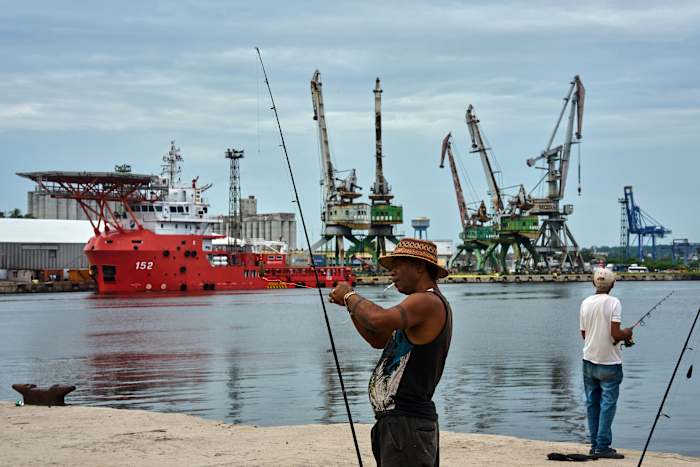
The second pillar of the Díaz-Canel PR offensive is attracting foreign direct investment (FDI). The state-controlled press points to special economic zones like the Port of Mariel as proof of modernization.
But foreign corporations entering Cuba face an institutionalized grift that would cause any rational CFO to veto the deal instantly.
The Dual Currency and Labor Monopolies
To understand why foreign investment fails in Cuba, you have to look at how labor is compensated. When a foreign company invests in a joint venture in Cuba, they cannot hire workers directly. They must go through a state employment agency.
- The Investor Pays the State: The foreign firm pays the Cuban state agency in hard currency (Euros or USD) for worker salaries—say, $2,000 a month per engineer.
- The State Pays the Worker: The state pockets the hard currency and pays the Cuban worker a fraction of that value in heavily devalued local currency or digital tokens.
This is a state-enforced labor tax that strips the foreign investor of the ability to incentivize staff, while starving the local population of the actual value of their labor. The state acts as an extractive middleman.
Furthermore, you cannot easily repatriate profits. The Cuban central bank routinely faces liquidity crises. Companies operating in the country have frequently found their bank accounts frozen or faced strict limits on converting local earnings back into foreign currency to send home. This isn't an economy transitioning to a market model; it is an economy running a liquidity ponzi scheme.
Dismantling the "People Also Ask" Flawed Premises
When people look into Cuban economic reforms, they ask the wrong questions because they assume the Cuban government shares the goals of typical developing nations. Let’s correct the record.
Does Cuba want to build a middle class?
No. A prosperous, independent middle class is the ultimate political threat to a totalitarian state. If citizens do not rely on the state for their food rations, their housing, and their employment, the state loses its leverage. The reforms are explicitly calibrated to keep private businesses small, fragmented, and dependent on state-controlled wholesale markets. The moment a private entity gains scale, it is choked off.
Is the US embargo the sole reason these reforms are necessary?
The embargo is Havana’s favorite scapegoat, but it is an intellectual cop-out. Cuba can trade with Europe, Canada, Latin America, and China. The reason Cuba lacks foreign exchange and goods is not because it cannot buy them, but because it does not produce anything of value to sell, and it routinely defaults on its debts. In 2015, the Paris Club forgave $8.5 billion of Cuban debt, yet Havana still managed to default on the restructured payments just a few years later. The problem isn't isolation; it's systemic insolvency.
The Illusion of the Vietnam Model
Defenders of the Cuban regime often point to Vietnam's Doi Moi reforms as the roadmap. They argue that a one-party communist state can successfully transition to market socialism and achieve rapid growth.
This comparison completely misunderstands Vietnamese history and Cuban psychology.
Vietnam embraced genuine agricultural de-collectivization in the late 1980s. They allowed farmers to own the fruits of their labor, sell to free markets, and compete. This created a bottom-up economic boom.
Cuba's leadership refuses to take this step. The state maintains an iron grip on agriculture through Acopio, the state purchasing agency that forces farmers to sell the vast majority of their crops to the government at artificially low prices. The result? Fertile Cuban land sits idle while the country imports over 70% of its food.
The Díaz-Canel administration lacks the ideological courage to implement a true market model because they remember the collapse of the Soviet Union. They viewed Mikhail Gorbachev’s Perestroika not as a model, but as a cautionary tale of how slight economic liberalization can lead to political collapse. Therefore, Cuba's reforms are designed to be reversible. They are valves opened to release pressure when the population is on the verge of rioting, and closed the moment the state's coffers are replenished.
The Sovereign Debt Shell Game
I have watched international funds and speculative investors get burned by sovereign debt restructuring in emerging markets for two decades. Cuba is in a league of its own when it comes to financial bad faith.
The regime's strategy is simple: default, renegotiate, extract new loans, and default again. When Díaz-Canel talks about new economic reforms to attract investment, he is speaking directly to international creditors, trying to convince them that this time is different.
It is never different.
+------------------------------------------------------------+
|             THE CUBAN ECONOMIC RECYCLE                     |
+------------------------------------------------------------+
|                                                            |
|    +-------------------> Economic Crisis <------------+    |
|    |                             |                    |    |
|    |                             v                    |    |
|  Default on               Announce Cosmetic           |    |
|  New Loans                    Reforms                 |    |
|    ^                             |                    |    |
|    |                             v                    |    |
|  Spend Capital            Attract Naive               |    |
|  on State Apparatus      Foreign/Diaspora Capital     |    |
|    |                             |                    |    |
|    +-----------------------------+                    |    |
|                                                       |
+------------------------------------------------------------+
The underlying structural metrics remain horrific. Inflation is rampant, the domestic currency is worthless, and physical infrastructure—from the electrical grid to Havana's sewage system—is collapsing from decades of underinvestment. Capital injected into this system does not go toward building factories or upgrading ports; it goes toward maintaining the internal security apparatus and funding tourism megaprojects owned by GAESA, the military-run conglomerate that controls the lucrative sectors of the economy.
Stop Looking at the Rhetoric, Look at GAESA
If you want to understand where Cuba is going, ignore the Ministry of Foreign Investment. Look at GAESA (Grupo de Administración Empresarial S.A.).
This is the commercial arm of the Cuban Revolutionary Armed Forces. It controls the hotels, the retail stores, the marinas, the financial exchange services, and the most profitable real estate in the country. GAESA does not operate under public scrutiny or state budget oversight. It is a state within a state, accountable only to the military elite.
When the government announces reforms to "involve Cubans abroad," they are inviting the diaspora to open small cafes and beauty salons while GAESA retains a monopoly on the high-margin industries. The private sector is handed crumbs, while the military elite holds the bakery.
This is not economic reform. It is an authoritarian oligarchy syndicating its operational costs to the private sector while privatizing the profits for the ruling class.
The Verdict for Capital Allocators
Any investor, fund manager, or diaspora entrepreneur who mistakes Cuba's current economic desperation for a capitalist awakening is committing financial suicide.
The regime cannot reform. To allow true economic freedom would mean allowing independent financial power centers to emerge. Independent financial power centers lead to political organization, and political organization is the end of the one-party state.
Havana's economic announcements are not a blueprint for transition. They are a distress signal wrapped in corporate buzzwords. If you inject your capital into Cuba under the current framework, you are not betting on the future of the Cuban people—you are financing the survival of their oppressors, and you will lose your shirt in the process.