The rain in London has a specific weight to it, a heavy, gray curtain that seems to press the history of a thousand years into the pavement. Inside the gilded silence of the palace, history isn't a textbook. It is the creak of a floorboard and the weight of a heavy wool coat. When King Charles III prepares for a state encounter, the stakes are rarely about the policy papers sitting on a mahogany desk. They are about the friction of two entirely different worlds colliding in a single handshake.
On one side, you have the ultimate symbol of endurance: a man who waited seven decades to inherit a role defined by restraint. On the other, the American whirlwind of Donald Trump, a figure who views tradition as something to be negotiated, disrupted, or redesigned. When these two meet, the air in the room changes. It isn't just a diplomatic meeting. It is a study in how humanity navigates the impossible gap between ancient duty and modern ego.
The Unspoken Language of the Tea Table
Imagine the scene at Clarence House. The fine bone china is laid out with surgical precision. There is a specific frequency to the clink of a silver spoon against a saucer, a sound that has signaled the start of high-level discourse for centuries. Charles, a man who views the soil of the English countryside with a near-religious devotion, sat across from a man who views land primarily through the lens of real estate.
The tension wasn't in their words. It was in their posture.
Charles leaned in, his hands gesturing with the practiced grace of a seasoned diplomat, trying to bridge the gap on the one topic that defines his soul: the environment. Trump, famously skeptical of the green movement, sat back. It was a clash of temporalities. One man was thinking in terms of geological epochs and the survival of the planet; the other was thinking in terms of the next news cycle and the immediate economic win.
They spoke for ninety minutes. It was supposed to be fifteen. That hour-long extension reveals the human truth beneath the headlines. Even between polar opposites, there is a magnetic pull to the exchange of ideas when the stakes involve the future of the world. Charles didn't lecture. He shared his passion. He tried to make a billionaire see the value in a blade of grass that couldn't be sold or paved over.
The Banquet and the Breach of Protocol
The white-tie dinner at Buckingham Palace is the closest thing the modern world has to a time machine. The dress code is rigid. The seating chart is a geopolitical puzzle. Every movement is choreographed.
Then came the moment that sent a ripple through the gathered aristocracy. During his toast, Trump reached out and placed a hand on the Queen’s shoulder. To some, it was a warm gesture of a guest feeling at home. To the palace watchers, it was a seismic event.
Charles, standing nearby, watched this play out with the stoic mask he has perfected over a lifetime. In that moment, we saw the invisible guardrails of the monarchy. The King isn't just a person; he is the vessel for a set of rules that keep a nation’s identity intact. Seeing those rules brushed aside by an American brand of informality highlighted the fundamental struggle of the 21st century: how do we maintain our sacred boundaries in an era that prizes the breaking of every mold?
The Spectacle of the South Lawn
Contrast the quiet tea at Clarence House with the thunderous arrival on the South Lawn. The pomp was turned up to a fever pitch. The King, in his formal military attire, stood as a pillar of continuity. Trump, ever the showman, leaned into the theater of the moment.
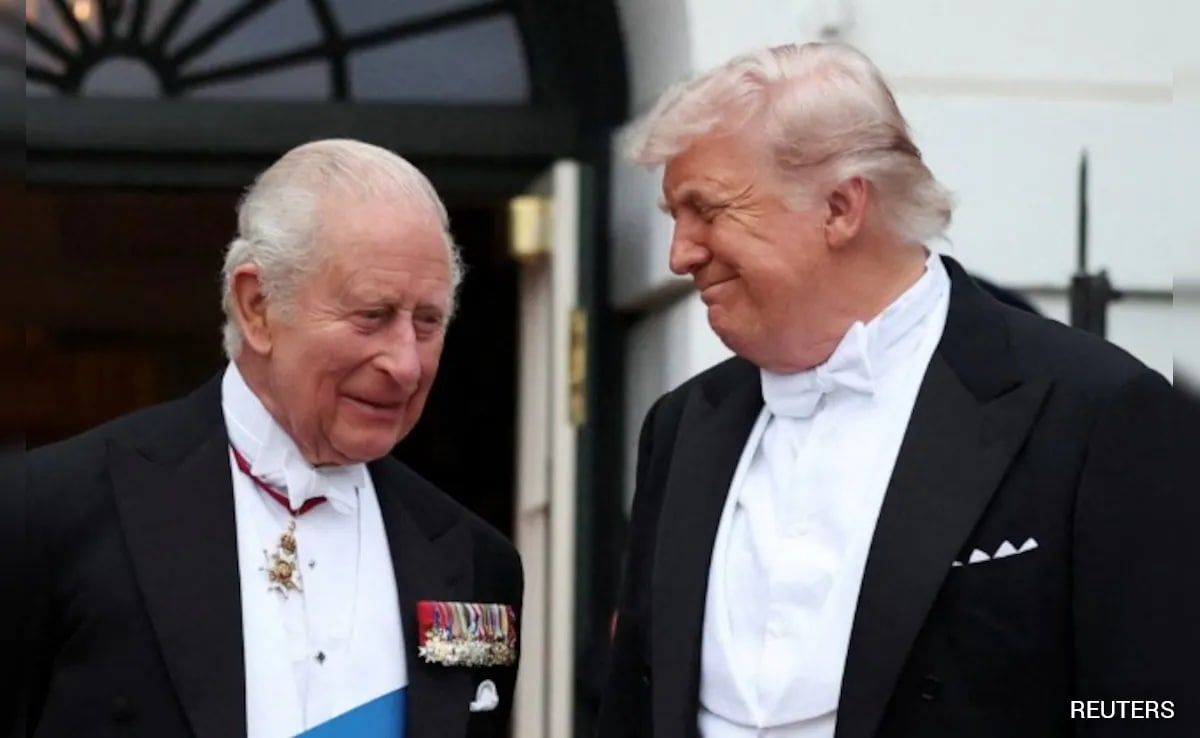
There is a specific photograph from this visit that captures the essence of their dynamic. They are walking side by side. Charles is looking slightly down, focused on the path, his steps measured. Trump is looking outward, chin up, scanning the horizon.
It was a visual metaphor for their respective burdens. Charles carries the past. Trump carries the present. The human element here is the sheer exhaustion that must come from being the living embodiment of a thousand-year-old institution while trying to find common ground with a man who wants to rebuild the world every morning.
A Shared Silence at the Cemetery
Away from the flashes of the press and the clinking of champagne flutes, there was a moment of genuine, unvarnished humanity. It happened during the commemoration of the 75th anniversary of D-Day.
Standing among the white crosses, the political theater evaporated. In the presence of the dead, the King and the President were reduced to their simplest forms: two men acknowledging a debt they could never repay. They didn't need to speak. The wind off the English Channel did the talking for them.
In this setting, the ideological differences felt small. The invisible stakes were no longer about trade deals or climate accords. They were about the shared heritage of the Atlantic alliance. For a brief window, the friction was gone. Charles, whose own family history is woven into the fabric of the World Wars, and Trump, who has always expressed a deep, almost mystical respect for military strength, found a rare, silent harmony.
It reminds us that even at the highest levels of power, we are all governed by the same ghosts.
The Garden of Contradictions
Perhaps the most telling moment of the entire visit occurred not in a palace, but in the discussion of a garden. Charles is a gardener. He believes that you can judge a man's character by how he treats the earth. He has spent his life building an organic paradise at Highgrove, a place where nature is allowed to lead.
Trump prefers the manicured perfection of a golf course, where nature is bent to the will of the game.
When they discussed the environment, it wasn't just a policy debate. It was a conflict of philosophies. To Charles, the Earth is a legacy to be curated. To Trump, it is a resource to be managed. Yet, reports suggest they found a way to laugh. There was a human warmth that transcended the ideological divide.
We often think of these figures as cardboard cutouts of their positions. We forget that they are people who get tired, who have senses of humor, and who are capable of being surprised by one another. The real story of the visit wasn't the "top five moments" found in a listicle. It was the realization that even the most rigid traditions and the most disruptive personalities must eventually find a way to sit in a room together and share a cup of tea.
The visit ended as it began, with the rain and the protocols and the heavy lifting of diplomacy. But something had shifted. The King had held the line of his convictions without breaking the bond of the alliance. The President had stepped into the heart of the establishment and, for a moment, slowed his pace to match the rhythm of the palace.
History is made of these small, human adjustments. It is built in the spaces between the speeches, in the moments where two men from different centuries try to understand what the other is seeing when they look out the window at the same world. It is a reminder that while power may be absolute, the people who hold it are always, deeply, and sometimes frustratingly, human.
The heavy doors of the palace closed. The motorcade moved off into the London mist. The china was packed away. What remained wasn't a list of facts, but the memory of a handshake that bridged an ocean and a century.