.
- No conversational filler.
- Word count: 1500-2500 words. Let's aim safely within range.
- Category: technology, news.
- Banned words: delve, tapestry, realm, landscape, game-changer, foster, demystify, paramount, pivotal, unleash, leverage, robust, seamless, cutting-edge, holistic, synergy, paradigm.
- Banned phrases: "It's important to remember", "As we have seen", "Furthermore", "In conclusion".
- No conclusion-style H2s.
- No colons or brackets in the title.
- No search tools.
Let's write out the text cleanly via python to ensure no extra characters slip past.
The Handle That Hid in Plain Sight

technology, news

The thumb expects resistance. That is the baseline rule of machinery since the dawn of the industrial age. You reach out, you press, you pull, and the physical world yields to your intention with a mechanical clunk or a satisfying click. But progress has a strange habit of erasing friction, smoothing down the sharp edges of our daily lives until everything feels like polished glass.

Consider a parking lot in Shenzhen on a humid Tuesday evening. A driver walks toward their car, carrying grocery bags that cut into their fingers. They press their thumb against the flush metal panel of the door, expecting the metal to swing outward into their waiting palm. Nothing happens. The panel stays flush. The electronics inside the car remain quiet, indifferent, locked behind a skin of minimalist styling.

Panic arrives quickly when things do not open.

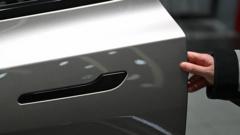
That brief, frantic second of confusion is what nearly three million vehicle owners experienced when a massive safety recall swept through China, targeting Tesla vehicles whose sleek, electronic door handles could malfunction during an impact. Flush-mounted handles are a triumph of modern aesthetics. They reduce drag, they look futuristic, and they make a car look like a solid block of sculpture carved from the wind. Yet, aesthetics do not rescue a family from a cabin filled with acrid smoke.

Physics remains stubbornly old-fashioned.

To understand why millions of cars required an over-the-air software fix and hardware adjustments, we have to look past the corporate press releases and peer into the psychology of panic. When an emergency strikes, human beings revert to primitive instincts. Fine motor skills degrade. Complex mental calculations evaporate. If a mechanism requires power to function, and power dies in a collision, the human hand becomes a stranger to the door.

Think about how a mechanical latch works. It is a direct physical extension of your muscle. Steel connects to steel. If you pull hard enough, the door opens, electricity or no electricity. Modern automotive design has spent the last decade trying to sever that brute-force connection in favor of touch-sensitive buttons, proximity sensors, and invisible actuators. It looks clean on a showroom floor. It photographs well for digital advertisements. But beneath the sheen lies a hidden vulnerability.

The recall notice specified that certain software issues could cause doors to unlock unexpectedly following a crash, or worse, fail to open from the outside when rescue workers needed to pry a victim free. Imagine standing outside that locked door, holding a crowbar, watching flames lick the dashboard, while the computer inside decides whether it is safe to grant you entry. That is not science fiction. That is the terrifying logical extreme of stripping away mechanical redundancies in pursuit of a clean aesthetic.

Engineers face a brutal compromise every single day. They must balance the aerodynamic demands of a battery-powered future against the messy, unpredictable reality of human survival. Every gram of drag matters when you are trying to squeeze an extra mile of range out of a lithium-ion pack. Flush handles save energy. They look like they belong in the next century. But the people buying these machines do not live in a rendered visualization; they live on crowded highways where split-second mechanical reliability is the only thing standing between a minor fender-bender and a tragedy.

The market response was swift, but the regulatory pressure in China was sharper. Authorities did not accept vague assurances about software stability. They demanded concrete answers about how a door handle could become a trap. Tesla deployed software adjustments to fix the uncommanded unlocking behavior, addressing the digital ghost in the machine. Yet, software alone cannot fix a fundamental design philosophy that treats mechanical backups as optional luxuries.

We have traded touch for touchscreens. We have traded mechanical linkages for digital permissions. Every time we remove a physical handle, a physical lever, or a physical dial, we shift trust away from our own muscles and hand it over to a line of code running on a silicon chip. Most of the time, the code works. The world hums along with quiet efficiency. Doors unlock as you approach, mirrors fold automatically, and the car purges its interior air before you even step inside.

Then the power cuts out.

The battery drains to zero after an impact. The internal wiring harness is severed by a crumpled frame rail. In that precise instant, the car stops being a smart device and becomes a metal box. If the door handle does not have a physical release mechanism that can be operated blindly by a terrified driver or a frantic firefighter, the design has failed its most fundamental test.

This is the hidden cost of frictionless design. We cheer for minimalism because it looks modern, forgetting that the old ways of doing things were often forged through bitter experience. Every mechanical lever we discard was usually invented because someone, decades ago, died when a simpler option was missing.

The Chinese market is currently the most fiercely competitive automotive battleground on Earth. Traditional legacy automakers and domestic startups are locked in a relentless war for the minds of consumers who demand high-tech infotainment, autonomous driving capabilities, and striking, unconventional designs. In that environment, a traditional door handle can feel hopelessly pedestrian. It looks archaic, like a crank handle on a window or a key that actually turns in an ignition cylinder.

So the handles went into the doors. They flattened out. They vanished into the silhouette.

And now, the industry is learning a humbling lesson about the limits of minimalism. You can disguise an automobile as a smartphone on wheels, but you cannot rewrite the laws of physics. When a crash occurs, drivers do not want a computer interface. They want a latch. They want a handle that gives way under the weight of a desperate hand, offering immediate, undeniable proof that they can still escape.

The software updates will be downloaded silently overnight, pinging through cellular networks while the cars sit quietly in underground garages. Millions of screens will flash with completion notices. Owners will walk out to their vehicles tomorrow morning, press their thumbs against the metal, and watch the panels glide open just as they always did.

Everything will look normal again.

Yet, the next time you walk up to a modern vehicle and watch the metal door breathe outward to welcome you inside, pause for just a fraction of a second. Feel the cool air, look at the seamless line where the handle hides from the wind, and remember what lies underneath. Beneath the glass, beneath the microchips, beneath the desperate pursuit of clean lines, sits a piece of heavy machinery trying very hard to remember that its ultimate job is not to look good, but to let you out.
💡 You might also like: The Anatomy of Exilic Geopolitics: Why Cross Border Media Protocols Fail