The dust does not settle. It hangs. It coats the back of your throat with the taste of pulverized limestone and old dreams, a chalky ghost that refuses to be swallowed.
When the earth tore itself open beneath Miranda State, the sound wasn't a roar. It was a low, guttural groan, the kind of noise a monolithic beast makes when its bones finally give way under impossible weight. Then came the silence. That is the part the news reports always miss. They tell you about the Richter scale—a dry, sterile number like 6.2 or 5.9 that means absolutely nothing to a mother staring at a mountain of shattered brick where her kitchen used to be. They don't tell you about the terrifying, suffocating quiet that follows the crash, right before the screaming starts.
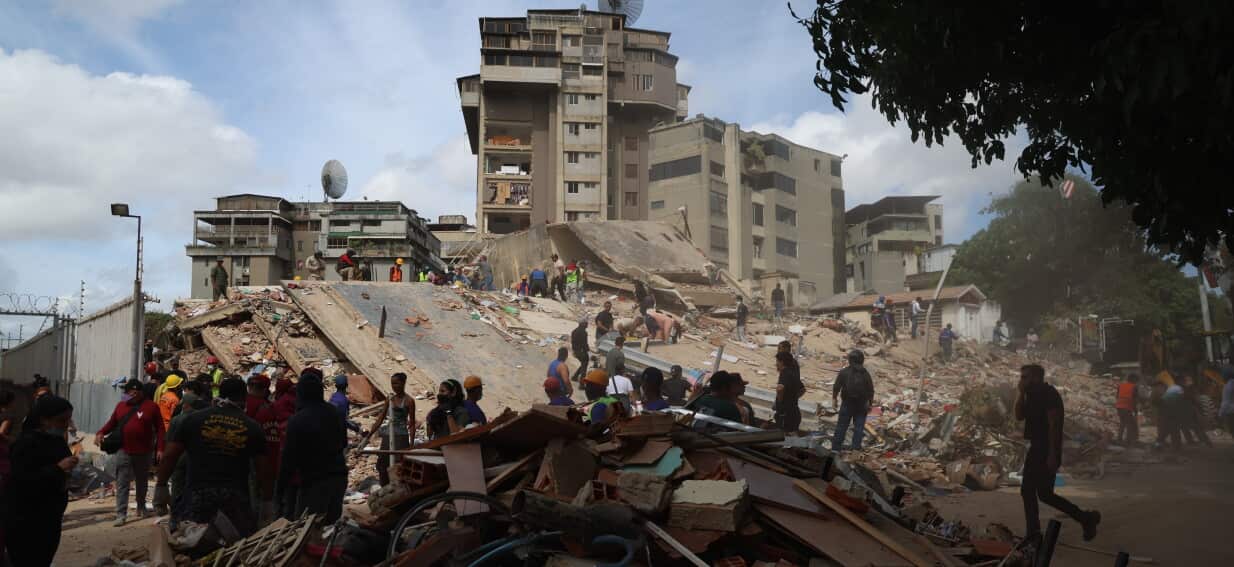
Elena’s fingers were bleeding. She didn't notice. The rough edges of a fractured cinderblock tore into her cuticles as she clawed at the debris of what hours earlier had been a modest apartment complex in Chacao. Beside her, men in faded yellow vests and teenagers in flip-flops worked in a desperate, uncoordinated choreography. They were lifting chunks of concrete that should have required a crane, fueled by the kind of adrenaline that only unadulterated terror can provide.
Every few minutes, someone would blow a whistle.
One sharp blast.
The entire hillside would freeze. Total stillness. Men held their breath. A dog whimpered in the distance and was quickly hushed. In those suspended seconds, everyone strained their ears toward the earth, praying for a cough, a scrape, a muffled cry from the dark belly of the rubble.
This is the reality of a post-earthquake landscape that statistics fail to capture. The news briefs broadcasted across the globe package these disasters into neat, sixty-second segments of rubble footage and official government tallies. But the true story of a disaster is never found in the macro. It is found in the micro—in the space between a whistle blast and the agonizing absence of an answer.
The Anatomy of an Aftershock
Seismology explains the mechanics perfectly. Tectonic plates shift, stress accumulates along fault lines, and energy is released in violent waves. It is simple physics. But physics feels like a cruel joke when you are standing on ground that feels less like solid rock and more like a fluid, living thing.
Consider a hypothetical structure built under the economic constraints of the last decade: substandard rebar, hurried concrete mixing, and a lack of municipal oversight. To a geologist, it’s a vulnerability. To the family living on the third floor, it’s a lottery ticket they didn't know they bought. When the main shock hits, the building doesn't just fall; it pancakes. Floors stack upon floors, compressing lives into gaps sometimes no wider than a textbook.
As the sun began to beat down on the rescue sites, the heat became an enemy of its own. In Venezuela, the tropical sun is unrelenting, baking the ruins and accelerating the dehydration of anyone trapped beneath them. Rescue workers, their faces masked with improvised bandanas to keep out the dust, paraded buckets of debris down human chains.
The strategy here is primitive but precise. Heavy machinery cannot be used yet. A single wrong move with a bulldozer could shift a load-bearing slab and crush a pocket of survival below. It is a game of horrific Jenga, played with human lives as the stakes.
But the physical danger is only half the battle. The psychological toll of the waiting is what breaks people.
The Geography of Hope
A few blocks away, outside a makeshift triage center at a local church, the atmosphere shifted from frantic labor to communal grief. The pews had been dragged into the courtyard to make room for cots. Statues of saints stared down at rows of plastic water bottles and boxes of donated antibiotics.
Here, the currency was information, and everyone was bankrupt.
An elderly man named Hector sat on the curb, his hands clasped between his knees. He wasn't digging. He had no strength left for that. Instead, he whispered the same prayer over and over, his lips moving in a rapid, silent rhythm that seemed to keep time with the distant thud of rescue tools. His grandson had been at a storefront when the tremors began.
"The earth isn't supposed to betray you," Hector muttered to anyone listening. His voice was cracked, dry from the dust. "You can hide from a storm. You can lock your door against a thief. But where do you step when the floor itself turns against you?"
His question hung unanswered. It highlighted a fundamental truth about natural disasters in urban centers: the trauma is structural, both materially and socially. The infrastructure of a city dictates who survives. Well-funded districts with strict building codes weather the shaking with minor cracks; informal settlements and neglected barrios cascade down hillsides like decks of cards. The earthquake does not discriminate, but human architecture does.
By mid-afternoon, rumors began to ripple through the crowd. Another major aftershock was predicted.
Panic is a contagion in these moments. A sudden movement by one person can trigger a stampede of families fleeing open plazas for even wider spaces. The local authorities tried to maintain order with megaphones, their voices distorting into metallic static that only added to the confusion. The updates were meager: dozens rescued, hundreds displaced, hospitals at capacity.
What Stays Behind
To understand the true weight of a disaster, you have to look at what remains when the television cameras pack up and leave. Long after the international community moves on to the next headline, the people of Chacao will be navigating a altered map of their own lives.
The scar on the skyline will heal slowly. New concrete will eventually cover the old. But the phantom vibrations will persist. For months, perhaps years, the rumble of a passing heavy truck will cause hearts to seize and hands to reach instinctively for doorframes. The ground may stop moving, but the mind keeps shaking.
As evening approached, the shadows lengthened across the ruins. The bright klieg lights of the emergency services sputtered to life, casting long, dramatic silhouettes of the diggers against the broken walls. The contrast was stark—blinding white light against pitch-black voids.
A sudden shout went up from the center of the collapse.
The human chain stopped. The buckets froze in mid-air. Elena scrambled forward, her breath catching in her throat. The rescue workers dipped lower into a newly cleared cavity, their flashlights cutting through the thick haze.
There was no whistle this time. Just a low, collective murmur that rippled outward through the crowd, a shared exhalation of a neighborhood holding its collective breath. A small hand, covered in gray soot but unmistakably moving, reached out from the darkness to grip the gloved hand of a volunteer.
No one cheered. The relief was too heavy for noise. Instead, a quiet reverence settled over the dirt, a fragile victory pulled from the wreckage of a city that refused to break entirely. The digging would continue through the night, one bucket, one prayer, one handful of dust at a time.