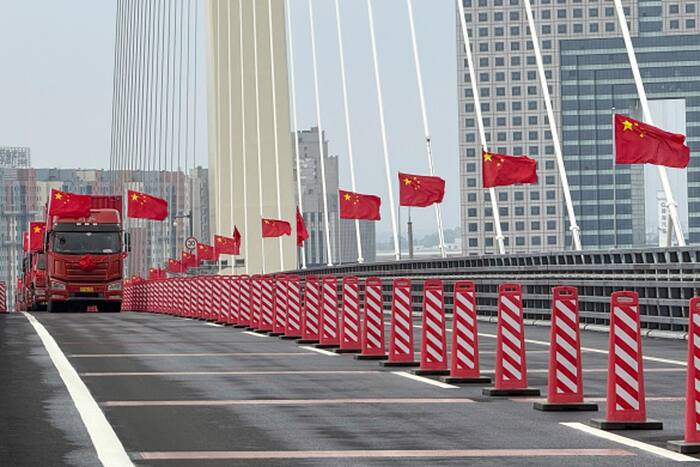
The river does not care about politics. It rolls down from the mountains of Changbai, cold and slate-gray, moving past mud-brick villages on one side and concrete towers on the other, indifferent to the treaties signed in distant capitals or the rusted padlocks on customs gates. For years, the water was the only thing connecting two worlds that stared at each other across a narrow gorge, separated by barely a mile of rushing current yet divided by epochs of isolation.
Then came the bridge.
It towers over the Yalu River, a massive sweep of steel and gray concrete that looks less like a civil engineering project and more like a monument to human persistence. For more than a decade, it sat finished yet empty. A monument to bureaucratic limbo. The asphalt was laid, the toll booths installed, the streetlights wired to electrical grids that hummed with no purpose, while weeds poked through expansion joints and the paint began to fade under the biting Manchurian wind.
To understand why a bridge can sit desolate for twelve years, you have to look past the blueprints and into the strange, pressurized geometry of international borders. Bridges are meant to unite, but they also terrify. They invite movement, commerce, the messy exchange of human lives that governments spend billions trying to regulate, tax, or contain.
Imagine standing on the Dandong embankment back in 2014, when the last heavy crane rolled away from the span. The air smells of coal smoke and fried street food from the nearby night market. You can see the opposite shore clearly enough to count the windows in the apartment blocks of Sinuiju. The locals call it the New Yalu River Bridge, though it has felt old for a long time. Billions of yen and yuan were poured into its pylons, envisioned as a roaring artery for trade between two nations whose economic destinies are asymmetrically entwined. One side boasts gleaming skyscrapers, high-speed rail networks, and a hunger for raw materials. The other side operates under a strict, self-imposed twilight, its factories humming only when fuel and electricity permit.
Why did it wait? The answers were never written on the bridge itself. They lived in conference rooms where diplomats argued over approach roads, customs facilities, and security protocols that stretched out across administrations, pandemics, and shifting geopolitical tides. A bridge needs ramps. A bridge needs customs warehouses, quarantine zones, and biometric scanners. If you build a highway to nowhere, you have an expensive sculpture. If you build a highway to somewhere strictly controlled, you have to decide who gets to walk across, what they are allowed to carry, and who holds the keys.
Time passed. Seasons turned. The bridge became a tourist attraction of a uniquely absurd kind. Tour boats packed with weekend sightseers from Beijing and Shanghai would putter up the river, cutting their engines just beneath the shadow of the silent steel arches. Guides would point their megaphones at the empty tarmac, spinning tales of what might happen when the gates finally opened. The tourists would snap photos, eat roasted chestnuts, and marvel at the strange ghost highway that ended abruptly in mid-air on the North Korean side, blocked by dirt berms and razor wire.
Bridges are promises made in solid form. When you pour concrete across a chasm, you are betting against distance and enmity. You are declaring that the people on the other side matter enough to warrant a shortcut.
By the time the final bureaucratic knots began to unravel, the world had changed completely. Global supply chains had fractured and re-formed. Regional alliances had shifted. Yet the fundamental physics of geography remained stubborn. Dandong needed an outlet for its manufacturing surplus, and North Korea needed an efficient conduit for goods that could bypass the aging, bottlenecked Friendship Bridge built nearly a century ago—a narrow, groaning iron relic built for steam trains and Model T Fords, utterly unsuited for the twenty-first-century tonnage of heavy trucks.
The opening did not arrive with a cinematic roar of fireworks and confetti. Borders do not reopen with Hollywood scripts. They open with the dry rustle of paperwork, the clank of heavy padlocks being lifted off steel chains, and the low, rumbling diesel roar of the first commercial freight carrier creeping forward at five miles per hour.
Consider the driver of that first truck. Let us call him Zhang. For twenty years, he has hauled cargo across the northern provinces, familiar with every pothole on the icy roads from Shenyang to the border. He knows the weight of his rig, the smell of burning brake pads on mountain descents, and the endless hours spent idling in queues near old crossing points where customs inspectors check every manifest by hand under flickering fluorescent lights.
When Zhang points his bumper toward the new span, he is not thinking about geopolitics. He is thinking about his delivery schedule. He is thinking about fuel efficiency, tire wear, and whether the electronic manifests will clear the gate before nightfall. As his tires transition from asphalt to the smooth, jointless expanse of the new bridge, the cabin grows suddenly quiet. The rhythmic thrumming of the old roads vanishes. Beneath him, the Yalu River rushes southward toward the Yellow Sea, cold and fast, carrying floating patches of autumn leaves and the occasional stray log.
He looks to his left and right. Through the reinforced glass of his windshield, the horizon opens up in a way it never could from the cramped deck of the old bridge. The sky feels bigger here. The distance between nations shrinks to the length of a five-minute drive.
Yet, as Zhang taps the brakes at the North Korean checkpoint, the illusion of borderless freedom evaporates instantly. Armed guards in pressed olive uniforms step forward. Dogs sniff the undercarriage. Paperwork changes hands through sliding glass slots. The bridge is a physical reality, but sovereignty is absolute. The steel span connects two landmasses, but it cannot bridge the immense ideological gulf that lies beneath the wheels.
This is the quiet paradox of modern infrastructure. We pave over history, lay fiber-optic cables across ocean floors, and string massive suspension bridges across hostile rivers, hoping that proximity will breed understanding, or at least commerce. We build monuments to connectivity while reinforcing the invisible walls inside our heads.
Back on the riverbanks, the tour boats still putter past, but the tour guide's script has changed. The ghost bridge is a ghost no longer. The tarmac is scarred with rubber marks, stained with oil drips, and polished by the relentless friction of commerce.
The river keeps moving. The mountains keep standing. And somewhere in the twilight, another convoy of heavy trucks lines up behind the gates, waiting for the green light to blink, ready to cross the chasm one axle at a time.


