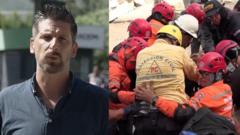
The dust settles first. It hangs in the humid coastal air above the Venezuelan shore, a thick, chalky fog that tastes of pulverized mortar and old lime. It coats the throat. It stings the eyes. But it is the silence that follows the dust—a heavy, suffocating weight—that tells you exactly how much the world has changed in ninety seconds.
On Wednesday evening, the earth along the San Sebastián fault system did not just move; it ruptured. A magnitude 7.2 foreshock near Yumare tore open the ground at 6:04 PM. For 39 seconds, people held their breath, gripping doorframes and praying to a god that seemed suddenly very distant. Then came the mainshock. A massive 7.5 magnitude monster struck less than a minute later, ripping eastward toward the sea, tearing through the foundations of Caracas and flattening the high-density coastal strip of La Guaira. It was a doublet event, a rare and brutal seismic one-two punch that scientists state hasn't been seen with this kind of violence in Venezuela for more than 125 years.
When the shaking stopped, a sprawling modern coastline lay shattered. Concrete apartment blocks, once packed with life, folded into themselves like accordion pleats. The United Nations estimates the damage at up to 8.7 billion dollars—nearly eight percent of the entire national economy gone before the sun could even set.
But nobody in La Guaira is thinking about the gross domestic product. They are listening to the rubble.
Consider a man named Alejandro. He is a hypothetical composite of the thousands of desperate fathers, brothers, and sons currently clawing at the debris with bare hands, but his reality is entirely true to the ground. Alejandro is staring at a gray mound that used to be his third-floor apartment. Somewhere beneath three stories of pancaked floorboards and reinforced concrete is his seven-year-old daughter, Camila. He can hear her. It is a thin, reedy sound, a muffled cry that sounds less like a human child and more like a trapped bird.
He is pulling at a chunk of jagged masonry. His knuckles are raw, bleeding into the gray dust. He is utterly alone.
This is the agonizing reality of the first 48 hours after a catastrophic earthquake. Aid agencies call it the golden window. It is a scientific calculation of human endurance: the time it takes for dehydration, crush syndrome, or internal bleeding to turn a trapped survivor into a statistic. In these initial hours, the probability of pulling someone out alive is high. Every tick of the watch is a literal theft of life.
Yet, the macro-level reality on the ground creates a cruel bottleneck. The twin quakes severely crippled the region's infrastructure. Simon Bolívar International Airport in Maiquetía sits closed, its runways cracked and its terminals structurally compromised. The main highways winding through the mountainous terrain from Caracas to the coast are blocked by massive landslides and fallen high-voltage power lines. Cellphone towers are dead. The state of emergency declared by acting President Delcy Rodríguez is an official recognition of a simple, terrifying fact: the people under the blocks are dying because the help cannot reach them in time.
Local emergency workers speak off the record about the profound technical limitations they face. There are not enough heavy cranes. There are not enough acoustic listening devices to pinpoint where the faint voices are coming from.
Instead, the burden falls on the community. Neighbors form human chains, passing buckets of broken brick down a line of bruised shoulders. They use car jacks, crowbars, and old tire irons to pry apart structural slabs that weigh tons. It is a desperate, illogical battle of muscle against stone, driven by the pure, unadulterated terror of what happens when the voices underneath finally stop.
By Friday night, the scale of the tragedy began to solidify into hard, immutable numbers. Health Minister Carlos Alvarado confirmed the death toll had climbed past 920. More than 3,200 people are filling the hallways of overwhelmed hospitals. But the most staggering metric—the number that keeps first responders awake under the glare of portable floodlights—is the missing. Over 68,900 people remain unaccounted for across the north-central region. They are the names whispered by relatives sleeping in makeshift plastic tents on the streets, terrified of the constant aftershocks that make the surviving structures groan and tilt precariously.
The international response is spinning up, a multi-million-dollar global rescue web trying to force its way through the logistical choke points. Teams from Spain, Mexico, Chile, Switzerland, and the United States are arriving with specialized search dogs and thermal imaging equipment. Nearly 900 foreign volunteers are now on the ground, joining 25 international search-and-rescue units.
But international aid is a massive, complex machine, and machines require time to assemble. They require permits, clear roads, and organized staging areas. To streamline the chaos, the government restricted access to La Guaira, requiring special permits just to enter the disaster zone to clear the gridlocked traffic for emergency vehicles.
For those trapped beneath the heavy concrete, this macro-level coordination feels agonizingly slow. It is a tragic mismatch of scales. A global relief effort moves in hours and days; a child trapped under a ceiling beam measures survival in minutes and breaths.
The Sun sets again over the Caribbean, painting the sky in deep streaks of orange and violet that look mocking in their beauty. In the darkness, the search changes. Without daylight, the rescuers rely almost entirely on sound. Every few minutes, a horn blows, and a whistle sounds across the debris fields of La Guaira.
Total silence is commanded. Hundreds of people—international specialists in high-tech helmets, local volunteers in torn shirts, families holding framed photos—freeze in place. Nobody breathes. They listen for a scratch, a moan, a rhythmic tapping against a pipe. Anything to prove that the concrete hasn't won.
In those quiet intervals, the true stakes of the disaster become clear. It is not about the billions in lost infrastructure or the geopolitical mechanics of international aid. It is about the vast, empty space between the silence of the stones and the voice of a child waiting for the light to break through.