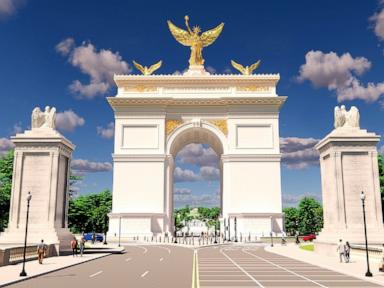
The legal battle to halt construction on President Donald Trump’s proposed monumental arch is not an aesthetic dispute over neoclassical architecture. It is a high-stakes jurisdictional collision between local governments and executive authority.
When the District of Columbia and the Commonwealth of Virginia filed a joint lawsuit to block the massive structure—envisioned to straddle the Potomac River corridor near the Arlington Memorial Bridge—they activated one of the most complex legal tripwires in American urban planning. At its core, the litigation argues that federal executive agencies bypassed mandatory environmental reviews, historic preservation statutes, and regional infrastructure oversight to fast-track a monument that alters the protected visual axis of the nation's capital. In similar developments, take a look at: What Most People Get Wrong About Surviving Three Days Trapped in a Drain Pipe.
For decades, building anything permanent in Washington, D.C., and Northern Virginia has required surviving a gauntlet of bureaucratic approvals. That system is currently under extreme stress.
The Jurisdictional Chokepoint on the Potomac
The proposed arch sits on a geographic seam where federal, district, and state authorities overlap in ways that routinely paralyze even routine highway maintenance. Reuters has also covered this fascinating topic in great detail.
To understand why D.C. and Virginia attorneys general found common ground on a federal injunction, you have to look at the physical footprint of the project. The western terminus of the Arlington Memorial Bridge anchors into Virginia soil near Arlington National Cemetery and the George Washington Memorial Parkway, while the eastern approach feeds directly into the National Mall and the Lincoln Memorial traffic circle in the District.
Jurisdictional sovereignty in this corridor is divided by inches. Under federal law, the National Park Service manages much of the immediate parkland, yet the underlying water rights, submerged riverbed boundaries, and connecting arterial roadways fall under the shared or contested control of the District of Columbia and the Commonwealth of Virginia.
The lawsuit centers on three primary statutory violations:
- The National Environmental Policy Act (NEPA): Plaintiffs allege that federal planners issued a truncated environmental assessment rather than a full Environmental Impact Statement, ignoring how massive foundation pilings in the Potomac riverbed could alter floodplain dynamics and local hydrology.
- The National Historic Preservation Act (NHPA): Under Section 106 of the NHPA, any federal undertaking that affects historic properties requires formal consultation with state and local historic preservation officers. The suit contends that consultations with the D.C. and Virginia preservation offices were treated as a rubber stamp rather than a substantive review.
- The Commemorative Works Act (CWA): Congress enacted the CWA specifically to prevent the National Mall and its surrounding monumental core from becoming cluttered with unvetted memorials. The statute requires explicit congressional authorization and a multi-stage site selection process before a single shovel hits the dirt.
Federal defense attorneys counter that executive directives governing federal parkland and national celebrations grant the administration broad latitude to commission temporary or semi-permanent celebratory structures, or to utilize existing discretionary infrastructure funds. That distinction—whether the arch is a permanent commemorative work or an executive-authorized federal installation—will likely decide the preliminary injunction.
Why the Sightline Rule Matters More Than Politics
Washington is not a normal city. It is an engineered visual composition.
Since Pierre L'Enfant drafted the city's master plan in 1791, and the McMillan Commission codified its monumental core in 1901, federal planners have guarded specific viewsheds with near-religious intensity. The axis stretching from the U.S. Capitol, down the National Mall, through the Washington Monument and the Lincoln Memorial, across the Arlington Memorial Bridge, and up the hill to Arlington House was deliberately designed as an unbroken symbolic line linking North and South.
Placing a towering triumphal arch directly across or adjacent to that axis physically interrupts a century-old architectural dialogue.
The U.S. Commission of Fine Arts (CFA) and the National Capital Planning Commission (NCPC) exist specifically to police these visual corridors. Historically, both bodies have rejected or forced major redesigns on projects backed by sitting presidents, Congress, and billionaire donors alike. The Eisenhower Memorial was delayed for over a decade due to disputes over its tapestries and columns. The National World War II Memorial faced fierce litigation over its placement between the Washington Monument and the Lincoln Memorial because critics argued it broke the open lawn's visual continuity.
In this instance, the plaintiffs argue that the administration attempted to circumvent the traditional NCPC and CFA review timelines by framing the arch under expedited executive authority. If a president can bypass the Commemorative Works Act and the NCPC simply by reclassifying a monument, the entire statutory framework protecting Washington's skyline collapses. Every future administration could theoretically drop its own legacy structure onto federal parkland without congressional sign-off or local input.
The Overlooked Infrastructure Nightmare
Strip away the political symbolism and the architectural theory, and you are left with a brutal engineering problem: traffic and soil.
The Arlington Memorial Bridge corridor is already one of the most congested commuter bottlenecks in the Mid-Atlantic. Tens of thousands of vehicles cross that span daily between Northern Virginia and downtown Washington. For the past several years, the bridge itself required a massive, multi-hundred-million-dollar rehabilitation just to keep its deteriorating concrete and steel bascule span from failing.
Building a monumental stone or concrete arch in this zone introduces severe civil engineering constraints that the lawsuit highlights in granular detail:
- Subsurface Instability: The Potomac River basin along the Tidal Basin and Memorial Circle consists of soft alluvial silt and reclaimed marshland. Supporting a multi-thousand-ton masonry or reinforced concrete arch requires driving deep caissons down to bedrock, generating intense vibration that engineers warn could compromise the historic masonry of the adjacent Arlington Memorial Bridge and the Lincoln Memorial seawall.
- Staging and Logistics: You cannot build a structure of that scale without shutting down major arterial lanes for heavy cranes, concrete pumpers, and staging yards. Neither D.C.'s Department of Transportation nor the Virginia Department of Transportation signed off on the traffic management plans required to reroute commuter flow off the George Washington Parkway and Rock Creek Parkway.
- Stormwater and Flood Mitigation: Federal agencies have spent hundreds of millions of dollars upgrading the Tidal Basin seawalls to combat rising river levels and chronic flooding. Dropping massive concrete footings into the riverbanks alters water displacement during storm surges, potentially pushing floodwaters toward surrounding infrastructure in both jurisdictions.
The Precedent of Executive Monument Building
Presidents wanting to leave physical marks on Washington is nothing new. History is littered with executive architectural ambitions that ran headlong into local resistance.
In the late 1940s, Harry Truman famously bypassed traditional pushback to add a second-floor balcony to the White House portico, infuriating preservationists and the Commission of Fine Arts. Decades earlier, Theodore Roosevelt completely gutted and rebuilt the West Wing, erasing Victorian interiors to impose his vision of neoclassical executive power.
Yet there is a sharp legal boundary between modifying the White House—which sits on a self-contained compound under direct executive stewardship—and erecting a massive monument across public riverways and interstate transit corridors.
When Ronald Reagan and the Vietnam Veterans Memorial Fund navigated the approval process for Maya Lin's design in the early 1980s, the project underwent years of public hearings, design compromises, and formal statutory approvals. Even then, opposition was so fierce that a compromise statue had to be added nearby to satisfy critics. That friction wasn't a flaw in the system; it was the system working as designed to ensure that permanent additions to the capital reflect broad consensus rather than unilateral executive will.
By bypassing that consensus-building machinery, the arch project invited immediate legal retaliation. State and municipal attorneys general understand that once concrete is poured and steel is erected, courts are notoriously reluctant to order demolition. In federal construction litigation, irreparable harm is the magic phrase. If D.C. and Virginia can convince a federal judge that allowing site preparation and foundation work to proceed will permanently alter historic land and disrupt regional infrastructure before the merits of the case are heard, they win the injunction—and an injunction often kills a time-sensitive political construction project outright.
The Counter-Argument From the Executive Branch
It would be a mistake to view the federal government's legal defense as entirely meritless. Constitutional scholars who study executive power point out that the federal government holds ultimate title to much of the land in question, particularly within the District of Columbia, which remains a federal district created under Article I, Section 8 of the Constitution.
From the administration's perspective, local officials in D.C. and Virginia are weaponizing procedural environmental and preservation statutes to obstruct a lawful federal initiative for political reasons. Federal litigators routinely argue that:
- Local jurisdictions lack standing to sue the federal government over the use of its own parkland unless they can prove concrete, individualized economic or proprietary harm—not merely generalized aesthetic objections or political disagreement.
- Under the Supremacy Clause, state and municipal permitting rules cannot be used to veto federal projects authorized under valid federal appropriations or executive directives.
- Delaying infrastructure and celebratory projects through endless NEPA litigation has become a standard tactic to run out the clock on an administration's term, effectively granting local officials a pocket veto over national initiatives.
This argument resonates strongly with conservative legal theorists and infrastructure reformers who have spent years arguing that NEPA and Section 106 reviews have mutated from protective guardrails into tools of bureaucratic paralysis. To supporters of the arch, the lawsuit is Exhibit A in why America struggles to build monumental public works anymore.
What Happens in Federal Court Next
The immediate battleground is the U.S. District Court for the District of Columbia, where the motion for a preliminary injunction will be argued before the broader administrative record is even compiled.
Judges in the D.C. Circuit are intimately familiar with administrative law and NEPA challenges. They rarely rule on the political merits of a project; instead, they examine the paper trail. The court will demand to see the exact statutory authority cited for the expenditure of funds, the dates and transcripts of any Section 106 consultations with D.C. and Virginia preservation officers, and the engineering studies justifying the omission of a full Environmental Impact Statement.
If the administrative record shows that federal agencies skipped mandatory steps to meet an artificial construction deadline, the court will almost certainly freeze the project under the Administrative Procedure Act (APA), which prohibits federal agencies from acting in an "arbitrary and capricious" manner.
Conversely, if the government can demonstrate that the work currently underway consists solely of preliminary surveying and non-invasive site testing—and that formal NCPC and CFA reviews are still pending before permanent structural steel or stone is placed—the judge may deny the immediate injunction while keeping the lawsuit alive on a fast-track schedule.
Either way, the heavy machinery will not be rolling freely across the Potomac anytime soon. In Washington, concrete moves slowly, and federal injunctions move fast.