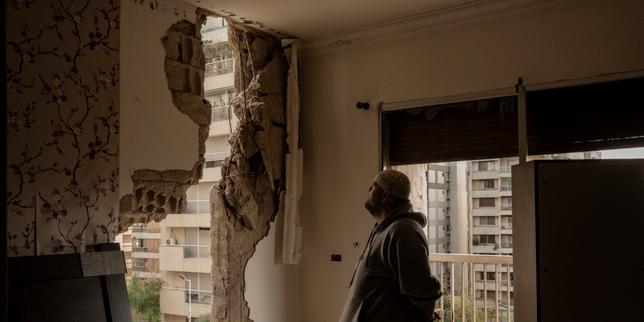
The Chihab building did not just collapse. It evaporated into a memory of dust and twisted rebar. Before the missiles arrived, it was a vertical neighborhood in the heart of Beirut’s Bachoura district, a place where the scent of cardamom coffee drifted from balconies and the rhythmic click of backgammon tiles provided the soundtrack to the afternoon. Now, it is a void.
Four missiles. That is all it took to erase generations of domesticity. When the Israeli strikes hit the residential tower, they didn't just target a structure; they dismantled the invisible threads that hold a family together. To look at the crater today is to see the physical manifestation of a city's collective trauma.
The Weight of a Key
Musa used to carry his house keys like a talisman. They were heavy, brass, and smoothed by decades of use. In Beirut, a key is more than a tool; it is a promise of return. But when the first explosion rocked the foundation of the Chihab tower, the very concept of "home" shifted from a sanctuary to a cage.
Imagine the sound. It isn't a single bang. It is a tectonic roar, the sound of thousands of tons of concrete deciding to become liquid. Musa survived because he was at the pharmacy down the street. His wife did not. His daughter did not. The facts reported in the news will tell you the death toll. They will list the names. What they cannot convey is the specific, agonizing silence that follows the roar—the moment when a man realizes he is holding a key to a door that no longer exists.
The Chihab tower was not a military bunker. It was a hive of life. There were teachers there. There were mechanics who spent their Saturdays with grease-stained fingernails, fixing the aging Peugeots that clog Beirut’s narrow veins. There were children who believed, with the innocent arrogance of youth, that the walls around them were permanent.
The Anatomy of a Strike
War has a way of turning architecture into a liability. The Chihab building stood tall, offering views of the Mediterranean that once felt like a luxury. Under the cold logic of modern warfare, that height became a vulnerability. When the missiles struck, the physics were merciless.
Modern ordnance is designed for maximum structural failure. The first hit destabilizes. The second penetrates. The third and fourth ensure that nothing remains standing. From a distance, it looks like a tactical success. Up close, it looks like a child’s bedroom sliced open, a teddy bear perched precariously on a ledge of jagged stone, staring out at a city that is burning.
This isn't just about the Chihab family. It is about the hundreds of families who lived in the shadow of that tower. When a high-rise falls in a dense urban environment, the shockwaves are psychological as much as physical. Windows miles away shattered. Hearts miles away stopped. The message was clear: no floor is high enough to escape the reach of the conflict.
The Geography of Loss
To walk through Bachoura now is to navigate a map of grief. Residents don't talk in addresses anymore. They talk in absences. "The place where the bakery was." "The corner where the Chihabs lived."
In the days following the strike, the search for survivors was a grueling, manual labor of love and despair. Civil defense workers dug with their bare hands, their yellow vests quickly turning the color of the rubble. They found wedding albums. They found school notebooks with half-finished math problems. They found the mundane debris of lives interrupted.
The political justifications for such strikes are often debated in air-conditioned rooms far from the heat of the rubble. Arguments about "human shields" or "tactical targets" feel hollow when you are standing in front of a pile of dust that used to be a kitchen. The human cost is not a variable in a geopolitical equation. It is the equation.
The Persistence of Dust
Beirut is a city built on top of itself. It has been destroyed and rebuilt seven times. There is a weary resilience in the bones of the Lebanese people, but resilience has a breaking point. Every time a building like the Chihab tower falls, a piece of that resilience turns to ash.
The survivors aren't just looking for housing. They are looking for the sense of safety that was stolen in a matter of seconds. Displacement is a slow-motion catastrophe. It starts with a night on a relative's floor, then a week in a crowded school-turned-shelter, then the realization that the life you spent forty years building is now contained in a single plastic bag of salvaged belongings.
Musa still goes back to the site. He stands near the perimeter tape, watching the excavators move the heavy chunks of his former life. He doesn't cry much anymore. He just watches. He is waiting for something that isn't coming back.
A City of Fragments
We often think of war as a series of grand movements, of maps and arrows and shifting borders. But war is actually a series of small, intimate tragedies. It is the loss of a favorite chair. It is the inability to find a photograph of your mother. It is the way the light hits a ruined balcony at sunset, illuminating the vacancy where a family used to eat dinner.
The Chihab tower is gone, but its ghost remains. It hangs over Bachoura like a shroud. Every person who passes the site is reminded of their own fragility. If it could happen there, it can happen anywhere. The four missiles didn't just break a building; they broke the social contract of the city.
The reconstruction will eventually begin. New concrete will be poured. New glass will be fitted. But the families of the Chihab tower will never truly be "home" again. They are the living debris of a conflict that refuses to end, scattered across a city that is running out of places to hide.
The dust has settled on the ground, but it has entered the lungs and the souls of everyone who witnessed the fall. It is a gritty, gray reminder that in the architecture of war, the most fragile material is always the human heart.