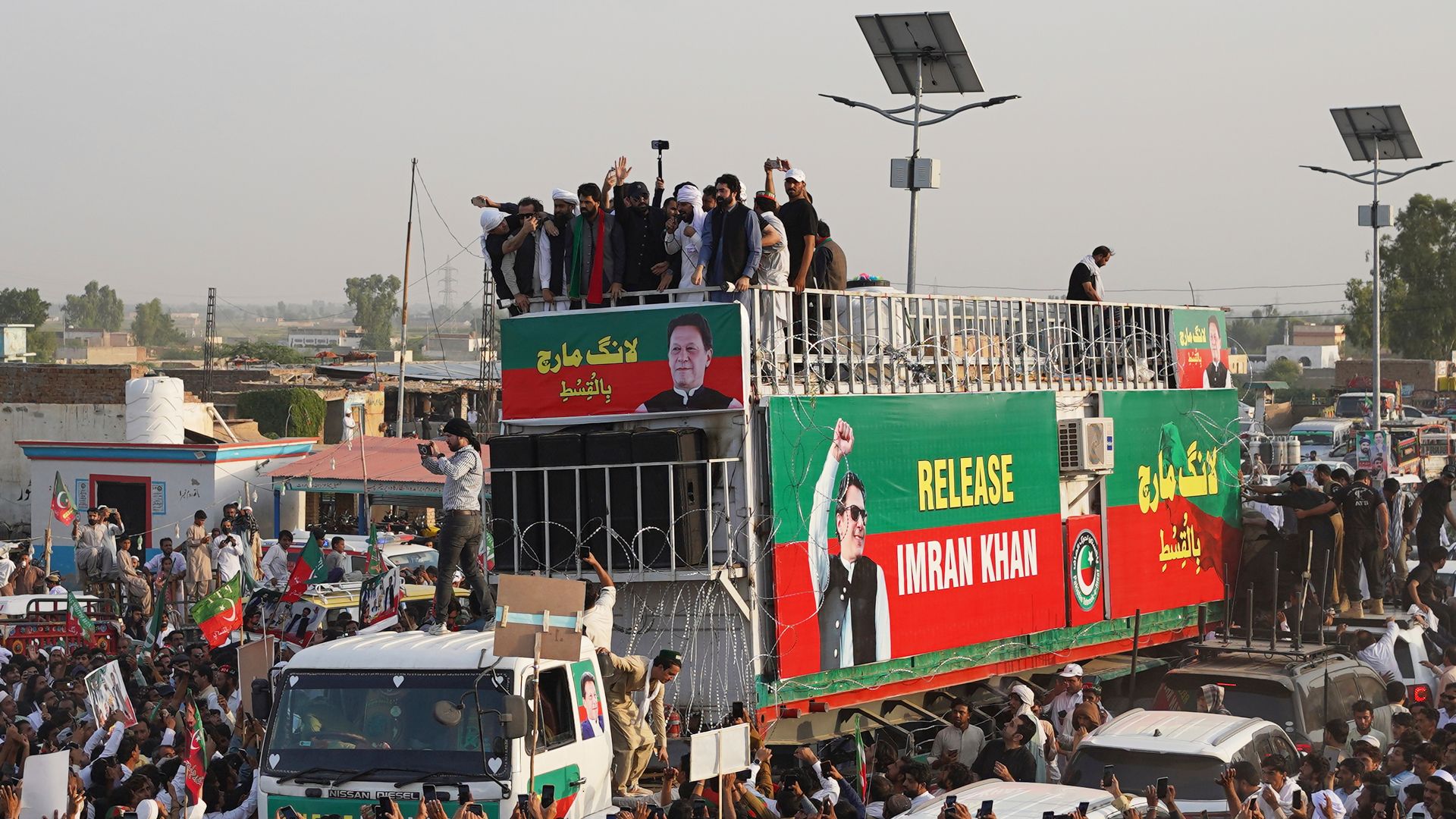
The shipping containers arrived first. They did not come with flags or fanfare. They came stacked high on the flatbeds of heavy-duty trucks, rumbling through the night to form a jagged, towering wall across the arteries of Pakistan’s capital. Steel on steel. Rust meeting the pale glare of sodium vapor lamps.
Islamabad was barricaded before the people even began to walk.
To understand what happens when thousands of supporters of imprisoned former Prime Minister Imran Khan push toward the Red Zone, you have to look at the asphalt. You have to look at the way a government responds when it is terrified of a crowd. The state turned its own boulevards into a labyrinth of concrete blocks and barbed wire, treating its citizens like an invading army.
And yet, they walked.
Consider a hypothetical shopkeeper from the dusty outskirts of Peshawar, let us call him Tariq. Tariq has never held a high-stakes political office. He has never drafted a policy paper or stood before a bank of microphones. His world is measured in the weight of flour sacks and the erratic flicker of a subsidized lightbulb. But Tariq closed his metal shutters, locked his shop, and joined the highway. Why? Not because he has memorized the legal charges against Khan—the disqualifications, the cipher cases, the prison sentences that stack like cordwood. Tariq marched because his electricity bill is three times what it was last year, because the purchasing power of the Pakistani rupee feels like an evaporating puddle under a July sun, and because he has been told, over and over, that his vote was an illusion.
When a crowd becomes a river, individual voices blur into a single, rhythmic roar.
The state calls it a security threat. The marchers call it a reckoning.
To look at Pakistan right now is to witness a profound collision between institutional inertia and raw, populist kinetic energy. Imran Khan sits inside Adiala Jail, stripped of his liberty, yet his presence exerts a gravitational pull that bends national politics entirely out of shape. He is an absence that commands more attention than any presence in the capital. Every locked gate, every shipping container, every tear gas canister fired into the autumn haze is an acknowledgment of that invisible power.
The government deployed the paramilitary Rangers. They invoked Section 144, banning public gatherings. They shut down mobile networks, plunging swaths of the country into a digital twilight where rumors travel faster than verified facts. They believed that by severing the digital tether, they could starve the movement of oxygen.
They miscalculated the architecture of human grievance.
When you muzzle a digital space, people take to the physical pavement. When you tell a citizen they cannot speak online, they show up at your barricade in person.
As the columns of marchers neared the federal capital, the tension tightened like a piano wire about to snap. Clashes erupted in bursts of smoke and scattering feet. Stones met rubber bullets. The air grew thick with chemical irritants, stinging the eyes of old men, young students, and weary laborers alike. These are the moments where history loses its abstract sheen and becomes visceral. It smells of burnt rubber, tear gas, and damp earth. It tastes like dust and desperation.
The authorities insist this is about maintaining public order. They argue that an unruly mob descending upon the seat of government threatens the constitutional fabric of the nation. They point to the disruption of commerce, the blocked roads, the potential for catastrophic violence. And from a technocratic perch, those are valid concerns. Chaos is expensive. An unstable capital frightens foreign investors and paralyzes diplomatic channels.
But here is the fracture line in that argument: order without legitimacy is merely occupation.
When millions of people feel that the electoral contract has been shredded, the streets become the only parliament left to them. The marchers do not see themselves as rioters; they see themselves as shareholders in a democracy attempting to reclaim a hijacked enterprise. They look at the barricades not as protection, but as proof that the ruling coalition fears the verdict of the populace.
History rarely moves in straight lines. It loops back on itself, repeating old tragedies with new costumes. Pakistan has walked this jagged road before. Leaders rise on waves of popular fervor, challenge the established establishment, stumble, fall, and find themselves behind bars, only for their followers to take up the banner with renewed, almost religious zeal. The cycle of confrontation between civilian populism, judicial maneuvering, and the deep state's invisible hand is a familiar script.
Yet, this chapter feels heavier. The economic stakes are existential. Pakistan is tethered to international bailout programs, struggling under a crushing debt burden, with inflation biting deep into the marrow of the working class. In such an environment, politics ceases to be a distant spectator sport. It is survival. When a family cannot afford wheat, political loyalty transforms from an abstract preference into a cry of defiance.
Standing at the edge of the police lines, watching the smoke drift across the Islamabad highway, you realize the futility of concrete blocks. You can stack them ten high. You can weld them together. You can wire them with razor wire and guard them with men in heavy helmets.
But you cannot stop a population that has decided it has nothing left to lose.
The sun dips low behind the Margalla Hills, casting long, bruised shadows across the barricades. The generators hum. The police grip their shields a little tighter. Out in the gathering dark, the distant, steady rumble of chanting continues to swell, refusing to fade into the night.


