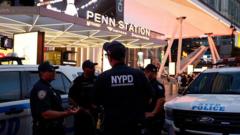
The air beneath Midtown Manhattan has its own weight. Anyone who has ever rushed through Pennsylvania Station knows the sensory overload of the place. It smells of damp concrete, stale pretzel grease, and the collective anxiety of hundreds of thousands of commuters desperately trying to be somewhere else. On a standard weeknight, it is a blur of motion. Faces blend into a monochromatic smear of humanity. You look down. You look at your phone. You avoid eye contact.
That survival mechanism—the intentional blindness of the urban commuter—is a shield. But on a recent evening, that shield shattered for hundreds of people in a matter of seconds.
Chaos does not announce itself with a trumpet blast. It begins with a shift in the ambient noise. A sudden tear in the fabric of the ordinary. A sharp yell, the scuffle of heavy boots, and then the sound that triggers a primal instinct in every human being: screaming. Inside the labyrinth of Penn Station, five people went from being anonymous travelers to statistics in a headline. But statistics are cold. They do not bleed, they do not feel the sudden, icy shock of adrenaline, and they do not have families waiting for them at the end of a train line.
To understand what happened, we have to look past the sterile police reports. We have to stand in the echoing corridors of the city's busiest transit hub and realize how fragile our illusion of safety truly is.
The Anatomy of an Instant
Imagine a man named Arthur. He is a hypothetical composite of the commuter crowd, but his routine is entirely real. Arthur is forty-two, carries a frayed laptop bag, and is thinking about a lingering spreadsheet as he navigates the subterranean maze near the eighth avenue subway lines. He is calculating whether he has time to grab a coffee before the 6:14 train to New Jersey.
Then, the world tilts.
A commotion erupts near the turnstiles. A flash of silver. A sudden, violent lunge. In the official press releases, the event is described with clinical precision: a suspect wielding a sharp object engaged in an altercation, resulting in five individuals sustaining non-life-threatening injuries.
But clinical language is a lie we tell ourselves to keep from panicking.
In reality, those affected did not experience a "non-life-threatening incident." They experienced a terrifying disruption of reality. For a victim, the blade is not a data point. It is a sudden, blinding flash of pain. It is the realization that a stranger has suddenly decided your life is disposable. The crowd, usually a cohesive river of commuters, fractured into a stampede. People dropped bags. Phones skittered across the dirty tile floors. Strangers knocked each other over, not out of malice, but out of the raw, desperate urge to survive.
The emergency response was swift. Siren wails soon echoed down from the street level, cutting through the heavy evening air. First responders descended into the subterranean heat, navigating against the tide of fleeing pedestrians. The five wounded were stabilized and rushed to nearby hospitals.
The physical wounds will heal. Stitches will be removed. Scars will fade into faint white lines. But the psychological architecture of those five individuals, and the hundreds who witnessed the flash of violence, has been permanently altered.
The Illusion of the Bubble
We walk through the world inside a protective bubble of assumptions. We assume the floor will hold. We assume the ceiling will not collapse. We assume the person walking toward us on the concourse is bound by the same social contract that keeps us from acting on our darkest impulses.
When an event like the Penn Station stabbing occurs, it pops that bubble. It forces a uncomfortable truth into our awareness: we are profoundly vulnerable.
This vulnerability is magnified by the very nature of transit hubs. Penn Station is a crossroads of the human condition. It funnels corporate executives, tourists, student groups, and the city’s most marginalized populations into the same narrow, low-ceilinged corridors. It is a pressure cooker. When mental health crises, systemic failures, and random malice collide in those tight spaces, the explosion is devastating.
Following the attack, the predictable cycle of public discourse began. Pundits demanded more policing. Officials promised increased surveillance. Critics pointed to systemic gaps in mental health infrastructure and the fraying social safety net of the city.
These debates are necessary, but they often miss the immediate, human reality of the aftermath. They treat the event as a political chess piece rather than a human tragedy. For the commuters returning to Penn Station the very next morning, the political talking points mattered less than the cold sweat on their palms as they descended the stairs back into the station.
The Morning After
Consider what happens next: the sun rises. The yellow crime scene tape is pulled down. Maintenance crews scrub the tiles until the stains disappear beneath the glare of fluorescent lights. The turnstiles click. The trains roll in.
The city demands resilience. It expects its inhabitants to shake off horror and get back to work.
Watch the commuters the morning after an attack. The atmosphere is noticeably different. The silence is heavier. People are no longer staring exclusively at their screens; their eyes dart. They scan jackets, watch hands, and calculate distances between themselves and the edges of the platform. The communal trust that allows a city of millions to function has been taxed.
This is the hidden tax of public violence. It is paid in increments of fear. It is the extra heartbeat of anxiety when someone shouts too loudly on a platform. It is the decision to stand against a pillar rather than in the open.
Yet, beneath the heightened tension, something else happens. A quiet, stubborn defiance emerges. People still show up. They still board the trains. They refuse to let fear dictate their geography. This resilience is not born out of bravery; it is born out of necessity. The rent must be paid. Life must move forward. The collective will of the city pushes back against the isolated act of a madman.
The Long Echo
We live in a culture that consumes tragedy rapidly. A news alert flashes on a screen, sits in the consciousness for an hour or two, and is displaced by the next catastrophe, the next political scandal, the next viral video. We have developed a high tolerance for collective trauma.
But for five families in New York, that evening remains frozen in time. It is a phone call received in the middle of dinner. It is the frantic drive to Bellevue or Mount Sinai. It is the agonizing wait in a sterile room smelling of industrial disinfectant, listening to the hum of vending machines while waiting for a doctor to appear through double doors.
The true cost of the Penn Station attack is found in those quiet rooms. It is found in the weeks of physical therapy, the unexpected medical bills, and the sudden, irrational fear of crowds that will plague the victims for years to come.
The story of Penn Station is not just a story of violence. It is a mirror reflecting the fragile, beautiful, and sometimes terrifying reality of modern urban life. We are all connected by the tracks we travel on, bound together in the tight spaces of our shared world. When one person strikes out, the ripples shake us all.
As the evening rush hour begins anew, the trains hiss to a halt. The doors slide open. The crowd pours out into the concrete cavern, a sea of individuals carrying their own burdens, their own dreams, and their own unspoken fears, walking together into the neon-lit dark.