Donald Trump’s recent broadside against the Vatican represents more than a standard political spat. It is a direct challenge to the oldest diplomatic institution on earth. By telling the Pope to "get his act together," Trump isn't just criticizing policy; he is attempting to displace the moral authority of the Church with his own brand of nationalist populism. This isn't a misunderstanding. It is a hostile takeover of the concept of divine mandate.
The friction between the 45th President and the Holy See has moved beyond the typical borders of immigration and climate change. It has entered the territory of the metaphysical. Trump views himself as the sole arbiter of American greatness, a position that requires him to be beyond the reach of traditional moral critique. When the Pope speaks on behalf of the "least of these," he isn't just offering a different political opinion. He is asserting a spiritual hierarchy that Trump refuses to recognize.
The Theology of America First
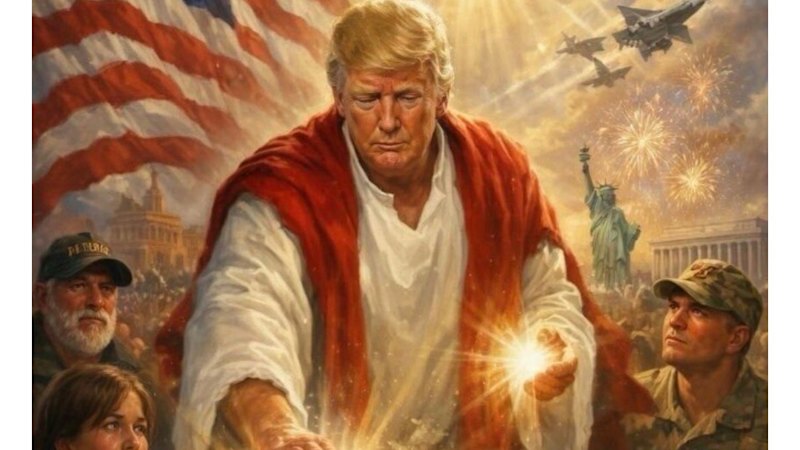
To understand the vitriol, one must look at how Trump has successfully reframed the Republican base’s relationship with faith. For decades, the religious right looked to institutional leaders for guidance. Trump flipped the script. He convinced a massive segment of the electorate that he is the protector of their faith, regardless of his personal adherence to its tenets. This created a new kind of secularized religion where the "Nation" is the temple and Trump is the high priest.
When the Pope critiques capitalism or calls for open borders, he is attacking the pillars of this new American faith. Trump’s response—that the Pope needs to "get his act together"—is a signal to his followers that no international body, not even one claiming a direct line to God, has jurisdiction over the American interest. It is an assertion of absolute sovereignty.
The Border as a Sacred Wall
The most frequent flashpoint remains the physical border. For the Pope, the wall is a symbol of exclusion that contradicts the Gospel. For Trump, the wall is the primary sacrament of his movement. He views the Pope's intervention as an infringement on national security. The rhetoric used by the Trump camp suggests that the Church has been compromised by "globalist" interests, rendering its moral proclamations void.
This isn't just about bricks and mortar. It’s about who defines the "neighbor." The Pope uses the term in the biblical sense, encompassing the migrant and the refugee. Trump restricts the term to the citizen. By narrowing the scope of moral obligation, Trump makes it easier for his supporters to ignore the Vatican's pleas without feeling like they are abandoning their religion.
The Infallibility Trap
The Catholic Church operates on the doctrine of Papal Infallibility, though it is strictly limited to matters of faith and morals. Trump operates on a version of political infallibility. He cannot admit error because his brand is built on the image of the "winner." When these two versions of certainty collide, the result is a total breakdown in communication.
Trump’s "God complex" isn't necessarily a belief that he is a deity. It is a belief that his instincts are superior to any established tradition or expertise. In his worldview, a Pope who doesn't prioritize the economic interests of the West is a "weak" leader. Strength is the only currency Trump respects. By telling the Pope to fix his house, Trump is attempting to exert dominance over an entity that has survived for two millennia.
Why the Base Chooses the Politician over the Priest
It seems counterintuitive that devout Catholics and Evangelicals would side with a real estate mogul over the Bishop of Rome. However, the data shows a clear shift. Many American Christians feel abandoned by what they perceive as the "liberal" drift of the modern Church. Trump offers them something the Pope does not: a sense of immediate, tangible power.
The Pope offers penance and sacrifice. Trump offers victory and restoration. For a population that feels culturally besieged, the promise of a "win" is far more intoxicating than a lecture on global solidarity. Trump has tapped into a deep-seated desire for a muscular Christianity that fights back, even if it has to fight the Church itself to do so.
The Geopolitical Fallout
This tension has real-world consequences for American soft power. The Vatican remains a massive player in international mediation. From the normalization of relations with Cuba to peace talks in Africa and South America, the Holy See often goes where traditional diplomats cannot.
By alienating the Pope, the Trump administration risks losing a vital channel of communication. If the U.S. is seen as being at odds with the moral center of the Western world, its ability to lead a global coalition is severely diminished. Trump’s "America First" policy becomes "America Alone" when even the most ancient allies are publicly berated.
The Roman Response
The Vatican’s response has been uncharacteristically blunt. While they typically prefer the shadows of "quiet diplomacy," the scale of Trump’s rhetoric has forced them into the light. The Pope’s remarks about those who build walls not being Christian were a direct shot across the bow. It was a rare moment where the Church explicitly linked political policy to spiritual status.
This back-and-forth has created a schism within the American Church. We now see "Trump Catholics" who are more aligned with the MAGA platform than with the social teachings of the Papacy. This internal divide weakens the Church’s influence in Washington, allowing Trump to operate with even less religious oversight than his predecessors.
The Weaponization of Secularism
Ironically, Trump uses the language of secularism to defend his religious posture. He argues that the Church should stay out of politics, a stance usually reserved for the far left. By demanding the Pope focus on "church business," Trump is attempting to quarantine the Church's influence to the pews and the liturgy, keeping it far away from the halls of power where policy is made.
This is a strategic move. If the Church is confined to the "spiritual realm," it cannot comment on tax cuts, environmental deregulation, or military intervention. Trump wants a religion that provides a moral veneer for his actions without ever questioning the actions themselves. He wants a Chaplain, not a Prophet.
The Mirror of Modern Populism
This conflict is mirrored in other parts of the world. In Hungary, Brazil, and Italy, populist leaders have frequently clashed with religious institutions that prioritize human rights over national identity. Trump is simply the most visible practitioner of this trend. He represents a global movement that views internationalism—whether it’s the UN or the Vatican—as a threat to the "will of the people."
The "God complex" isn't just a personal quirk of Trump’s personality. It is a requirement of modern populism. To lead a movement that demands absolute loyalty, one must eventually displace any other source of ultimate authority. The Pope is simply the most formidable obstacle in that path.
The End of the Consensus
For decades, there was a quiet agreement that American politicians would at least pay lip service to the Vatican. That era is over. Trump has shown that there is no political cost to attacking the Pope—in fact, there might be a benefit. It fires up his base, reinforces his "outsider" status, and proves he is willing to say what others will not.
This shift marks a permanent change in the American political landscape. The religious vote is no longer a monolith that follows the lead of the clergy. It is a fragmented, highly politicized group that is increasingly taking its cues from cable news and social media rather than the pulpit.
The Strategy of Chaos
By attacking the Pope, Trump also creates a distraction. Every hour spent debating his "God complex" is an hour not spent discussing the specifics of his legislative agenda or his legal challenges. It is a classic move from the Trump playbook: pick a fight with a beloved figure to dominate the news cycle and force everyone to take a side.
The Vatican, for its part, seems unsure how to handle a leader who refuses to follow the traditional rules of engagement. You cannot shame someone who views shame as a weakness. You cannot bargain with someone who views every interaction as a zero-sum game.
The Future of the Moral High Ground
The long-term impact of this feud will be measured in the erosion of institutional trust. If Trump can convince millions of people that the Pope is "out of touch" or "part of the swamp," he effectively removes the final check on his moral authority. At that point, the definition of "right" and "wrong" becomes whatever the executive says it is.
This is the ultimate goal of the "God complex." It is not about wanting to be worshipped; it is about wanting to be unquestioned. When the leader of the free world tells the Vicar of Christ to "get his act together," he is telling the world that the era of moral accountability is over. The only thing that matters now is power.
The American electorate is currently participating in a massive experiment. Can a democracy function when its leaders reject every external moral compass in favor of their own reflection? The answer will not come from the Vatican, and it won't come from the White House. It will come from the voters who must decide if they want a president or a sovereign who answers to no one.
The tension remains unresolved because it is unresolvable. As long as Trump views compromise as surrender and the Pope views the marginalized as a priority, the two will remain on a collision course. The question for the public is which version of "infallibility" they are willing to live under.
The altar and the rally stage are now in direct competition for the heart of the country. One promises a difficult path toward a universal good; the other promises a quick return to a gilded past. In the current climate, the gilded past is winning.