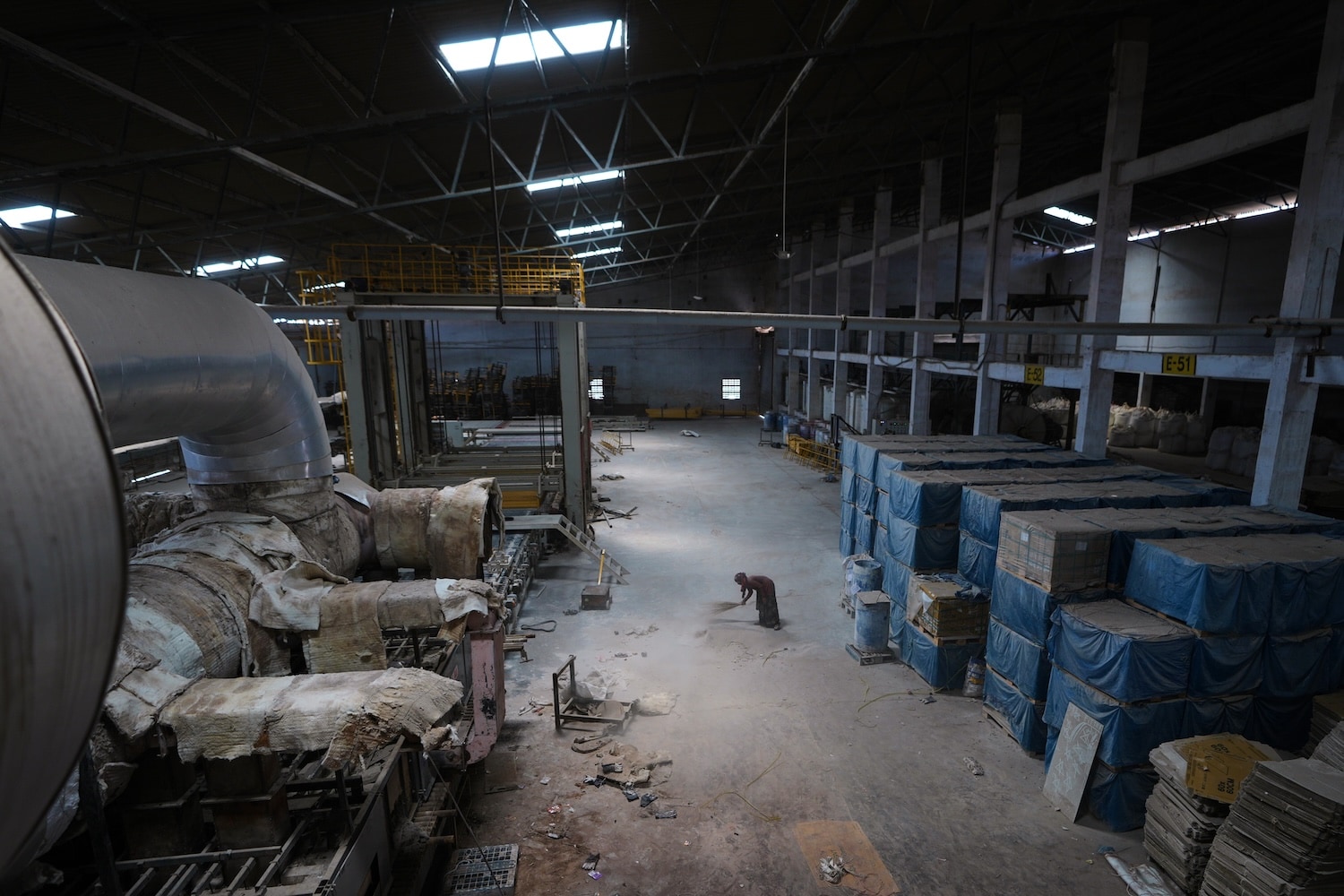
The dust in Morbi doesn’t just settle; it claims everything. It coats the windshields of thousands of trucks, the eyelashes of factory workers, and the tea stalls that line the National Highway 8A. For decades, this patch of Gujarat has been the ceramic heartbeat of the world, second only to China. It is a place defined by heat. The roar of the kilns—massive, block-long tunnels of fire—is the town’s constant soundtrack.
But lately, the roar has faded into a terrifying silence.
The fire is dying. Not because the world has stopped wanting tiles, but because a war thousands of miles away has choked the veins of the city. Morbi runs on natural gas. Specifically, it runs on gas that flows through a geopolitical labyrinth involving Iran and the shifting sands of Middle Eastern conflict. When the missiles fly and the tankers stop moving, the temperature in Gujarat drops.
The Ghost in the Machine
Consider Rajesh. He isn’t a CEO or a politician. He is a "kiln master," a man whose entire existence is calibrated to the precise color of a flame. In his world, a two-degree drop in temperature isn’t just a statistic; it’s a batch of ruined porcelain. It’s the difference between a high-gloss finish and a dull, brittle sheet of clay.
When the news broke that the gas supply from Iran was disrupted, Rajesh didn't look at a stock ticker. He looked at the pressure gauges. He watched the needles dip. He felt the radiating warmth of the factory floor begin to ebb away, replaced by the damp, creeping chill of an idle industrial park.
Morbi houses over 800 ceramic units. They produce everything from the sleek floor tiles in London high-rises to the sanitaryware in suburban homes across India. Together, they consume staggering amounts of energy. For years, the trade-off was simple: India provided the manufacturing muscle, and the Middle East provided the fuel. It was a marriage of convenience that ignored the fragility of the bridge connecting them.
Now, that bridge is on fire. Or rather, the fire that crossed it has been snuffed out.
The Geography of a Heartbeat
To understand why a disruption in Iranian gas matters so much, you have to understand the sheer scale of Morbi’s hunger. The hub consumes nearly 7 million cubic meters of gas every single day. This isn't a commodity that can be swapped out like a different brand of flour in a bakery. The infrastructure is hard-wired. The kilns are tuned to specific pressures and chemical compositions.
When the Iranian supply chain falters—due to sanctions, regional escalations, or the looming shadow of wider conflict—Morbi is forced to turn to the spot market. This is the industrial equivalent of buying gasoline by the thimble at a premium price during a hurricane.
The prices don't just rise. They explode.
The cost of liquefied natural gas (LNG) can jump by 30% or 40% in a single week. For a factory owner operating on razor-thin margins, this is a death sentence. They face a choice that isn't really a choice: run the kilns at a massive loss or shut them down and watch their workforce drift away.
The Human Cost of Cold Stone
Silence is the loudest sound in an industrial town. When the kilns go cold, the ecosystem collapses. The truck drivers who move the finished goods find themselves sleeping in their cabs, waiting for loads that never come. The small vendors selling thepla and tea outside the factory gates see their daily earnings vanish.
There is a psychological weight to a dead factory. The ceramic process is continuous; once a kiln is shut down, restarting it is an arduous, expensive process that can take days. It is an admission of defeat. Each cold kiln represents hundreds of families whose stability is tethered to a pipeline they will never see, controlled by leaders they will never meet.
The irony is thick. Morbi has always prided itself on resilience. It survived the devastating 1979 Machchhu dam failure and the 2001 earthquake. It rebuilt itself into a global titan. Yet, this current crisis is different. It is invisible. You cannot dig your way out of a gas shortage with a shovel. You cannot rebuild a broken supply chain with bricks and mortar.
The Redirection of Power
The struggle for Morbi is a microcosm of a much larger shift. We are witnessing the end of the era of "easy" globalization. For thirty years, the world operated on the assumption that resources would always flow to where the labor was cheapest and the manufacturing was most efficient. We built a world of deep dependencies.
Now, the bill is coming due.
The Indian government and the Gujarat State Petroleum Corporation are scrambling to find alternatives. They talk of diversifying, of looking toward Qatar or the United States, or even pivoting to electric kilns. But transitions take time. Time is the one thing a kiln master like Rajesh doesn't have. His clay is drying. His orders are being cancelled. His competitors in other countries are already circling, ready to pounce on the market share Morbi has spent decades securing.
The shift to "green" energy is often discussed in plush boardrooms as a moral imperative. In Morbi, it is discussed as a matter of survival. If they cannot find a way to heat their furnaces without being held hostage by the volatility of the Strait of Hormuz, the town will become a museum of what used to be.
The Fragility of the Finished Product
There is something poetic about a ceramic tile. It is a piece of earth, baked until it becomes as hard as stone and as beautiful as glass. It is designed to last for centuries. It is the floor your children will learn to walk on and the walls that will surround your most private moments.
But before it is permanent, it is incredibly fragile. Before it is fired, it is just mud. If the heat fluctuates, it cracks. If the gas stops, it remains mud.
We walk over these surfaces every day without thinking about the fire required to make them. We don't think about the pressure gauges in Gujarat or the geopolitical chess match in the Persian Gulf. We only care that the tile is straight and the color is right.
Behind that perfection is a town holding its breath. Thousands of men and women are looking at the sky, not for rain, but for a sign that the madness elsewhere will stop long enough for them to relight their fires. They are waiting for the heat to return. They are waiting to hear the roar again.
Until then, the dust continues to settle. It covers the silent machines and the empty crates. It settles on the hands of the workers who have nothing to do but wait. In the darkness of the world’s most famous tile hub, the only thing being manufactured right now is uncertainty.
The kilns are cold, and the world is starting to feel the chill.