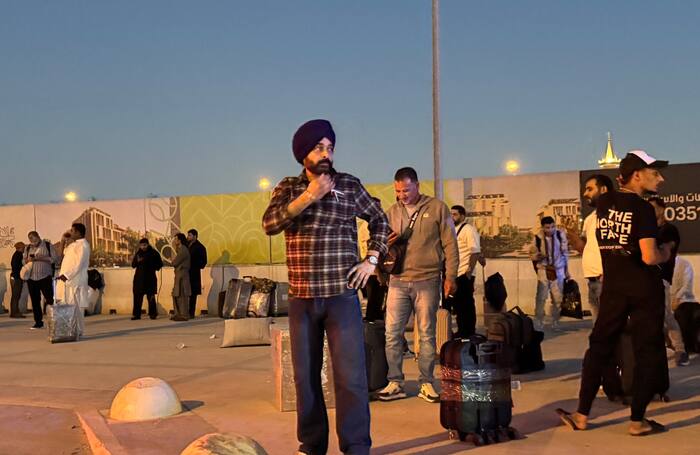
The lazy consensus arrives packaged in panic. Whenever a threat materializes in the Gulf, the reflexive playbook is predictable: shutter the airspace, push schools behind computer screens, and let the machinery of alarmism run at full speed. Headlines blare about suspended flights in Riyadh and empty desks, framing every disruption as an existential siege. It makes for high-drama reporting, but it fundamentally misunderstands how modern urban centers absorb shock.
Panicking over temporary airspace closures and remote classrooms treats the symptom while ignoring the system's actual resilience. Cities like Riyadh do not grind to a halt because a regional flare-up triggers a defensive posture. They adapt, absorb, and recalibrate while the outside observers fixate on the temporary scramble.
Let us look at what the conventional narrative misses. When security protocols force airports to lock down or shift learning online, the assumption is that the society is fracturing under pressure. The reality is far more mundane and far more resilient. Critical infrastructure possesses redundancy that knee-jerk media coverage completely ignores. Supply chains reroute. Logistics networks adjust. Virtual learning environments scale up in hours, not weeks, because the infrastructure for digital continuity has been standard practice for years.
Treating a defensive security measure as a sign of systemic collapse is lazy analysis. Airspace suspensions are tactical pauses. They are designed to mitigate risk in a narrow window, not signal the unraveling of a regional economy. Yet the commentary treats every flight diversion as a catastrophe, feeding a doom loop that benefits nobody except the purveyors of anxiety.
The real story is not that a flight got delayed or a classroom moved to the cloud. The real story is the speed with which a metropolis of millions absorbs a kinetic shock and keeps moving.
Consider the operational reality of aviation hubs in the Middle East. These facilities are engineered with redundancy that most Western planners can only envy. When a corridor closes, alternate routes open. When airspace tightens, scheduling algorithms reoptimize within minutes. Calling this a crisis ignores the heavy lifting done by logistics professionals who plan for precisely these disruptions every single day. I have watched operations teams manage airspace shifts under intense pressure, and the contrast between their calculated execution and the frantic panic on cable news is staggering.
Then there is the reflexive pivot to online education. For years, skeptics treated remote learning as a broken compromise born of emergency. That excuse expired long ago. Shifting Riyadh schools online overnight is not an educational crisis; it is a demonstration of institutional muscle memory. The systems are built, tested, and ready. Treating a routine pivot to digital classrooms as a tragedy misreads the flexibility of modern youth and educators.
The danger lies in letting the panic dictate the strategy. When leaders pander to the worst-case framing, they incentivize permanent overreaction. Every minor friction point gets blown into a structural failure. That creates a feedback loop where caution is mistaken for weakness, and prudence is painted as panic.
Stop treating temporary defensive measures as systemic defeats. A resilient city does not pretend threats do not exist; it builds systems flexible enough to absorb them without breaking stride. The next time a headline screams about closures and canceled routes, look past the sirens. The real action isn't the pause. It's how fast the gears start turning again.


