Mateo watches the crack in his kitchen wall the way a sailor watches a storm on the horizon. It is a thin, jagged lightning bolt that runs from the ceiling down to the floorboards, widening by a fraction of a millimeter every month. He doesn’t need a satellite to tell him what is happening. He doesn't need a PhD in geology or a specialized sensor from the European Space Agency. He just needs to try and roll a marble across his floor. It always rolls toward the eastern corner, pulled by the slow, relentless tilt of a house that is no longer level with the world.
Mexico City is disappearing.
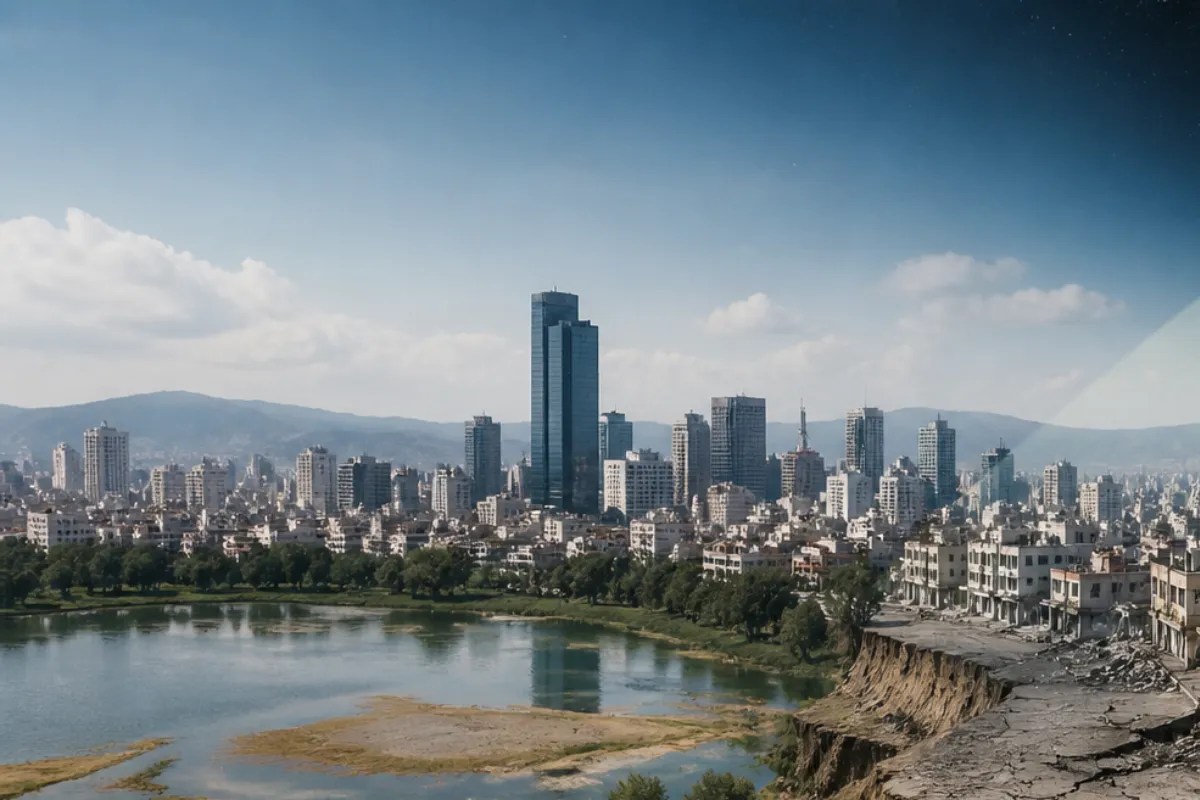
It isn't vanishing in a sudden, cinematic burst of fire or a dramatic tectonic shift. It is retreating into the earth, inch by agonizing inch, at a rate that has now reached nearly twenty inches per year in certain neighborhoods. To look at the city from a satellite is to see a bowl that is slowly collapsing in on itself. But to stand on the ground in Iztapalapa or the Centro Histórico is to feel the weight of ten million lives pressing down on a foundation of mud.
The Ghost of a Great Lake
The problem began five centuries ago with a misunderstanding of water. When the Spanish arrived, they found Tenochtitlan, a shimmering Aztec capital built on an island in the middle of Lake Texcoco. It was a masterpiece of hydraulic engineering, a city that lived in harmony with the tides. The conquistadors saw the water as an enemy, a barrier to the paved, dry European ideal they craved. They drained the lake. They replaced the water with stone and soil.
They didn't realize they were building a megalopolis on top of a sponge.
The soil beneath Mexico City is a highly compressible volcanic clay. Imagine a massive, water-logged sponge. As long as that sponge is full of water, it can support weight. But the moment you begin to squeeze the water out, the structure of the sponge collapses. It shrinks. It hardens. And once it has been squeezed dry, it can never be reflated.
Today, the twenty-one million people living in the metropolitan area are thirsty. Because the natural lake system was destroyed, the city has to look elsewhere for its lifeblood. It looks down. About 70% of the city’s drinking water is pumped from the ancient aquifers deep underground. Every gallon extracted is a gallon of support removed from the city’s feet.
The result is a phenomenon known as subsidence. It is the literal sinking of the land. In the last century, parts of the city have dropped by more than thirty feet. The Angel of Independence, the iconic gilded monument on the Paseo de la Reforma, was originally built at street level. Today, city officials have had to add more than a dozen steps to its base because the monument sits on deep, sturdy piles that haven't moved, while the street around it has simply fallen away.
The Hidden War Underground
Walking through the Centro Histórico is an exercise in vertigo. You see a colonial church leaning precariously to the left, while the modern office building next to it bows to the right. The sidewalks are a topographical map of disaster, buckled and heaved by the uneven pressure of the sinking earth.
Consider the hypothetical life of Sofia, a municipal engineer. Her entire career is spent fighting a war against gravity that she knows she cannot win. When the ground sinks unevenly—which it always does—it tears apart the city's nervous system. Water pipes snap. Sewage lines crack and begin to flow backward.
Because the pipes are constantly breaking, the city loses about 40% of its treated water to leaks before it ever reaches a faucet. It is a cruel irony: the city is sinking because it is pumping too much water out of the ground, yet it is desperately short of water because the sinking is destroying the infrastructure meant to deliver it.
The stakes are not just aesthetic. They are existential.
As the ground settles, the clay layers become more compact. This changes the way seismic waves move through the earth. During the devastating earthquakes of 1985 and 2017, the soft, water-saturated lakebed acted like a bowl of gelatin, magnifying the tremors and causing buildings to oscillate until they collapsed. The more the city sinks, the more it alters its own vulnerability to the next big one.
A Problem Seen From the Heavens
In recent years, the scale of this collapse has moved from local observation to global alarm. InSAR technology—Interferometric Synthetic Aperture Radar—has allowed scientists to map the city’s descent with terrifying precision. Satellites orbiting hundreds of miles above the Earth bounce radar signals off the rooftops of Mexico City, measuring the time it takes for the signal to return.
The data is undeniable.
Unlike many other sinking cities around the world, such as Venice or Bangkok, Mexico City’s subsidence is not primarily caused by rising sea levels. It is entirely self-inflicted. It is an internal collapse. The weight of the buildings and the extraction of the water have created a downward spiral that the satellites show is accelerating.
The most alarming discovery is that the sinking is now irreversible. Even if the city stopped pumping water tomorrow, the clay layers have already been crushed. The "pore pressure" that once held the earth up is gone. The city has committed to its descent.
The Weight of Inequality
The sinking isn't a democratic disaster. It chooses its victims based on their zip code.
In the wealthier neighborhoods of the west, where the ground is firmer and built on volcanic rock, the sinking is negligible. But in the east, in the sprawling, working-class districts like Iztapalapa, the earth is a traitor. Here, the sinking is at its most violent.
Families in these areas spend their weekends patching cracks that reappear within a month. They watch as their front doors become stuck in their frames because the house has shifted two inches to the side. They live with the constant hum of water trucks—the pipas—because the municipal lines have long since shattered under the pressure of the subsiding soil.
The people here are the first to feel the "water stress" that the rest of the world discusses in academic terms. They are living in the future of urban crisis. They are the pioneers of a world where the very ground beneath your feet is a finite resource.
The Search for a New Rhythm
There are solutions, but they require a total reimagining of what a city is.
Architects and urban planners are beginning to talk about "Sponge Cities"—urban environments designed to absorb rainwater rather than shunting it into drains. If Mexico City could capture the massive deluges it receives during the rainy season and use them to recharge the aquifers, it might slow the descent.
Some neighborhoods are experimenting with permeable pavement. Others are installing massive rainwater harvesting systems on their roofs. There is a growing movement to restore the ancient "chinampas"—the floating gardens of the Aztecs—which would allow the city to coexist with its water rather than fighting a war it is destined to lose.
But these are small interventions against a massive, historical momentum.
To save Mexico City, the inhabitants must change their relationship with the earth. They have to stop viewing the lakebed as a platform to be conquered and start viewing it as a living, breathing entity that requires balance.
Mateo still watches the crack in his wall. He has stopped filling it with plaster; he knows the plaster will only crack again. Instead, he has started to measure it. He talks to his neighbors about how much their floors have tilted. They have developed a dark humor about it, joking about which house will reach the center of the earth first.
But underneath the jokes is a profound, quiet resilience. They are the inhabitants of a city that is literally folding into history. They walk on streets that were once water, living in houses that are slowly returning to the mud.
The satellites will continue to watch from above, recording the slow, steady fall of a great civilization. They will see the bowl deepen and the edges fray. But they won't see the way a mother in Iztapalapa adjusts her child’s bed so they don't roll into the wall at night. They won't see the way a community gathers to repair a broken pipe for the tenth time in a year.
Mexico City is sinking, yes. But it is not drowning. It is learning how to breathe underwater, one broken pipe and one tilted floorboard at a time. The earth is claiming its due, but the people are still there, stubbornly carving out a life on a foundation that refuses to stay still.
The marble on Mateo's floor hits the wall with a soft click. He picks it up, walks back to the high side of the room, and lets it go again.