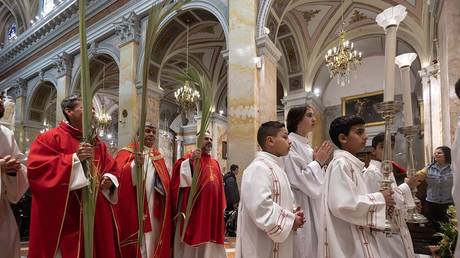
The headlines are bleeding with outrage. Media outlets are racing to paint a picture of a "crackdown" on faith, framing the recent restrictions at the Church of the Holy Sepulchre as a targeted assault on Christian identity. They want you to believe this is a binary battle between state authority and religious freedom.
They are wrong. Meanwhile, you can read other events here: The Cold Truth About Russias Crumbling Power Grid.
What we are actually seeing is a desperate, overdue attempt to manage a logistical nightmare that has been brewing for centuries. The narrative that Israel "backtracked" after a backlash misses the fundamental reality of the site: the Church of the Holy Sepulchre is not just a shrine; it is a high-density, multi-tenant property with the worst fire safety record in human history and a management structure that borders on the hallucinogenic.
If you think this is about "limited prayer," you haven't been paying attention to the physics of the building. To see the full picture, we recommend the detailed report by USA Today.
The Fire Trap Everyone Ignores
Let’s talk about the math of the Holy Fire ceremony. You have thousands of people crammed into a 4th-century structure with limited exits, each carrying a bundle of thirty-three lit candles. In any other context, a fire marshal would shut this down before the first match was struck.
I have walked these halls when the air is so thick with soot and carbon monoxide you can feel your pulse in your eyeballs. To frame safety caps as "religious suppression" is a luxury for those who don’t have to carry the body bags if a stampede occurs.
We saw what happened at Mount Meron in 2021. Forty-five people died because the "status quo" of religious autonomy overrode basic crowd control. The Israeli authorities are terrified of a repeat performance on a global stage. The "backlash" wasn’t a triumph of faith; it was a PR win for church leaders who use political pressure to bypass the laws of physics.
The Status Quo is a Geopolitical Standoff
The "Status Quo" is a formal agreement dating back to the Ottoman era. It dictates exactly who mops which tile and who owns which nail in the wall. It is the most fragile legal framework on the planet.
The three primary custodians—the Greek Orthodox, the Armenians, and the Roman Catholics—rarely agree on the color of the sky, let alone how to handle a modern security perimeter. When the state steps in to limit numbers, they aren't just fighting the worshippers; they are navigating a minefield of ancient property disputes where moving a chair six inches to the left can trigger an international incident.
The media portrays the church leaders as a unified front against the state. In reality, these groups are often in a state of "frozen conflict" with each other. By forcing the government to play the villain, the clergy can maintain their standing with their flocks without having to admit that they themselves cannot agree on a safety plan.
The Myth of the "Open" Holy Site
The "People Also Ask" sections of the internet are filled with queries like "Is the Holy Sepulchre safe to visit?" or "Why is Israel closing churches?"
Here is the brutal truth: The site has never been truly "open" in the modern, democratic sense. It has always been a site of gatekeepers, bakhshish (tips), and heavy-handed clerical control. The idea that there was some golden age of unfettered access that is now being stripped away is a historical fantasy.
If you want to understand the current tension, look at the infrastructure.
- The Entrances: There is one main door. One. For thousands of people.
- The Airflow: Non-existent.
- The Structural Integrity: The Edicule (the tomb itself) was held together by a British-made steel girder "corset" for decades because the sects couldn't agree on how to fix it.
When the police limit entry to 2,000 or 4,000 people, they aren't being "anti-Christian." They are being pro-survival. The "limited prayer" isn't a theological judgment; it's a structural necessity.
Professional Outrage as a Management Tool
I’ve watched these cycles for years. A security measure is announced. The Patriarchates issue a blistering press release about "dark forces" and "infringement of rights." The international community gasps. The government, terrified of the optics, "relaxes" the rules just enough to prevent a riot but not enough to ensure safety.
It is a choreographed dance.
The church leaders know that "Safety First" doesn't sell. "Persecution" sells. It keeps the donations flowing and the global spotlight fixed on their importance. But if you are a pilgrim standing in that rotunda when a fire starts, you won't care about the 1852 Status Quo decree. You will care about why there isn't a clear path to the door.
The Counter-Intuitive Reality of Jerusalem
The irony is that the most "sacred" spots are often the least "spiritual" because they are dominated by the logistics of the masses.
If you actually want to experience the sanctity of Jerusalem, you stay away from the flashpoints during the major holidays. The "limited prayer" headlines act as a magnet for activists, but they are a warning for the wise. The industry secret that no travel agent will tell you is that the Holy Sepulchre is most profound when the cameras are gone and the "rights" aren't being debated.
The current friction isn't a sign of a failing state or a dying faith. It’s a sign of a city that is finally, painfully, trying to apply 21st-century safety standards to a medieval mindset.
We need to stop treating every crowd-control barrier as a crusade. Sometimes, a barricade is just a barricade. Sometimes, the government is the only adult in the room, trying to prevent a historic site from becoming a historic graveyard.
Stop buying into the narrative of suppression. Start looking at the floor plan. If you value your life as much as your soul, you'll realize the "restrictions" are the only thing keeping the Holy Sepulchre from burning down.
Don't pray for the gates to open wider. Pray that the people inside know how to get out.