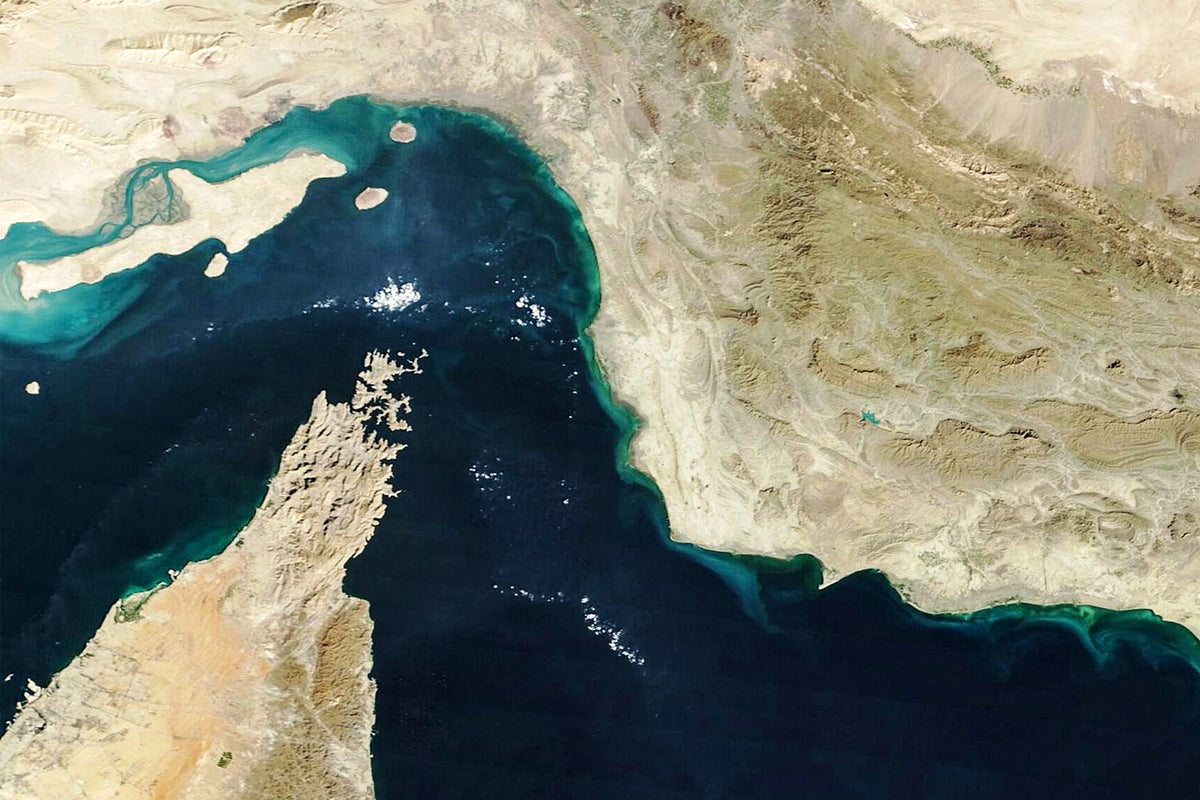
Twenty-one miles. That is the distance between the jagged cliffs of Oman and the Iranian coast. To look at it on a map, the Strait of Hormuz appears as nothing more than a tiny, pinched nerve in the neck of the Persian Gulf. But through this blue vein pulses nearly thirty percent of the world’s seaborne oil. If that nerve is severed, the lights do not just go out in the Middle East. They flicker in Tokyo, dim in London, and grow prohibitively expensive in the American Midwest.
Consider a captain named Elias. He is hypothetical, but his anxiety is shared by every merchant mariner currently navigating a Very Large Crude Carrier (VLCC) through those waters. Elias stands on a bridge high above 2 million barrels of volatile cargo. He knows that his ship, nearly the size of the Empire State Building laid on its side, is essentially a giant, slow-moving target. He is not worried about a storm. He is worried about a fifteen-foot fiberglass boat with an outboard motor and a shoulder-fired missile.
This is the fragility of our modern existence. We live in a digital age, yet we are tethered to a physical geography that has not changed since the dawn of empire. The United States and Iran have been locked in a cold stare across this water for decades, but the current rhetoric has shifted from diplomatic posturing to a tangible, logistical threat of a blockade.
The Geography of a Nightmare
To understand why a blockade is so terrifying, you have to understand the math of the water. The shipping lanes are narrow. Because of the depth requirements for massive tankers, the actual navigable path for inbound and outbound traffic is only two miles wide in each direction, separated by a two-mile buffer zone.
Imagine a six-lane highway being squeezed into a single alleyway.
If the U.S. or its allies decide to "choke" the strait, or if Iran attempts to shutter it in retaliation for sanctions, they don't need a massive armada of battleships. Modern naval warfare in the Persian Gulf is an exercise in asymmetry.
Iran has spent forty years perfecting the art of the "mosquito fleet." They utilize hundreds of fast-attack craft that can swarm a larger vessel like hornets. They possess a massive stockpile of sea mines—some sophisticated, some little more than floating contact bombs designed decades ago. In a narrow channel, a handful of well-placed mines creates a psychological barrier that no insurance company on earth will allow a tanker to cross.
The American Calculus
The United States maintains a permanent presence in the region through the Fifth Fleet, headquartered in Bahrain. For Washington, the threat of a blockade is a tool of "maximum pressure." The logic is simple: if the global economy is the heart, the Strait of Hormuz is the primary artery. By threatening to restrict movement, the U.S. signals to the world—and specifically to China, the largest importer of Persian Gulf oil—that the flow of energy is a privilege, not a right.
But how would a blockade actually work?
It wouldn't look like a wall of ships. It would look like a "Maritime Security Zone." The U.S. Navy would use its Aegis Combat System to track every moving object within a hundred miles. Drones like the MQ-4C Triton would circle at 50,000 feet, providing a constant, unblinking eye over the water.
If a ship refuses to comply with an inspection or attempts to bypass a closed lane, the escalation is rapid. First comes the radio warning. Then the electronic jamming, where the ship’s GPS begins to drift and its communication goes silent. Finally, there is the kinetic option: a boarding party from a helicopter or a precision strike on the ship’s rudder.
The goal isn't to sink ships. Sinking a tanker is an ecological and logistical catastrophe that no one wants. The goal is to make the risk of moving through the strait higher than any profit margin can justify.
The Hidden Cost of a Single Spark
What happens when the flow stops?
Most people think of the gas pump. That is the immediate, visceral reaction. We see the numbers tick up at the station on the corner and we feel a pinch in our wallets. But the "invisible stakes" go much deeper.
The global economy operates on a "just-in-time" delivery model. Refineries in South Korea and India are calibrated to process specific grades of crude coming out of the Gulf. If those ships stop for even ten days, those refineries begin to shut down. When refineries shut down, the production of plastics, fertilizers, and chemicals stalls.
Think about a farmer in Iowa. He might not know where the Strait of Hormuz is, and he might not care about naval maneuvers in the Gulf of Oman. But the fertilizer he needs for his spring planting is a byproduct of the petroleum industry. If the Strait is blocked, his costs double. The price of bread in his local grocery store rises. The stability of his community begins to fray.
This is the butterfly effect of 21st-century geopolitics. A skirmish between a patrol boat and a destroyer in a distant body of water can trigger a recession in a hemisphere that is fast asleep when the shots are fired.
The Ghost of 1988
We have been here before, though the stakes were smaller then. During the "Tanker War" of the 1980s, Iran and Iraq both targeted merchant vessels to bleed each other’s economies. The U.S. launched Operation Earnest Will, the largest naval convoy operation since World War II, to protect Kuwaiti tankers.
It was a chaotic, bloody period. It culminated in Operation Praying Mantis, a single day of high-seas combat where the U.S. Navy destroyed a significant portion of the Iranian fleet.
The lesson from 1988 is that once a blockade begins, it is almost impossible to keep it "limited." Violence in the Strait has a way of expanding. It spills over into the air, into the cyber realm, and into the oil fields themselves. If a blockade is enforced, the response isn't just on the water; it is a missile strike on a desalination plant in Riyadh or a cyberattack on a power grid in Virginia.
The Technology of Denial
Today, the "tools of the trade" have evolved. We are no longer just talking about cannons and torpedoes.
- Smart Mines: Modern mines can be programmed to ignore small fishing boats and only detonate when the specific acoustic signature of a heavy tanker passes overhead.
- Anti-Ship Ballistic Missiles: Iran’s Khalij Fars missile is designed specifically to hit moving targets at sea from hundreds of miles away.
- UUVs (Unmanned Underwater Vehicles): Small, silent drones that can attach explosives to a hull without ever being detected by sonar.
When the U.S. threatens a blockade, it is betting that its technological superiority can "sanitize" the water. It is a bet that we can see everything, track everything, and kill anything that moves without permission.
But technology is a double-edged sword. The more we rely on complex systems to manage the Strait, the more vulnerable we are to "spoofing." A sophisticated adversary doesn't need to fire a shot if they can make a tanker’s navigation system believe it is ten miles away from its actual position, causing it to run aground in those narrow, jagged lanes.
The Human Element
Back on the bridge, Captain Elias watches the horizon. To him, the "Strait of Hormuz" isn't a geopolitical talking point. It is a graveyard of nerves. He sees the grey silhouettes of warships on his radar and he doesn't feel protected; he feels like he is standing in the middle of a shooting range.
He knows that if the blockade happens, he is the one who will be stranded. He and his crew will sit on a literal powder keg, waiting for a diplomat in a climate-controlled room thousands of miles away to decide if they are worth the risk of an escalation.
The tragedy of the Strait is that it forces us to confront how thin the ice really is. We built a world of infinite connectivity and instant gratification on a foundation of 19th-century geography. We are a spacefaring, AI-driven civilization that can still be brought to its knees by a few well-placed rocks and some gunpowder in a twenty-mile stretch of water.
The blockade is a ghost that haunts the global market. It is the ultimate "black swan" event, except we all know exactly where the swan lives. We know its name. We know its coordinates.
The U.S. and its rivals continue to play this high-stakes game of chicken because the Strait is the only lever big enough to move the world. But levers can snap. And when they do, the recoil is felt by everyone, from the captain on the bridge to the person turning on a light switch in a quiet suburb half a world away.
The water remains blue, the cliffs remain sharp, and the world holds its breath, hoping that the twenty-one miles stay open for just one more day.