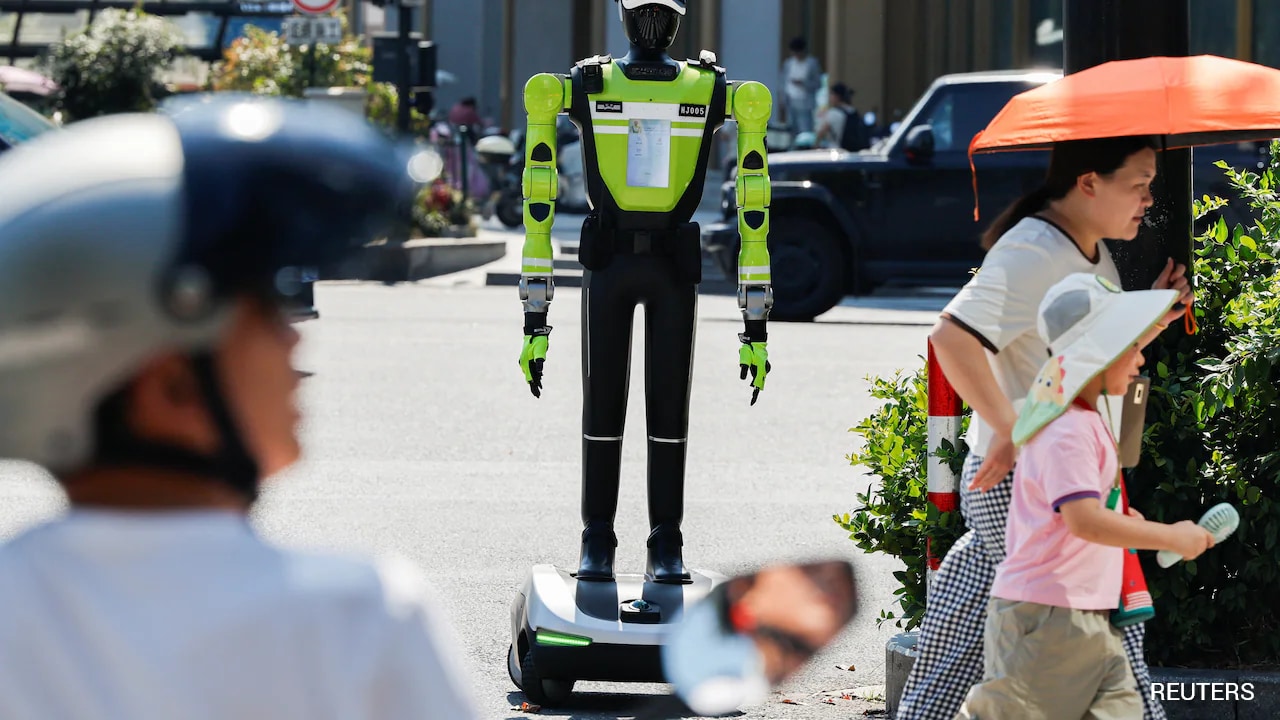
China's newly deployed traffic robots cannot draw a weapon, nor can they slap handcuffs on a fleeing driver. These autonomous or remote-operated units patrol major intersections in cities like Shenzhen and Beijing, broadcasting warnings, capturing license plates, and issuing digital citations. They are not frontline enforcers of physical law. Instead, they function as rolling cameras and digital mouthpieces. Municipal authorities pitch them as safety upgrades and efficiency multipliers. Stripped of guns and physical arrest authority, these machines still represent a fundamental mutation in how modern states manage human behavior on asphalt.
The Mechanical Face of Municipal Surveillance
Walk down a bustling avenue in a tier-one Chinese metropolis, and the air hums with a quiet, electronic authority. The traffic robocop rolls on motorized treads or wheels, a white and blue chassis equipped with high-definition optical lenses, thermal sensors, and flashing LED matrices. It looks less like an officer of the law and more like an industrial vacuum cleaner crossed with a science fiction prop.
Anatomy of a Street-Level Unit
These machines do not carry firearms. They lack the biological capacity for physical restraint. When a pedestrian jaywalks or a delivery moped drifts past a painted stop line, the machine does not give chase. It stops. Its onboard microphone projects a pre-recorded or dynamically generated voice command, telling the offender to step back behind the curb. Simultaneously, facial recognition software or license plate readers log the infraction against national databases.
The hardware is deceptively simple. Behind the polished fiberglass exterior lies a cluster of edge-computing processors designed to handle local video feeds without sending every megabyte back to a central cloud server. This edge processing matters. It reduces latency, allowing the robot to react to sudden pedestrian movements in fractions of a second. Yet, the physical limitations are stark. A determined citizen can simply walk around the machine. A vandal can spray-paint its optics. The state knows this. The absence of weapons or arrest powers is not an oversight. It is a calculated design choice.
Powering these units requires substantial engineering compromises. Most models rely on lithium-ion battery packs that sustain continuous patrols for six to eight hours before requiring a return to a designated inductive charging pad. In extreme summer heat, internal processor temperatures soar, forcing the onboard cooling fans to work overtime and draining reserves faster than projected. Municipal engineering teams have learned that absolute operational uptime remains a distant ideal. Street dust, monsoon rains, and corrosive urban pollutants degrade exterior sensors within months, demanding rigorous maintenance schedules that require human technicians to intervene constantly behind the scenes.
Why Municipalities Are Replacing Human Officers with Iron
Human traffic police officers are expensive. They require salaries, healthcare, pensions, and shift rotations. They get tired during grueling summer heatwaves in Guangzhou. They get angry when motorists scream obscenities at them during morning rush hour. Machines do none of these things.
The economic rationale driving municipal governments to deploy these units is straightforward. Local budgets across China face severe strains following real estate market contractions and mounting local debt obligations. City administrators are forced to cut spending wherever possible. Automated enforcement hardware replaces human personnel at a fraction of the long-term operational cost. A robot does not take sick leave or demand hazard pay for standing in the middle of a polluted intersection during a smog advisory.
Beyond economics lies the problem of occupational hazard. Directing traffic at a chaotic intersection exposes human officers to toxic exhaust fumes, erratic driving, and occasional physical violence. By placing a metal shell in the line of fire, the state removes its personnel from immediate physical risk. The machine absorbs the environmental hostility of the modern asphalt jungle. If a delivery driver crashes into a robot, nobody bleeds. A technician simply arrives with a wrench and a spare parts kit.
Furthermore, human officers introduce variables of corruption and discretion. A human traffic cop can be bribed to look away from a minor violation, or can lose their temper and escalate a minor verbal dispute into an ugly physical confrontation that damages the public image of the local police bureau. A machine operates with cold, unyielding consistency. It does not accept bribes, and it does not feel insulted. Every single infraction detected results in an identical, documented response.
The Illusion of Non-Violent Enforcement
Western media often frames these unarmed traffic units as benign novelties. A cute little metal cop giving polite warnings about red lights. This interpretation misreads the architecture of modern state control.
Physical violence is only one method of coercion. Administrative friction can be far more effective. A robocop that cannot arrest you can still trigger an automated sequence that locks you out of high-speed rail ticketing systems, downgrades your social credit score, or docks your digital wallet for an unpaid fine before you even reach your destination. The weapon is not a pistol at your hip. The weapon is the administrative network connected to the robot's camera lens.
When citizens realize that defying a harmless-looking machine carries severe economic and social consequences, behavioral modification occurs without a single punch thrown or baton swung. This is the quiet genius of the system. It replaces the messy theater of physical confrontation with frictionless, automated compliance. People stop running red lights not because a burly officer stands on the corner with a nightstick, but because the algorithm behind the cute white box remembers every single infraction.
This model of control shifts the burden of enforcement entirely onto the individual. In older policing paradigms, the state had to expend finite resources pursuing, detaining, and prosecuting rule-breakers. With automated street units, the infrastructure simply locks you out of modern conveniences until you log into an app, view your violation video clip, and pay your fine digitally. The citizen effectively polices themselves out of fear of administrative paralysis.
The Logistics of Asphalt Control
Operating autonomous units in dense urban environments presents monumental engineering challenges. Sidewalks in older Chinese districts are cluttered with shared bicycles, street food vendors, and sprawling utility poles. A robot attempting to navigate a crowded Beijing alleyway faces obstacles that baffle even advanced navigation software.
To counter this, municipalities deploy these units along heavily sanitized corridors. High-visibility tourist zones, newly constructed financial districts, and wide, multi-lane boulevards serve as the primary testing grounds. In these sterile environments, the machines perform adequately. They maintain their patrol loops, flash their warning lights, and gather steady streams of telemetry data.
Yet, the moment they encounter true chaos, their limitations become glaring. A sudden downpour can flood low-lying optical sensors. A swarm of electric scooters cutting across pedestrian paths can overwhelm the processing queues of the local computer vision models. Maintenance logs from early municipal trials reveal a high rate of hardware failures, sensor recalibrations, and manual overrides. Human operators sitting in distant control rooms spend hours every day remote-piloting stuck or confused units out of awkward corners. The autonomy is frequently an illusion masking an army of low-wage remote monitors sitting behind computer screens miles away from the street.
The software pipelines running these units also struggle with behavioral edge cases. Pedestrians in major cities are notorious for ignoring traffic signals when traffic appears clear. If a robot halts its forward progress every time a pedestrian steps off the curb prematurely, the machine causes traffic gridlock behind it. Programmers are forced to tune the navigation algorithms to tolerate a certain baseline level of human disobedience, creating an awkward compromise between absolute rule enforcement and urban flow efficiency.
Where Automated Compliance Leads Next
The proliferation of unarmed street robots is merely an intermediate phase. Once populations become conditioned to the presence of unthreatening metal boxes policing pedestrian habits, the threshold for heavier intervention shifts.
Cities are already experimenting with deeper integrations between these mobile units and fixed infrastructure like smart traffic lights, automated bollards, and localized facial recognition nodes. The robot is the mobile tentacle of a fixed nervous system. It creeps into spaces where traditional pole-mounted cameras cannot reach, peering down narrow alleyways and lingering near school gates.
There is no grand conspiracy here. There is only the steady, bureaucratic optimization of urban space. Every city wants smoother traffic flow, lower accident statistics, and absolute order. Unarmed robots provide a politically palatable way to achieve these metrics. They project a friendly image of technological progress while tightening the invisible ropes of continuous observation.
Export markets are already being targeted by the manufacturers of these units. Municipalities across Southeast Asia, the Middle East, and parts of Eastern Europe are watching these trials closely, evaluating whether similar low-cost, non-lethal automated patrollers can solve their own urban congestion and policing budget shortfalls. As manufacturing scales up, the unit costs drop, making widespread deployment feasible for cash-strapped local governments worldwide.
The streets of tomorrow will not be patrolled by human officers keeping order through physical intimidation. They will be tended by impassive machines that never blink, never forget, and never negotiate. The metal box on the corner does not need a gun to control you. It only needs to watch.