Silence.
That is the sound of a dinner party dying a slow, polite death around a wooden board covered in grocery-store cheddar and sad, sweating slices of prosciutto. You know the exact moment it happens. Your guests smile tightly, chew on a flavorless water cracker, and reach for their wine glasses just to have something to do with their hands. For another perspective, see: this related article.
We have been conditioned to believe that hosting requires either three days of frantic, Michelin-star kitchen labor or surrendering entirely to pre-packaged mediocrity. Both options miss the point of gathering people around a table. Food is not a performance metric, nor is it mere fuel to keep your friends from getting too tipsy before the main course arrives. It is an invitation to pay attention.
Consider a hypothetical evening in late November. Outside, the air is sharp enough to sting your cheeks, and everyone arriving at your front door is carrying the low-grade exhaustion of a long week. Imagine your friend Elena—let’s call her Elena, a graphic designer who lives on iced coffee and takeout—taking off her coat and walking into your kitchen. She is expecting the usual bowl of mixed nuts and maybe a block of brie that is still too cold in the center to spread. Instead, she sees a shallow ceramic bowl filled with whipped, snow-white cheese flecked with toasted spices, crowned with a glossy, deep-violet compote that smells faintly of warm cloves, crushed black pepper, and caramelized garlic. Related coverage regarding this has been provided by Cosmopolitan.
She dips a piece of charred sourdough into the bowl. Her eyebrows go up. The conversation shifts from polite small talk about traffic to an immediate, urgent demand to know what on earth is in that dip.
That specific alchemy happens when you pair spiced garlic ricotta with blueberry chutney. On paper, the combination sounds like a typographical error. Garlic and blueberries belong in separate zip codes of the culinary map, separated by the high walls of sweet versus savory. Yet, when you bring them together under controlled heat, they unlock a flavor profile that standard recipes completely fail to explain because they treat cooking like an assembly line rather than a conversation between ingredients.
The Architecture of Contrast
To understand why this pairing works, you have to look at the chemistry of human appetite. Our palates are wired to chase contrast, a phenomenon food scientists often refer to as sensory-specific satiety. When you eat something purely sweet, your taste receptors fatigue within three bites. When you eat something purely rich and fatty, like plain ricotta, your tongue gets coated in milk lipids, dulling your ability to taste anything else.
This is where most home cooks stumble. They buy a tub of whole-milk ricotta, scoop it into a bowl, drizzle a little olive oil on top, and wonder why it tastes like wet chalk. Raw ricotta is a blank canvas, almost aggressively mild, with a moisture content hovering around seventy percent. Left alone, it lacks the structural backbone to hold its own against crusty bread or cured meats.
Now, picture what happens when you roast garlic slowly until its sharp, sulfurous bite—caused by a compound called allicin—breaks down into complex, nutty sugars. You whip that roasted garlic into the ricotta alongside warm, earthy spices like cumin, smoked paprika, and freshly cracked coriander seed. Suddenly, the fat in the cheese becomes a delivery vehicle. Capsaicin and aromatic oils are fat-soluble, meaning the dairy captures those spice molecules and holds them on your tongue twice as long as water ever could.
Then comes the counterpoint.
Blueberries are naturally high in pectin and malic acid. When you simmer them down with apple cider vinegar, a touch of brown sugar, fresh ginger, and a pinch of cayenne, you are not making jam. Jam is blunt; it hits one high, sugary note and stays there. Chutney is sharp, viscous, and complex. The acidity in the vinegar and berries slices right through the heavy milk fats of the ricotta, resetting your palate with every single bite. You get heat, sweet, acid, cream, and earth all at once.
The Fear of Ruining Good Ingredients
I will admit something that used to embarrass me in my twenties: I was terrified of cooking fruit with savory aromatics. For years, my culinary worldview was strictly segregated. Fruit went into smoothies or pies; garlic and onions went into skillets with olive oil and salt. The first time I tried to make a savory fruit condiment—a plum sauce I attempted in a cramped apartment kitchen with a broken exhaust fan—I burned the sugar, undercooked the shallots, and ended up with something that tasted like hot cough syrup. I threw the entire pan into the sink, opened all the windows in the middle of February, and ordered pizza.
That failure taught me the single most important rule of making chutney: patience with heat is non-negotiable.
If you rush blueberries over a high flame, the natural sugars scorch before the cell walls of the fruit break down, leaving you with bitter, watery skins floating in burnt syrup. You have to treat the process like a slow steep. The aromatics—minced ginger, shallots, mustard seeds, or cinnamon—need to bloom gently in fat or liquid first, releasing their essential oils without browning too fast. Only then do the berries enter the pot, bursting slowly and releasing their deep anthocyanin pigments until the mixture turns the color of midnight.
Think of the ricotta and the chutney as two musicians playing a duet. The ricotta is the upright bass—warm, resonant, steady, holding down the low end so the whole piece feels grounded. The blueberry chutney is the brass section—bright, brassy, cutting through the room with just enough tartness to keep everyone awake. Neither one works nearly as well solo, because without the bass, the brass feels shrill, and without the brass, the bass puts the room to sleep.
Gathering Your Elements
Before you turn on a burner, set your ingredients out on the counter and let the dairy come closer to room temperature. Cold ricotta resists whipping, staying grainy instead of turning into silk. If you have twenty minutes to spare, line a fine-mesh sieve with a clean kitchen towel or two layers of cheesecloth, dump the ricotta inside, and let it drain over a bowl. Removing even three tablespoons of excess whey transforms the texture from watery to cloud-like.
For the Spiced Garlic Ricotta:
- 2 cups whole-milk ricotta, drained if particularly wet (avoid part-skim here; you need the butterfat for texture)
- 1 whole head of garlic, top quarter sliced off to expose the cloves
- 2 tablespoons extra-virgin olive oil, divided
- 1 teaspoon ground cumin, preferably toasted and freshly ground
- 1/2 teaspoon smoked paprika (sweet, not hot, unless you want serious smoke)
- 1/2 teaspoon crushed coriander seeds
- Zest of 1 large lemon, finely grated
- 3/4 teaspoon flaky sea salt, plus more to taste
- 1/4 teaspoon freshly cracked black pepper
For the Blueberry Chutney:
- 2 cups fresh or frozen blueberries (if using frozen, do not thaw them first, or they will turn to mush before the spices bloom)
- 1 medium shallot, finely diced
- 1 tablespoon fresh ginger, peeled and grated into a paste
- 1/3 cup apple cider vinegar, unfiltered with the mother if you have it
- 1/4 cup dark brown sugar, packed (the molasses note anchors the fruit)
- 1 small cinnamon stick
- 3 whole cloves
- 1/4 teaspoon red pepper flakes
- 1/4 teaspoon kosher salt
- 1 teaspoon neutral oil or unsalted butter
Roasting the Soul Out of the Garlic
Start with the oven at 400 degrees Fahrenheit. Take that whole head of garlic, peel away the loose papery outer layers while keeping the bulb intact, and slice off the top crown so every clove is peeking out. Place it on a small square of aluminum foil, drizzle a tablespoon of your olive oil directly over the exposed cloves, and sprinkle with a pinch of salt. Wrap the foil tightly into a little pouch and set it directly on the oven rack.
Give it thirty-five to forty minutes. You are waiting for the cloves to turn soft, golden, and spreadable like warm butter. If you pull it out at twenty-five minutes, the cloves will still be fibrous and sharp, which will ruin the velvet texture of the cheese. Let the pouch cool until you can handle it without burning your fingertips, then squeeze the bottom of the bulb so the caramelized paste slides straight out into a mixing bowl.
While the garlic roasts, toast your dry spices. Drop the cumin and coriander into a dry skillet over medium-low heat for about ninety seconds, shaking the pan constantly until they smell nutty and warm. Transfer them immediately to a cool plate so they stop cooking. Spices burn in the blink of an eye, and burnt cumin tastes like dirt.
Building the Chutney
Set a heavy-bottomed saucepan over medium heat and warm the teaspoon of butter or neutral oil. Add the diced shallot and a pinch of salt. Stir them for three or four minutes until they soften and turn translucent, making sure they do not brown. Toss in the grated ginger, cinnamon stick, cloves, and red pepper flakes. Stir for just thirty seconds until your kitchen smells like an autumn market.
Now add the blueberries, apple cider vinegar, and dark brown sugar. Stir gently to dissolve the sugar into the vinegar, bringing the liquid up to a gentle simmer. Once you see small bubbles breaking the surface, turn the heat down to low.
Let it simmer uncovered for twenty to twenty-five minutes, stirring occasionally with a wooden spoon. Watch how the berries transform. Around minute ten, they will begin to pop, flooding the pan with vibrant purple juice. Around minute eighteen, the pectin will start to thicken the liquid, clinging to the back of your spoon. You want a jammy, glossy consistency with some whole berries still intact for texture—not a completely smooth puree. Pull the pan off the heat, fish out the cinnamon stick and the three whole cloves (biting into a whole clove at a party is an unpleasant surprise nobody deserves), and let the chutney cool completely. It will continue to thicken as it drops to room temperature.
The Whip and the Swirl
Into the bowl with your roasted garlic paste, add the drained ricotta, the remaining tablespoon of olive oil, the toasted cumin, smoked paprika, coriander, lemon zest, flaky sea salt, and black pepper.
You can use a food processor here for an ultra-smooth, restaurant-style mousse, pulsing for about twenty seconds until the mixture looks like whipped cream. Or, if you prefer a bit more rustic body, use a simple balloon whisk and beat it vigorously by hand for two minutes until the cheese lightens in color and holds soft peaks. Taste it right off the spoon. Does it need another pinch of salt? A little more lemon zest to wake up the dairy? Adjust it now while the base is still bare.
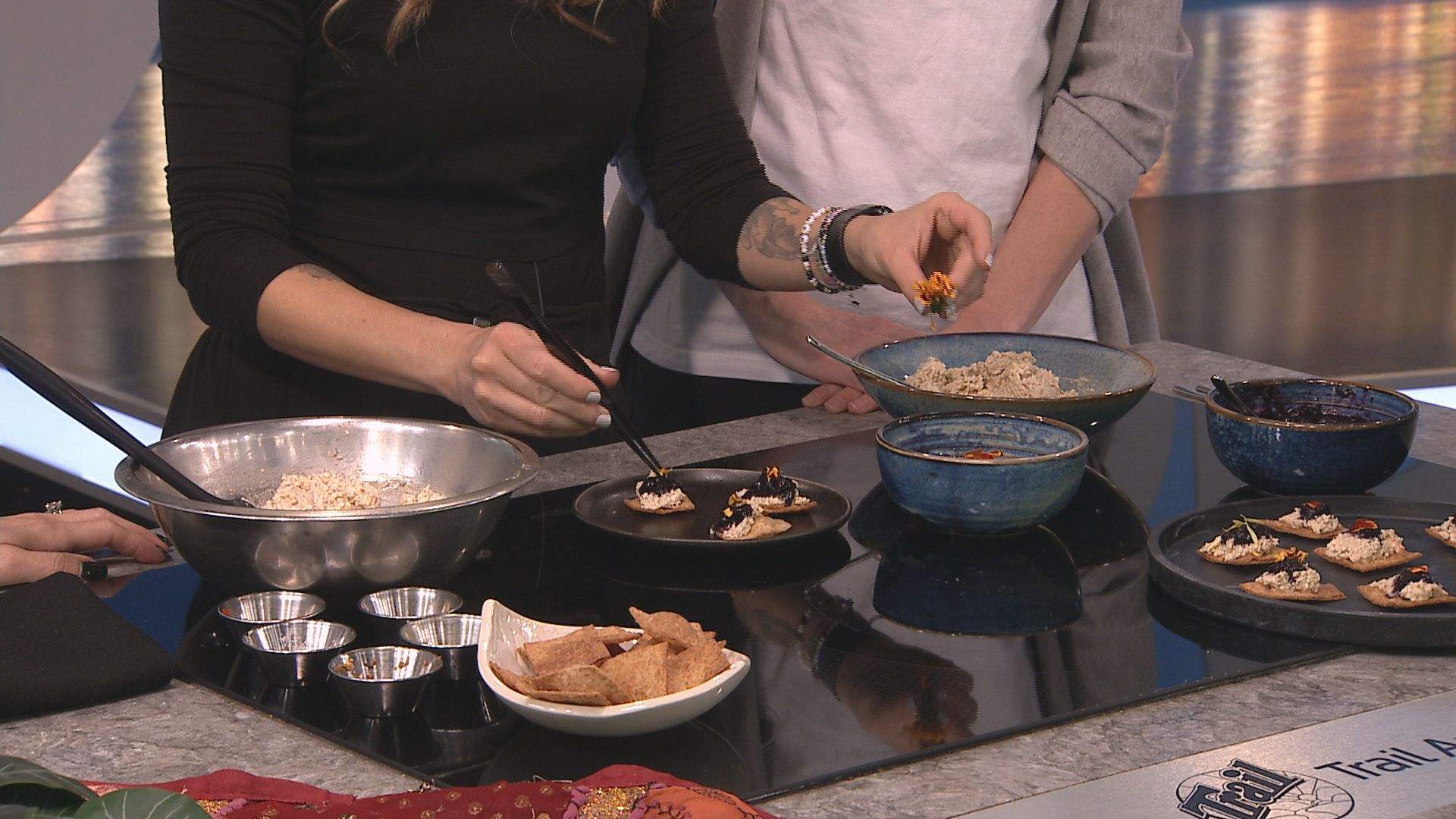
Spoon the spiced ricotta into a wide, shallow serving bowl. Use the back of a large metal spoon to push the cheese outward from the center, creating deep ridges, valleys, and a shallow well in the middle. Those crevices are functional architecture; they give the chutney somewhere to pool and cling instead of sliding off onto the table.
Spoon the cooled blueberry chutney directly into the center well, letting some of the deep purple syrup spill over the white ridges. Finish with a final pinch of flaky sea salt, a crack of black pepper, and maybe a drizzle of good olive oil if you want extra sheen.
Serving Beyond the Standard Cracker
People often ask how far ahead they can prepare this, and the answer is actually the best part for anyone hosting a gathering. Both elements improve after a night in the refrigerator. The garlic and spices infuse deeper into the ricotta curds, and the chutney settles into a richer, more cohesive glaze. Just pull the ricotta out of the fridge forty-five minutes before guests arrive so it loses its chill, and assemble the two layers right before serving so the purple juice does not bleed into the white cheese too early.
Skip the fragile water crackers; they will snap right in half under the weight of this dip. Serve it alongside thick slices of sourdough baguette brushed with olive oil and toasted until the edges are crisp, or warm pita wedges cut into triangles. If you have leftovers—which is rare—spread the spiced ricotta onto a toasted bagel the next morning, top it with the remaining chutney, and lay a crisp slice of bacon or a fried egg right over the top.
Imagine sitting at that table at the end of the night, the candles burned down to stubs, the wine bottles empty, and a single smear of purple and white left at the bottom of the ceramic bowl, scraped clean by the last crust of bread.