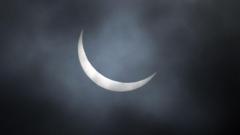
Every astronomy blog on the internet is currently hyperventilating over the upcoming partial solar eclipse. Local guides point you toward empty fields in Lincolnshire, telling you to pack a lawn chair, grab your certified ISO glasses, and stare worshipfully at the western horizon as the Moon takes a massive bite out of the Sun.
It is comfortable, lazy advice. And it is completely wrong. Meanwhile, you can read other events here: Seventy Two Hours Downstream From Safety.
If you treat this celestial event like a standard park picnic, you are going to miss the actual physics of what makes viewing a low-altitude eclipse from eastern England so punishingly difficult. Let us dismantle the lazy consensus and look at why your standard viewing strategy is built to fail.
The Geography Myth
The prevailing narrative treats Lincolnshire as a prime observatory platform because of its flat terrain. Look across the fens, they say, and you get an unobstructed horizon. To explore the complete picture, check out the excellent article by The Points Guy.
This argument completely misunderstands atmospheric optical air mass. When an eclipse happens low in the sky—such as the late-evening event on August 12, 2026, where maximum obscuration hovers near an altitude of just 11 degrees—you are not just looking through air. You are looking through a thick, soup-like wedge of the lower atmosphere.
Light from a low-altitude sun passes through roughly six times more air mass than light from a sun directly overhead. You aren't just fighting local cloud cover; you are fighting atmospheric scintillation, thermal shimmer off agricultural land, and high-altitude moisture plumes rolling in off the North Sea. Standing in an open Lincolnshire field does nothing to fix optical physics.
The Low-Horizon Trap
Imagine a scenario where you drive out to the middle of nowhere, set up an expensive tripod, and wait for first contact. You have your eclipse glasses ready. You trust the coordinates.
Then, three minutes before maximum eclipse, a low-lying marine layer or distant cumulus cloud bank—sitting fifty miles away over the wash—swallows the lower five degrees of the sky. Game over.
This is the variable everyone glosses over. Low-altitude eclipses require an unobstructed western horizon not just locally, but for miles out. Lincolnshire is flat, yes, but it borders a major maritime weather interface. Sea breezes drop inland during late afternoon, condensing moisture right in the precise strip of sky where the eclipsed sun is trying to set.
If you want a genuine tactical advantage, you stop looking at flat ground charts and start looking at elevation vectors and wind convergence models.
How to Actually Watch It
Stop treating astronomical events like tourist attractions. If you want to see this thing without cursing your local meteorologist, you have to change your methodology.
- Ditch the sea-level fens: Move inland to slightly elevated ground that lifts your line of sight above the immediate ground-level thermal inversion layer.
- Track the jet stream and humidity, not just cloud cover: A clear blue overhead sky is useless if the western horizon is choked by industrial haze and maritime moisture soup.
- Leverage binoculars with proper solar filters: Do not rely on naked-eye viewing when the sun is bleeding through thick atmospheric haze near the horizon. The atmospheric distortion will smear the crescent into an unrecognizable red smudge.
The universe does not care about your weekend plans, and geography won't save you from basic optics. Stop waiting for the local paper to tell you where to stand, and start respecting the atmosphere you are trying to shoot through.
12 August 2026 Solar Eclipse: Join Our Public Telescope Event at the University of Lincoln
This video provides a direct look at the 2026 solar eclipse context and local observational setups in Lincolnshire.