The asphalt in Monaco does not forgive. It is a narrow, twisting ribbon of absolute malice, hemmed in by unforgiving armco barriers and the suffocating weight of history. For nearly two hours, the drivers inhale a toxic cocktail of pulverized carbon fiber, burning rubber, and the salty briny air of the Mediterranean. It is a sensory assault that leaves the skull throbbing. To win here is to survive a localized war. To lose here, especially in the dying breaths of the afternoon, is a psychological wound that rarely heals.
Lewis Hamilton knows every millimeter of this place. He knows how the car settles over the bumps near the Casino, and he knows exactly how much curb he can take at the Swimming Pool before the physics of a Formula 1 car decide to rebel. On Sunday afternoon, he looked poised to remind the world why he owns seven world titles. He had driven a masterclass of tire management, positioning his silver machine with the millimeter-perfect precision of a surgeon.
Then came Kimi Antonelli.
To understand what happened in the closing laps of the Monaco Grand Prix, you have to look past the cold telemetry data and the flickering timing screens. You have to look at the generational chasm separating two men inside identical carbon-fiber survival cells. On one side, the veteran who has won everything, fighting the creeping reality of time. On the other, a teenager carrying the terrifying burden of being labeled the next prodigy, a kid whose career has been fast-tracked through the racing ranks at a speed that defies logic.
The Pressure Cooker of the Portier
Monaco is an anomaly in modern sports. In an era where racing tracks are designed with vast asphalt runoff areas that turn mistakes into minor inconveniences, Monte Carlo remains an unyielding relic of the past. Clip a wall at Turn 4, and your suspension shatters. Breathe off the throttle for a fraction of a second at the tunnel exit, and the car behind will ruthlessly hunt you down.
For forty laps, the race was a chess match played at two hundred miles per hour. Hamilton led from the front, controlling the pace with an agonizingly slow rhythm that drove his pursuers to the brink of madness. It is a classic Monaco tactic. Dictate the speed, save the tires, and make your car as wide as humanly possible. Behind him, Antonelli kept watching, learning, and waiting.
Every driver speaks about the "Monaco blur"—the sensation where the barriers seem to close in on your peripheral vision the longer the race goes on. Your arms grow heavy. Your neck muscles scream under the lateral G-forces. The heat radiating from the engine behind your spine turns the cockpit into a localized oven.
Consider the sheer mental exhaustion of this exercise. A regular driver makes hundreds of micro-adjustments per lap. In Monaco, that number doubles. You are constantly fighting the steering wheel, correcting slides before they happen, predicting the grip levels on painted white lines that offer zero traction.
Hamilton was executing this dance flawlessly. His pit wall was quiet, issuing only brief, monosyllabic confirmations over the radio. They believed the race was secured. The strategy had worked. The pit stops were done. All that remained was to bring the car home.
But the racing gods are notoriously cruel in the Principality.
The Inciting Spark
With less than ten laps remaining, a stray piece of debris from a midfield tangle settled on the racing line near the Grand Hotel Hairpin. It was small, almost invisible to the naked eye at racing speeds, but enough to trigger a brief, chaotic sequence of events. A sudden yellow flag. A momentary hesitation.
In that single heartbeat of uncertainty, the gap between Hamilton and Antonelli shrunk from a relatively comfortable two seconds to a mere car length.
Suddenly, the dynamic of the afternoon shifted entirely. The hunter became the hunted.
Antonelli did not drive like a rookie in those final laps. He drove with a terrifying, cold detachment that usually takes a decade to cultivate. Where an older driver might calculate the risks of a championship points haul, a teenager sees only the open space in front of them. The Italian youngster began placing his car in places that seemed mathematically impossible, poking the nose of his machine into Hamilton’s mirrors, forcing the champion to watch his back instead of looking ahead.
The tension in the pit lane was palpable. Engineers stopped looking at their strategy software and simply stared at the monitors, their knuckles turning white against their headsets.
We often talk about experience as the ultimate weapon in sports. We tell ourselves that the wisdom of a veteran will always triumph over the raw, unpolished energy of youth. It is a comforting narrative. It makes us feel that time spent equates to security. But Monaco has a habit of tearing up comfort blankets.
The Anatomy of an Overtake
The move, when it finally arrived, was not a clean, textbook maneuver executed on a long straight. There are no long straights in Monaco. It was a piece of pure, improvisational theater born out of sheer desperation and supreme confidence.
Coming down the hill toward the chicane, Hamilton took the defensive line, forcing Antonelli toward the dirty side of the track where the discarded rubber marbles accumulate. It should have been the end of the argument. Choosing the inside line on that specific corner usually means missing the braking point entirely and sailing straight into the escape road.
Instead, Antonelli braked late. Shockingly late.
The car pitched forward violently, the front tires locking up in a brief, screeching protest of blue smoke. For a fraction of a second, it looked like a catastrophic miscalculation. The type of mistake that defines a young driver's career for all the wrong reasons.
Then, the tires bit.
The car rotated on a dime, scraping past Hamilton’s left rear tire with millimeters to spare. It was a breath-taking display of car control, a moment where a young man refused to accept the laws of physics and somehow forced the machine to bend to his will. Hamilton, caught completely off guard by the audacity of the maneuver, had to open his steering wheel to avoid a collision, losing his momentum just enough to let the youngster slip through into the lead.
The grandstands erupted. The harbor, lined with multi-million dollar yachts, transformed into a wall of sound as horns blared into the afternoon sky.
The Weight of the Crown
The final two laps were a blur of defensive driving from the young Italian. Hamilton pursued him like a shadow, throwing everything he had at the teenager, desperate to force a mistake that never materialized. Antonelli crossed the finish line with his front wing practically brushing the checkered flag, securing a victory that felt less like a sporting achievement and more like a definitive cultural shift.
When the engines finally died in the pit lane, the silence that followed was heavy.
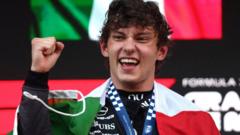
Antonelli climbed out of his cockpit, collapsing onto the survival cell in a state of pure emotional and physical exhaustion. His visor was raised, revealing eyes that looked bewildered by what he had just accomplished. He had not just won a race; he had conquered the most difficult circuit in the world against the most successful driver to ever live.
A few yards away, Hamilton sat in his car for a long, quiet minute. He did not storm off. He did not throw his steering wheel. He simply stared forward into the middle distance, watching the celebrations begin around the podium. It was the look of a man who recognized that the future had finally arrived, uninvited and ahead of schedule.
The podium ceremony in Monaco is always a grand affair, filled with royalty, champagne, and the anthems of victorious nations. But on this day, the real story was told in the glances exchanged between the two men on the steps. One man was looking back at a legendary career that is slowly entering its twilight. The other was looking out at a horizon that suddenly belongs entirely to him.
The trophies will be polished and placed into glass cases. The statistics will be updated in the record books. But the memory of that breathless, smoky dive into the chicane will linger in the minds of everyone who witnessed it—a stark, unforgettable reminder that in the world of high-stakes racing, the past is nothing more than a ghost, and the present belongs to whoever is brave enough to seize it.