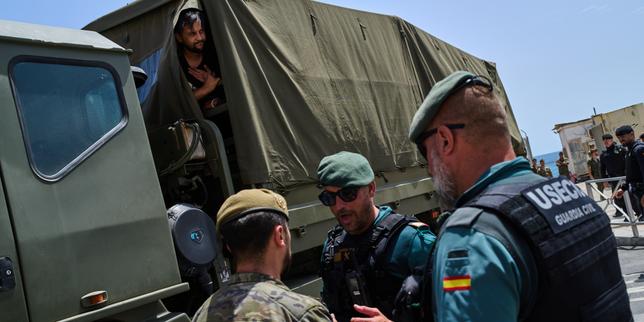
Geopolitical pressure points expose the fragile architecture of multilateral coalitions faster than diplomatic communiques can obscure them. The May 2021 border event in Ceuta, where Moroccan authorities relaxed border controls and permitted the unauthorized entry of more than ten thousand individuals into Spanish territory within a forty-eight-hour window, functioned as a stress test for the European Union. Standard political commentary frames this occurrence as a bilateral diplomatic dispute between Madrid and Rabat, or as a humanitarian emergency driven by localized economic desperation. Both interpretations miss the structural reality.
The Ceuta crisis was an operational manifestation of structural leverage asymmetry. It laid bare the absence of a unified European migration doctrine, exposing a governance model where external borders are managed collectively in theory, but managed unilaterally under crisis conditions in practice. When a single member state absorbs the kinetic impact of a migratory surge weaponized for diplomatic coercion, the response mechanism reveals deep fractures between supranational ideals and national security imperatives. Deconstructing this event requires analyzing three interacting variables: the operational mechanics of asymmetric border pressure, the institutional paralysis of the Schengen framework under duress, and the transaction costs embedded in externalized migration management.
The Mechanics Of Asymmetric Border Pressure
Bilateral diplomacy between the European Union and its southern neighbors relies on a transactional equilibrium. The union provides development assistance, security funding, and trade concessions; in exchange, transit states absorb the enforcement costs of intercepting migratory flows before they reach European external perimeters. This arrangement operates as a classic principal-agent problem. The principal, the European Union, delegates border containment to the agent, the transit state, while maintaining imperfect information and limited direct control over the agent's enforcement intensity.
When diplomatic tensions escalate over external issues—such as the hospitalization of Polisario Front leader Brahim Ghali in Spain—the agent possesses a high-gain, low-cost countermeasure: strategic non-enforcement. By temporarily degrading border surveillance infrastructure or issuing internal directives to security forces to stand down, the transit state converts a latent migratory population into a dynamic political asset.
The economic and logistical profile of this pressure tactic relies on several distinct variables:
- Asymmetric Response Velocity: The transit state can alter its enforcement posture instantaneously, while the target state requires hours or days to mobilize tactical reserves, legal frameworks, and civil protection units.
- Localized Concentration: By channeling arrivals into a specific geographic bottleneck like Ceuta or Melilla, the transit state maximizes immediate administrative overload, transforming a manageable demographic flow into an acute urban crisis.
- Plausible Deniability: Transit authorities frequently attribute enforcement lapses to operational fatigue, civil unrest, or localized intelligence gaps, rendering formal diplomatic retaliation difficult to calibrate.
This dynamic proves that physical barriers without continuous operational cooperation are porous. A border is not merely a wall; it is a real-time negotiation sustained by continuous administrative inputs from both sides of the demarcation line. When one party unilaterally withdraws its administrative inputs, the border ceases to function as a filter and becomes an open conduit.
The Schengen Governance Paradox
The friction observed during the Ceuta crisis highlights an inherent architectural flaw within the Schengen area: the centralization of freedom of movement without a corresponding centralization of border enforcement costs.
Under the Schengen acquis, the elimination of internal border controls requires absolute confidence in the integrity of the external perimeter. If a migrant enters Ceuta, they enter Spanish territory. Because Spain is integrated into the Schengen zone, that individual possesses the legal and physical capacity to transit onward to France, Germany, or other destination states, provided they navigate internal transit networks. Consequently, a localized security event on the North African coast carries systemic externalities for every other member state.
Despite this systemic interdependence, the financial, legal, and operational burdens of crisis management remain concentrated on the frontline state. Brussels provides crisis response funding through instruments like the Asylum, Migration and Integration Fund, but these allocations operate reactively rather than proactively. Frontline states face a dual hazard:
- The Sovereignty Trap: If a frontline state requests direct operational intervention from EU agencies like Frontex, it invites supranational oversight into its sovereign border management protocols, which carries domestic political costs.
- The Burden Retention Reality: If the frontline state manages the crisis independently, it absorbs the fiscal expenditure of temporary housing, administrative processing, and security mobilization, while other member states retain the political luxury of critique without exposure.
This dynamic creates a prisoners dilemma among European capitals. Rather than formulating an integrated containment and burden-sharing doctrine, member states default to defensive postures. Internal border checks are quietly reinstated or contemplated, and diplomatic alignment frays as individual governments pursue bilateral appeasement strategies with the transit state to insulate themselves from secondary movements.
The Cost Function Of Externalized Migration Control
The long-term strategic takeaway from the events in Ceuta involves the economics of externalization. Lacking internal consensus on how to process asylum applications and manage demographic pressures transparently, the European Union has increasingly outsourced its border enforcement to authoritarian or semi-authoritarian neighbors.
This strategy introduces severe moral hazard and structural vulnerability. By making security cooperation contingent on ongoing financial subsidies and political concessions, the European Union trains transit states to utilize migration as a recurring bargaining chip. Each iteration of this cycle increases the unit cost of compliance. The transit state learns that a credible threat of border relaxation yields immediate diplomatic concessions, while the European Union finds itself locked into a path-dependent relationship where cutting off aid risks an immediate, unmanaged surge across its borders.
Furthermore, externalization suppresses the development of robust internal processing architectures. Instead of building scalable, digitized, and humane asylum processing hubs that distribute applicants equitably across all member states, the system relies on physical containment at geographical anomalies like exclaves or isolated islands. When those containment points fail, the entire administrative apparatus collapses into emergency management.
Strategic Capital Allocation For Border Resilience
To resolve the structural vulnerabilities exposed by the Ceuta crisis, European migration policy must transition from crisis-driven reaction to institutionalized resilience. This requires a fundamental redesign of resource allocation and legal frameworks.
First, burden-sharing must be codified as an automated, mandatory mechanism rather than a voluntary, post-crisis negotiation. Frontline states should not bear the initial processing burden alone; incoming migratory cohorts must be mathematically distributed across member states prior to domestic settlement, utilizing a composite index of GDP, population density, and historical integration capacity.
Second, agreements with transit states must be decoupled from short-term diplomatic disputes through multi-year, legally binding frameworks that include automatic financial penalties for non-enforcement, paired with expanded legal pathways for economic mobility that reduce the clandestine population available for political weaponization.
Third, the operational mandate of Frontex must evolve from an advisory observer into an executive enforcement authority capable of deploying standing tactical units directly to external flashpoints before a localized administrative failure escalates into a systemic crisis.
The institutional cost of inaction is clear. As climate shifts, demographic imbalances, and regional instabilities intensify across the Mediterranean basin, the frequency of weaponized migration pressures will increase. Treating these events as isolated humanitarian anomalies guarantees future systemic failures. Border security in a multipolar world requires structural integration, financial predictability, and zero tolerance for strategic blackmail.