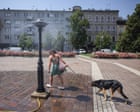
You can't hide from forty-degree heat when your house was built to act like a thermos.
Over 191 million people across Europe just spent the weekend trapped in a stifling atmospheric oven. The massive weather system, known technically as an "Omega block," trapped a high-pressure bubble of scorching air directly over the continent, turning historical towns into literal sweatboxes. As the system rolled east out of France and Britain, it completely smashed all-time temperature records across Germany, Czechia, Poland, and Hungary.
We aren't talking about a typical summer spike. We are talking about historic thresholds collapsing one after another in a matter of 48 hours.
If you think this is just an excuse to visit the beach early, you're missing the real crisis. Central Europe's infrastructure is failing because it was engineered for a climate that no longer exists.
The Numbers That Shocked the Meteorologists
For decades, the idea of forty-degree Celsius (104°F) heat in places like eastern Germany or northern Prague was a statistical anomaly. This weekend, it became reality.
The national weather services spent two days frantically updating their record books. Take a look at exactly how high the mercury climbed:
- Germany: Reached a blistering all-time high of 41.7°C (107.1°F) in Coschen, a small town near the Polish border. This bypassed a record of 41.5°C set just 24 hours earlier in Drewitz.
- Czechia: Logged 41.9°C (107.4°F) in the northern town of Doksany, completely obliterating past national benchmarks.
- Poland: Clocked 40.5°C in Słubice, wiping out a 105-year-old national record that had stood untouched since 1921.
- Hungary: Reported 40.7°C in Budakalász, surging past previous thresholds.
Even regions further north and south couldn't escape. Denmark registered its highest temperature since records began in 1874, hitting 36.6°C north of Odense. Meanwhile, Slovakia logged its warmest night on record, with the mercury refusing to drop below 26.3°C.
When nights stay that hot, the human body never gets a chance to cool down, driving up medical emergencies.
Why the Infrastructure Is Breaking Down
The real story isn't just the numbers on the thermometer. It's the physical breakdown of daily life.
Northern and Central European cities were designed to trap heat, not repel it. Less than 5% of homes in Germany have traditional air conditioning. Instead, residential buildings feature heavy insulation and triple-glazed windows meant to keep apartments warm during brutal winters. In June, those same design choices convert homes into brick kilns.
In the western German city of Dormagen, emergency workers had to evacuate dozens of elderly residents from a local nursing home after interior temperatures spiked to a life-threatening 35°C (95°F). One resident died overnight.
The transportation network didn't fare any better. The German rail operator, Deutsche Bahn, issued urgent notices advising passengers to cancel all nonessential travel. Trams in Prague had to slash their operating speeds down to 40 kilometers per hour—and as low as 10 kilometers per hour under bridges—simply because the overhead power lines were at risk of warping and snapping in the intense sun.
Even the highways are buckling. Outside Berlin, sections of the famous A2 Autobahn literally burst open when the concrete expanded too fast under the sun, forcing immediate police closures.
The Silent Threat to Food and Power
Most people realize that extreme heat makes commuting miserable, but few think about what it does to industrial power grids and food supplies.
To keep a nuclear power plant running safely, you need cool water from nearby rivers to condense the steam back into water. When river temperatures spike, plants have to throttle back production to avoid dumping boiling water back into the ecosystem, which would instantly kill off marine life. Hungary’s Paks nuclear power plant had to cut output on one of its main reactors because the Danube River became too warm. Switzerland had to take similar measures with its Beznau station on the River Aare.
Simultaneously, farmers across the region are watching topsoil dry out into dust. Italy's longest river, the Po, is already starting to dry up, triggering early drought panics for dairy and grain producers.
How to Handle Extreme Regional Heatwaves
If you live in or are traveling through Central Europe during these shifting weather patterns, relying on traditional habits won't keep you safe. You need to adjust your daily routine immediately when an extreme heat alert hits your phone.
- Create an artificial night cycle: Close your exterior shutters, windows, and heavy curtains the moment the sun hits your building in the morning. Do not open your windows during the day to "let a breeze in"—you're just letting in 40-degree air. Open everything wide only after midnight when the outside air drops below the indoor temperature.
- Track your local rail status: If you have tickets on major European rail networks during a heat warning, check the carrier's app before heading to the platform. Most lines offer free cancellations or rebooking during extreme weather to keep people out of stalled, un-air-conditioned train cars.
- Ditch the sports: When public security agencies send out mass text alerts telling you to avoid strenuous activity, listen to them. Acclimatization takes weeks. Forcing a heavy run or a long bike ride in unaccustomed 40-degree humidity is a direct ticket to heat exhaustion.
The climate data shows these events aren't temporary flukes. They are the new baseline. Cities from Berlin to Warsaw have to stop treating these summers as freak weather events and start rebuilding their public spaces, grids, and transit networks to survive them.
If you are currently traveling through Germany or Poland and want a visual look at how local cities are managing the crisis, watching this BBC News coverage of the European heatwave provides an excellent breakdown of the public event cancellations and the direct impact on regional infrastructure.